A hospital lab that stores acids and bases runs into one problem steel cannot solve: the cabinet itself corrodes. Hydrochloric acid from a chemistry analyser, sodium hydroxide from a cleaning cycle, formalin from histology — over a working life these attack painted steel at the seams and hinges long before the cabinet reaches its rated age.
Polypropylene is the material hospitals settled on for that job, and the 30-gallon double-door cabinet is the size that shows up most often in clinical labs — big enough for a month of reagent stock, small enough to fit a corridor alcove. Here is what it holds, how it locks, and where it fits into a hospital’s chemical storage plan.
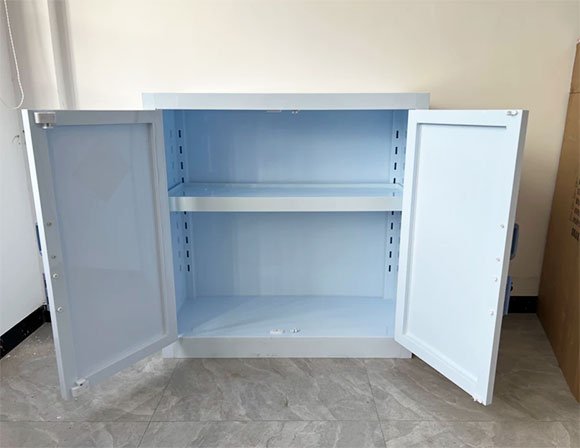
Why hospital labs specify polypropylene instead of steel
Three departments drive most of the demand for corrosive storage in a hospital, and all three are hard on steel:
- Clinical chemistry — concentrated hydrochloric acid and sodium hydroxide used in analyser maintenance, plus sulfuric acid in some wet-chemistry methods
- Histology and pathology — formalin as a fixative, glacial acetic acid in staining and decalcification
- Sterile processing — descaling and disinfectant chemicals, many of them acidic
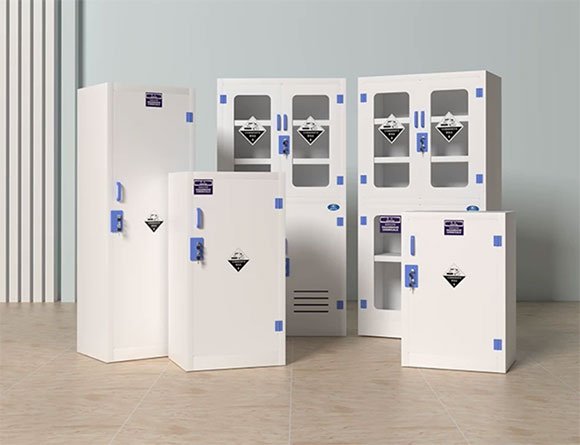
Moulded polypropylene has no coating to chip and no steel to pit. The material is chemically inert against the acids and bases a hospital actually uses, and the welded shell has no seam a spill can creep behind. That is why the blue-and-white cabinet outside the prep room is polypropylene rather than a painted steel unit.
There is a compliance angle as well. Hospital accreditation reviews — Joint Commission standards on hazardous chemical management, CAP checklists for laboratory accreditation — look at whether corrosives are stored in purpose-built cabinets with secondary containment, and whether the cabinet is inspected and logged. A cabinet that physically cannot corrode removes one class of finding before the inspector arrives.
What 30 gallons actually holds in practice
The capacity figure matters less than what it means on the floor. Thirty gallons is roughly 113 litres of stored liquid volume — the working stock a clinical chemistry bench goes through in a typical month, or the reserve a histology department keeps behind the grossing room.
Two things decide whether that is the right size for a specific lab. The first is container size: stock bottles, winchesters and bulk jugs consume shelf space differently for the same volume. The second is refill frequency — a cabinet that empties and refills monthly suits the 30-gallon size, while a department buying quarterly may need the 60 or 90-gallon unit. Send the reagent list with quantities and the sizing follows from there.
Double door, adjustable shelves, and why both matter
A double-door cabinet opens the full width of the body, which changes how the unit behaves in a corridor or a bench-side alcove — the doors do not need swing clearance to one side. Inside, adjustable and removable shelves let the cabinet be reconfigured as bottle sizes change, and each shelf carries a spill lip so a cracked bottle does not drain straight to the base.
Locking, and the dual-control requirement
Hospitals rarely store strong acids on open shelves. Dual-control procedures — two named staff, two keys or a key plus a record — are standard in laboratories handling concentrated corrosives, and the cabinet has to support that. The locking arrangement on this size uses a double lock on the doors with padlock compatibility, so the access control in place today does not have to be rebuilt when the department tightens its procedure.
Access records matter as much as the lock itself. Inspectors look for a log that matches withdrawals to staff names, which is why the cabinet carries an inventory card holder on the door rather than a hazard label alone.
Venting, siting and spill containment
Corrosive cabinets are normally vented, unlike flammable cabinets — a distinction that trips people up when a lab is specifying both. This cabinet has two vent ports shipped with caps, so the unit works as delivered in a well-ventilated room, and can be ducted to the lab exhaust where local practice or chemical volatility calls for it.
Siting follows a few practical rules. Keep the cabinet away from egress routes and heat sources, place it on level floor so the base sump works as designed, and leave the sump empty — it is containment for a spill, not extra storage. Where a lab also stores flammable solvents, the corrosive cabinet and the flammable cabinet stay physically separated, because a spill that mixes the two creates hazards neither cabinet was designed for.
- Base sump kept empty and inspected for residue
- Vent caps in place unless ducted to exhaust
- Level floor, no blocked egress path
- Separated from flammable storage and from strong oxidizers
- Doors closed and locked between withdrawals
Specification summary
| Item | Specification |
| Capacity | 30 gallons (approx. 113 L) |
| Construction | Moulded polypropylene, seam-welded shell |
| Doors | Double door, full width |
| Shelves | Adjustable, removable, with spill lip |
| Base | Leak-proof spill sump |
| Locking | Double lock, padlockable, dual-control ready |
| Venting | Two vent ports with caps, ductable |
| Certification | CE marked |
FAQ
What chemicals belong in this cabinet?
Acids and bases, and the corrosive reagents a hospital uses daily — hydrochloric, nitric and sulfuric acid, sodium and potassium hydroxide, formalin, and most staining reagents. It is not for flammable solvents such as xylene or ethanol; those belong in a metal flammable storage cabinet.
Can the cabinet be ducted?
Yes. Both vent ports accept a duct connection, and the unit ships with caps so it can also be used unvented in a room with adequate air exchange. Local practice and the volatility of the chemicals stored decide which configuration is right.
Is a floor or bench-top installation better?
It depends on the bottle sizes and the room. Bench-top and under-bench units suit small working quantities; floor-standing units hold bulk stock and keep heavy containers at a safer handling height. Both come in the same range of capacities.
How is the cabinet shipped?
Packed with edge protection and moisture film, on a pallet, with the vent caps and shelf hardware in a separate parts bag so nothing goes missing in transit. Installation hardware and documentation travel with the unit.
What is the difference between an acid cabinet and a corrosive cabinet?
In practice they describe the same product. “Acid cabinet”, “corrosive cabinet” and “acid-base cabinet” all refer to a cabinet built from chemical-resistant polymer for storing acids, bases and other corrosives. What matters is the material — polypropylene or polyethylene — not which of the three names appears on the quotation.
Does a polypropylene cabinet need grounding?
Not for the reason a flammable cabinet does. Grounding on a flammable cabinet controls static during pouring of flammable liquids. Polypropylene is non-conductive, and static control belongs on the dispensing equipment rather than on the cabinet shell. If your site procedure calls for a grounding point, it can be specified.
Hengna supplies polypropylene acid and corrosive storage cabinets from 4 to 90 gallons, CE marked, with adjustable shelves, base spill sumps and ductable vent ports. Send the reagent list, the container sizes and the room plan, and the cabinet selection comes back in writing within 24 hours — including a note on which chemicals should go into a flammable cabinet instead.