
September 28, 2026
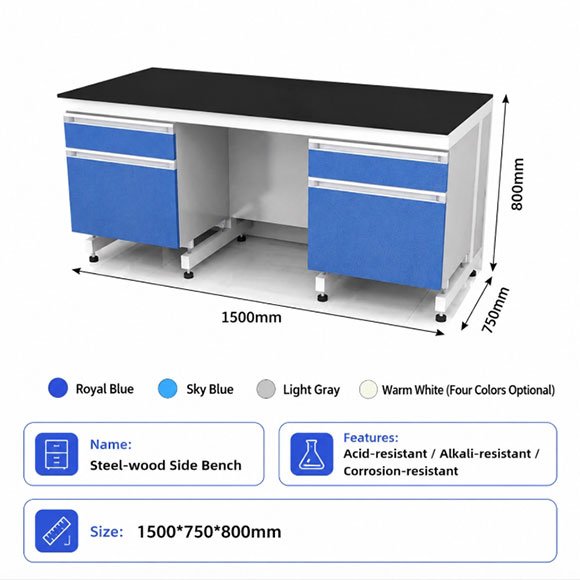
Quick answer: Six factors move the price of a lab bench: the worktop material and thickness, the steel gauge, the length and configuration, the fittings (sinks, racks, valves), the coating and color, and the order quantity with its shipping mode. A factory-direct quotation prices all six openly — send the chemical list and dimensions and the number comes back in writing. Most buyers overpay in one of two ways: they over-specify a bench for chemicals it will never touch, or they buy through layers that each add a margin. Both are avoidable. This page breaks down what actually drives the cost of a laboratory bench, from a factory that builds every unit on its own line. The 6 Factors That Move the Price 1. Worktop material and thickness. A 12.7mm phenolic top is the value baseline. 16mm and 19mm phenolic add section stiffness for heavy loads and wide spans. Epoxy resin adds solvent and heat headroom at a premium. Stainless steel and welded PP sit at the top of the range for special applications — order them only when the chemical list calls for it. 2. Steel gauge. Cabinet bodies run 1.0mm, 1.2mm or 1.5mm cold-rolled steel. The jump from 1.0 to 1.2mm buys deformation resistance for loaded drawers and long spans; 1.5mm is for heavy instrument duty. Matching the gauge to the load avoids paying for strength the lab does not use. 3. Length and configuration. Bench length runs 1000mm to 4500mm in modular steps. Drawer packs, door cabinets and open bays price differently — a drawer-heavy configuration costs more than a door-heavy one of the same length. 4. Fittings. Sink units with polypropylene basins, reagent racks, service valves and power outlets each add cost. Planning utilities at the drawing stage is cheaper than retrofitting later. 5. Coating and…
September 25, 2026
Quick answer: We supply lab benches to UAE and GCC projects with salt-spray tested coatings for gulf air, 220-240V compatible configurations, export-grade crating and tender documentation support. Bench lengths run 1000-4500mm; worktops in phenolic, epoxy, stainless or welded PP matched to the chemical list. The Gulf is one of the most active lab construction markets in our export book: quality control labs for pharma distributors, school STEM rooms, hospital laboratories and industrial testing stations. It is also a market where the environment punishes underspecified furniture — salt air, heat and constant AC cycling find every weakness in a cheap finish. This page covers what UAE buyers order, how we build for the conditions, and how the export process runs. What UAE Labs Order Most Three project types repeat across the region. Quality control and testing benches for pharmaceutical distributors and food-safety labs — chemical-resistant worktops with sink units and reagent racks. School and university STEM rooms — durable benches in multi-station runs, specified for student throughput. Hospital and clinic laboratories — benches paired with storage cabinets for samples and reagents. Each type has a different specification, and each starts from the same inputs: the room dimensions and the chemicals in use. Built for Gulf Conditions Coastal air carries salt, and salt holds moisture against any finish. Our cabinet bodies use 1.0-1.5mm cold-rolled steel with electrostatic powder coating, and every production batch is backed by a 72-hour neutral salt spray test on coating panels — the report ships with the goods. Worktops carry an E1 formaldehyde rating. Voltage is specified for 220-240V compatibility, which covers UAE, Saudi and wider GCC mains. None of this is a premium feature; it is the baseline for surviving a gulf install. Export Logistics to the UAE Benches ship knock-down in wooden crates with foam cushioning…

September 22, 2026
Quick answer: Phenolic resin worktops are the default for most labs — they resist acids, alkalis and impact at a reasonable cost, in 12.7mm, 16mm and 19mm thicknesses. Epoxy resin worktops win when solvents, sustained heat and constant moisture dominate: hood-adjacent benches, digestion stations, wash areas. Both pair with the same steel frames, so the decision is the worktop — and it pays to make it once, correctly, because redoing a worktop costs more than the gap between the two materials. Buyers ask us this every week, and the honest answer depends on what touches the surface. Choose the wrong worktop and it swells, stains or cracks within a year; choose the right one and it outlives the cabinets under it. Here is how the two materials actually behave, from a factory that machines both. What Phenolic Resin Worktops Handle Well Solid phenolic resin is a dense composite — the surface color runs through the core, so scratches do not show a white line. Our phenolic tops come in 12.7mm, 16mm and 19mm thicknesses with an E1 formaldehyde rating and PVC edge banding that seals the core from moisture. Against the daily chemistry of a working lab — dilute acids, alkalis, salt solutions, stains and impacts from glassware — phenolic holds up for years. It is also the lighter and more economical of the two materials, which is why it appears on most of the benches we ship to schools, QC labs and research facilities. For a typical chemistry teaching lab or a quality control bench, phenolic is not the budget compromise — it is the correct specification. Where Epoxy Resin Wins Epoxy resin is a cast, homogenous material with broader resistance to solvents and higher sustained temperatures. Three situations justify the upgrade: benches next to fume hoods where solvent…
September 19, 2026
Quick answer: A chemical resistant lab bench pairs a non-reactive worktop — solid phenolic resin, epoxy resin, 304 or 316 stainless steel, or welded polypropylene — with a protected steel frame. The worktop absorbs the abuse from acids, alkalis and solvents; the frame stays dry under a sealed coating. General chemistry labs do well with a phenolic top. Daily strong corrosives call for PP or 316 stainless. Spilled sulfuric acid should not end a worktop’s life. Yet in many labs, a bench that handles glassware and daily experiments starts swelling at the edges within a year. The failure is rarely the steel frame. It is the surface. A chemical resistant lab bench is specified from the top down: worktop material first, then frame protection, then the seals around every opening. This page explains how our factory builds them and how to pick the right combination for your lab. What Is a Chemical Resistant Lab Bench? A chemical resistant lab bench is a laboratory workbench built to withstand acids, alkalis, solvents and stains without swelling, blistering or corroding. It combines three protections: a non-reactive worktop, a powder-coated or stainless steel frame, and sealed joints around sinks and reagent outlets. It is standard equipment in chemistry teaching labs, quality control labs and industrial testing stations. Where the Chemical Resistance Comes From The worktop does the heavy lifting Solid phenolic resin worktops come in 12.7mm, 16mm and 19mm thicknesses. The material resists acids, alkalis and impact, and the panels carry an E1 formaldehyde rating. Edges are sealed with PVC banding so liquids cannot wick into the core. For labs that need more heat and solvent headroom, epoxy resin worktops are available on request. The frame stays dry Cabinet bodies are made from 1.0mm, 1.2mm or 1.5mm cold-rolled steel with electrostatic powder coating cured…

July 12, 2026
A pharma QC lab isn’t a school science room. The bench you put in there has to pass an audit. Most lab furniture vendors don’t understand this. They sell you the same bench they’d sell to a high school chemistry teacher — and call it “lab grade.” But when your QA team runs through the supplier qualification checklist, and later when the auditor walks through your QC lab with a flashlight checking for gaps, rust, and surface contamination — that’s when the cheap stuff gets flagged. This GMP compliant lab bench is built for exactly that standard. No gimmicks. Every detail is there for one reason: clean easily, don’t trap contaminants, resist chemicals, and pass inspection. What “GMP Compliant” Actually Means for a Lab Bench Let me be clear — we’re not a GMP-certified facility. What this bench is: the materials and construction meet the requirements GMP sets for pharmaceutical laboratory furniture. That breaks down to three things. 1. The worktop must be non-absorbent. In a QC lab, the work surface sees methanol, ethanol, acetonitrile, dilute hydrochloric acid, sodium hydroxide — daily. A cheap laminate top absorbs spills at the edges and along any scratch. Once liquid gets into the core, it swells. The surface bubbles. The auditor runs a cotton swab along the edge seal and sees discoloration. That’s a finding. Solid phenolic resin doesn’t have this problem. It’s one homogenous slab — multiple layers of kraft paper impregnated with phenolic resin, fused under high heat and pressure. No separate core and surface layer to delaminate. Spill acid on it, leave it for 24 hours, wipe it off. No stain, no swelling. The auditor’s swab stays clean. 2. The casework must have no dead zones for contamination. Pharma QC areas are often classified. Dust and residue settle inside cabinets and…
July 6, 2026
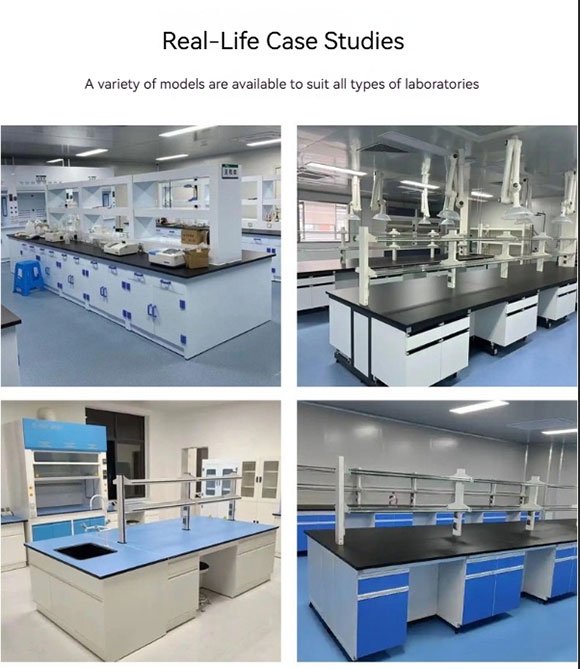
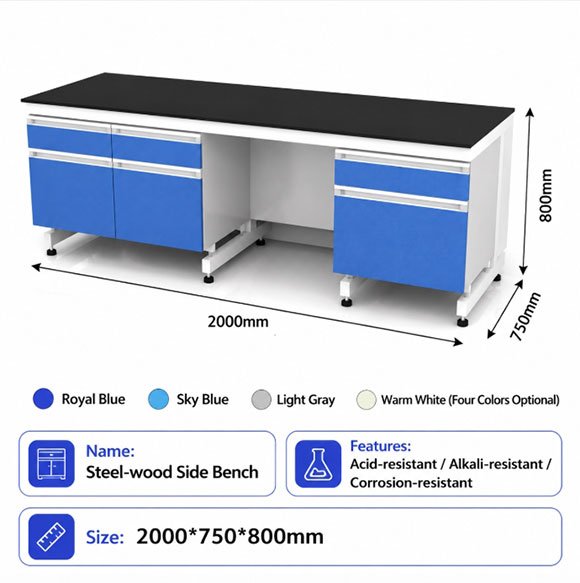
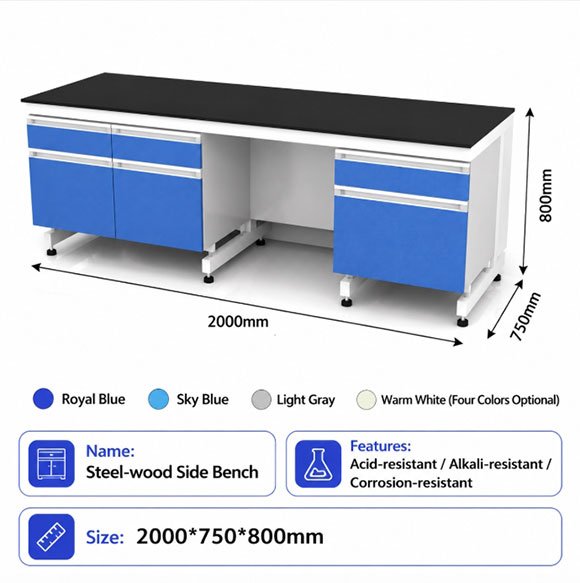
What students touch every day shouldn’t be bottom-tier. Walk into most school labs and look at the workbenches. The laminate top is peeling at the edges, the particleboard underneath has swollen from water spills, and the drawer slides grind like there’s sand in them. After five years, you’re either patching them up every semester or replacing the whole lot. The worst part for a school procurement officer? It’s not that you can’t afford better — it’s that buying cheap means owning the blame when it falls apart. Our steel-wood lab bench isn’t some breakthrough. Cold-rolled steel for the frame, solid phenolic resin for the worktop, acid-resistant fittings. That’s it. But once you take the construction apart, every detail lines up with how a school lab actually gets used. Frame: 1.2mm Cold-Rolled Steel, Not Paper-Thin Sheet Metal Cheap lab furniture uses 1.0mm or even 0.8mm steel — thin enough that you can feel the flex when you lean on it. Looks fine on day one. Two years later? Drawer tracks are crooked, doors won’t close flush, the whole bench wobbles when someone sets a microscope down. Students aren’t gentle. Instruments, beakers, reagent bottles — the weight adds up, and the bench takes it year after year, class after class. Our frame is 1.2mm cold-rolled steel, welded, then electrostatic powder coated. Knock on it — you’ll hear a solid thud, not a hollow ring. Four leveling feet at the corners let you dial out uneven floors. Classroom floors are rarely perfectly flat; this handles it without shims. Worktop: Solid Phenolic Resin, Not a Laminate Veneer Here’s what matters — there are two kinds of “lab bench tops” on the market, and they’re not the same thing: Laminate-faced tops are MDF or particleboard with a thin decorative layer glued on top. Looks decent out…
June 27, 2026
Does Your Lab Actually Need All-Steel? Three Questions A steel-wood bench handles most labs just fine. But if you answer yes to any of these three questions, stop comparing — you need all-steel. The reasoning behind all three is the same: iron rusts, stainless steel does not. The frame on this bench — from the skeleton to the cabinet doors to the drawer fronts — is 304 stainless steel throughout. Knock a corner, scratch a panel, nothing. There is no iron underneath waiting to turn red. Powder-coated cold-rolled steel holds up under normal conditions, but daily disinfectant wipes eat through the coating. First the gloss fades, then the surface blisters, then the steel underneath starts rusting. Stainless steel does not care what you wipe it with. Sodium hypochlorite, ethanol, peracetic acid — none of them leave a mark. The worktop is 19mm solid phenolic resin. Most benches come with 12mm or 16mm tops. Those work. The extra 3 millimeters here give the worktop noticeably more rigidity. Set a centrifuge on it running at full speed — the bench stays still, the glassware does not rattle. Chemical resistance is the same as our standard tops: dilute acids, alkalis, and organic solvents wipe clean without blistering or delamination. If your lab just needs moisture resistance and basic durability — no daily disinfection, no GMP — the steel-wood bench costs significantly less. Spend the difference on equipment. But if you checked any of the three boxes above, the money you spend on stainless steel comes back in years you do not spend replacing rusted frames. Where the Extra Money Goes A stainless steel frame costs more than powder-coated cold-rolled steel. Here is what the premium buys you, side by side. Factor All-Steel (this bench) Steel-Wood All-Wood Frame material 304 stainless steel Powder-coated cold-rolled steel Solid…
June 21, 2026
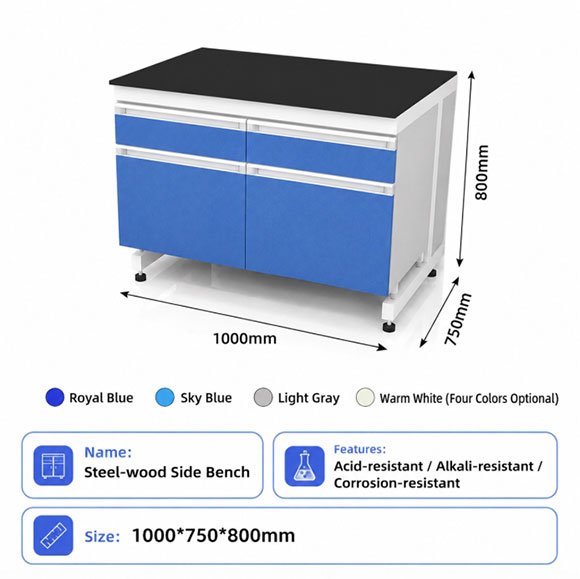
If you run a chemistry lab, you already know what kills a workbench faster than anything else. It is not the weight of the equipment. It is the spills. A drop of sulfuric acid eats through cheap laminate in minutes. Particleboard cores swell when water gets past the edge banding. A year later, the drawers do not close right and the frame wobbles. That is why the top on this bench is solid phenolic resin — not a thin veneer glued to a particleboard slab. The entire worktop, edge to edge, is a single piece of high-pressure thermoset composite. Search “phenolic resin lab bench top” and you will see it is the standard material for university chemistry labs and pharmaceutical QC stations. It handles dilute acids, alkalis, and common organic solvents without blistering or delaminating. Wipe it down after a spill, and it keeps working. Underneath, the frame and cabinet body are cold-rolled steel with electrostatic powder coating. A lot of cheap benches use hot-rolled sheet metal — the surface is rougher, the tolerances are looser, and the paint does not bond as well. Cold-rolled steel gives you a flatter, cleaner panel that takes the powder coat evenly. The coating itself is not spray paint. It is dry powder applied with an electrostatic charge, then baked at high heat to fuse into a hard, bonded finish. It resists scratches, does not peel, and holds up in humid environments where raw steel would rust in months. If you have also been looking at all-steel options for cleaner environments, we have a full stainless steel workbench built for GMP-grade cleanrooms. Steel Wood Lab Bench — Chemical Resistant Phenolic Resin Top Nine Standard Sizes — You Are Not Stuck with Two Options Most suppliers carry one or two widths and call it a product line. We stock nine, from…
June 18, 2025
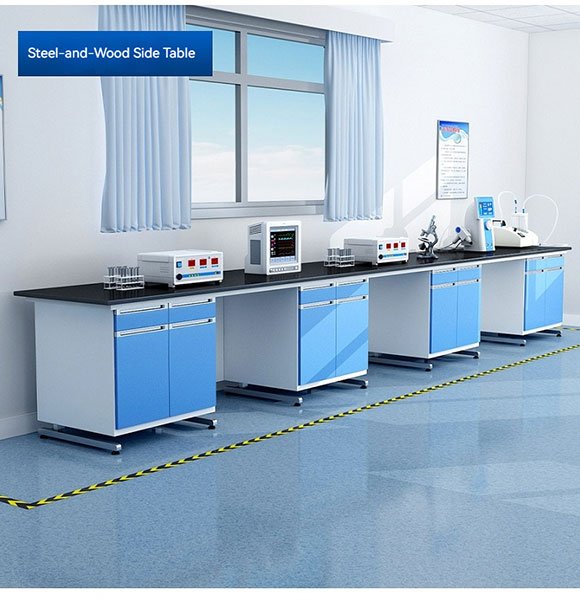
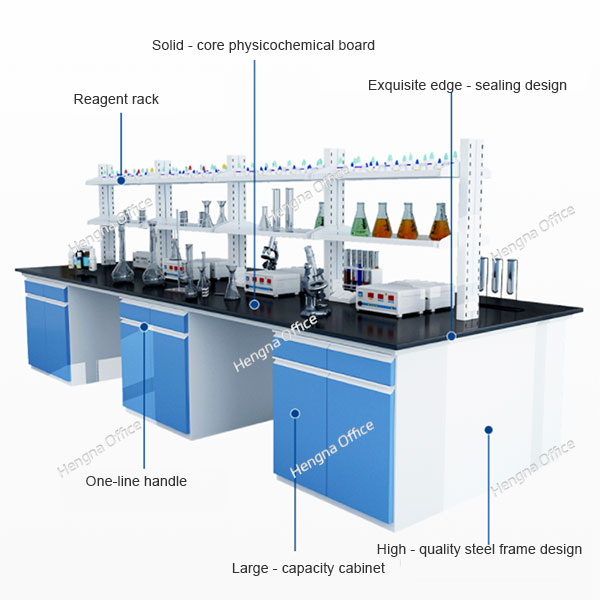
Quick answer: A laboratory workbench with a wood side table pairs a chemical-resistant main workbench with a wooden side table for paperwork, sample prep and storage. The main bench handles chemicals and instruments; the side table absorbs everything else. Splitting the two jobs keeps the wet workspace clear and the lab organized. Labs fail at the edges. The workbench is specified carefully, and then notebooks, reference manuals, spare pipettes and shipping boxes drift onto the same surface where reagents are open. A workbench with a dedicated wood side table fixes that by giving the auxiliary work its own place — close enough to reach, separate enough to keep the wet area clean. The Main Workbench: Built for the Wet Zone The primary workbench is constructed from chemical-resistant laminate or stainless steel, depending on the model, over a frame that holds the surface stable under daily use. This is where experiments happen: microscopes, spectrometers, open reagents, and the spills, heat and wear that come with them. The worktop is specified to resist acids and bases so a splash does not become a permanent scar. Height and depth follow ergonomic standards so staff can work long sessions without the fatigue that comes from reaching and bending. The Wood Side Table: The Dry Zone The wood side table is made from solid wood or quality wood composite, finished to resist minor spills and scratches. Its job is everything the wet zone should not touch: notebooks and reference materials, documentation during experiments, preliminary sample prep, and storage of less-frequently-used equipment in drawers or shelves. The natural wood finish also softens the look of a steel-heavy lab — a small detail that makes long days better. The side table height is coordinated with the main workbench, so the two surfaces work as one continuous workstation….
June 15, 2025
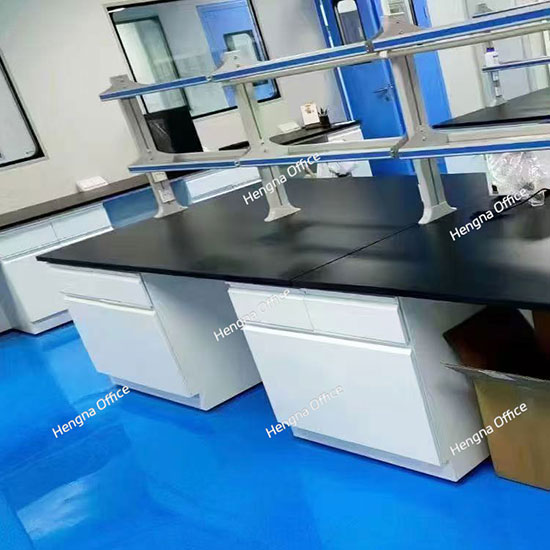
Full – Steel Laboratory Workbench (5300×750×800mm) – Ideal for Research, Quality Inspection & Chemical Labs I. Precisely Adapted Scenarios – A “Custom Partner” for Professional LabsIt is deeply focused on three core professional scenarios: research laboratories, quality inspection laboratories, and chemical laboratories, precisely matching different experimental needs:Research Laboratories: In cutting – edge research scenarios such as material development, drug synthesis, and micro – analysis, it provides a stable operating platform for researchers. Whether it’s for the precise preparation of trace reagents or the placement of large – scale precision instruments (such as spectrum analyzers, centrifuges, etc.), the 5300mm extra – long worktop can accommodate multi – person collaborative experiments, and the 750mm width reserves sufficient space for placing reagents and equipment, facilitating research breakthroughs.Quality Inspection Laboratories: Facing strict quality inspection processes for food, pharmaceuticals, industrial products, such as heavy metal detection and microbial inspection, the workbench needs to withstand high – frequency and diverse experiments. The all – steel material is durable, and the chemical – resistant panel worktop is stain – resistant and easy to clean, ensuring that experimental data is not affected by the environment and guaranteeing the accuracy and reliability of quality inspection results.Chemical Laboratories: In strong – corrosion scenarios such as acid – base titration and the synthesis of corrosive materials, the 12.7mm – thick solid – core chemical – resistant panel worktop acts as a “protective shield”, resisting the erosion of strong acids and alkalis; the all – steel frame provides stable support. Even with long – term contact with chemical reagents and high – temperature heating devices, it can maintain its structural integrity and safeguard experimental safety.II. Hard – Core Quality Support – All – Steel Structure + Super Strong Worktop(I) All – Steel Frame: 1.0mm Cold – Rolled Steel Plate Builds a “Strong…