
Selecting the right capacity for your flammable safety cabinet is one of the most practical decisions in setting up a compliant chemical storage area — and one of the most commonly overlooked. Choose a cabinet that’s too large and you’re paying for unused floor space. Choose one that’s too small and you end up with improperly stored containers sitting on workbenches or next to open flames.
The three most widely used sizes on the market are 22 gallon, 30 gallon, and 45 gallon. Each serves a distinct purpose based on the volume of chemicals you handle, the floor space available, and the nature of your operation. This guide breaks down the key differences and helps you pick the right size for your facility.
- 22, 30, or 45 Gallon Flammable Storage Cabinet Size Quick Comparison
- 22 Gallon Flammable Safety Cabinet: Best for Smaller Storage Needs
- 30 Gallon Flammable Safety Cabinet: The Middle Ground
- 45 Gallon Flammable Safety Cabinet: Built for High-Volume Storage
- 5 Factors to Consider Before Choosing
- Quick Sizing Reference
- Final Thoughts
22, 30, or 45 Gallon Flammable Storage Cabinet Size Quick Comparison
Before diving into specific use cases, here’s a side-by-side look at the core specifications:
| Specification | 22 Gallon | 30 Gallon | 45 Gallon |
|---|---|---|---|
| Usable Volume | Approx. 83 Liters | Approx. 114 Liters | Approx. 170 Liters |
| Relative Capacity | 1x (Baseline) | 1.37x | 2.05x |
| Typical Height | ~1650mm (65″) | ~1650mm (65″) | ~1650mm (65″) |
| Typical Width | ~590mm (23″) | ~790mm (31″) | ~1090mm (43″) |
| Typical Depth | ~460mm (18″) | ~460mm (18″) | ~460mm (18″) |
| Standard Shelves | 2 | 2–3 | 3 |
| Floor Footprint | ~0.27 m² (2.9 ft²) | ~0.36 m² (3.9 ft²) | ~0.50 m² (5.4 ft²) |
Key takeaway: All three sizes share roughly the same height. The difference is almost entirely in width. That means upgrading from 22 to 45 gallons doesn’t require more vertical clearance — just more wall space. This is worth knowing if ceiling height is a constraint in your facility.
22 Gallon Flammable Safety Cabinet: Best for Smaller Storage Needs
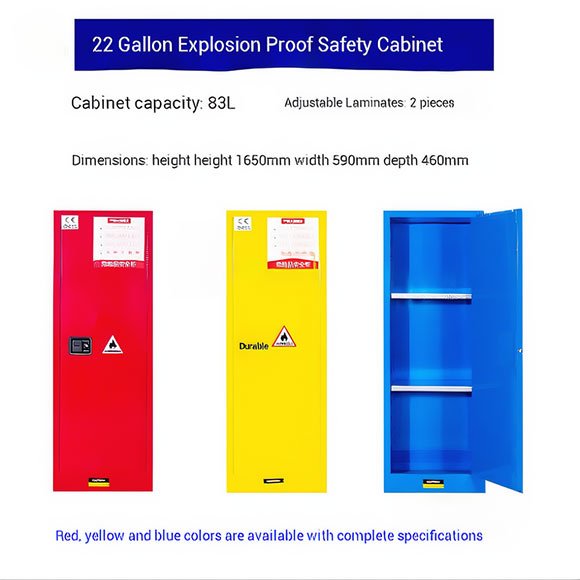
The 22 gallon cabinet is the most compact option and works well in environments where chemical volume is moderate and floor space is at a premium.
Ideal use cases:
- Small chemistry or testing labs storing 5–10 commonly used reagents
- Factory floor satellite storage — a secondary cabinet near the workstation so operators don’t walk to the main storage area for every refill
- School and university teaching labs
- Quality control departments with a limited number of standards and samples
- Tight spaces such as corridors, corners, or between equipment where a wider cabinet simply won’t fit
Key advantages: The smallest footprint of the three (around 0.27 m²) makes it easy to place in tight areas. Two adjustable shelves handle basic chemical classification. It’s also the most budget-friendly option, which matters when outfitting multiple locations or working within a tight capital budget. The single-door design keeps things simple — easy to install, easy to maintain.
Things to keep in mind: With roughly 83 liters of usable space, the 22 gallon cabinet fills up faster than you might expect. If you regularly store larger containers (such as 5-gallon pails) or more than 10 chemical types, you’ll likely find yourself running out of room. Overcrowding a safety cabinet creates spill risks and makes it harder to find and retrieve what you need — both of which defeat the purpose of having a proper cabinet in the first place.
30 Gallon Flammable Safety Cabinet: The Middle Ground
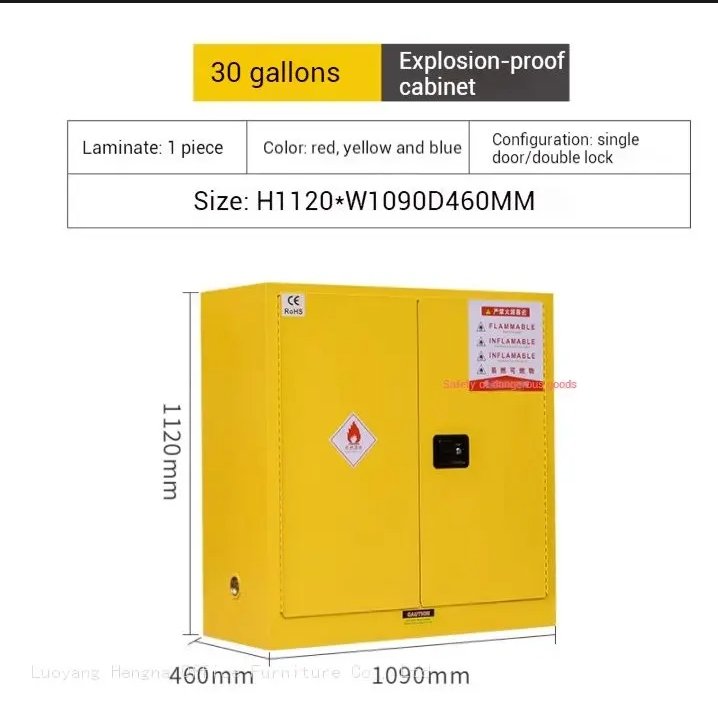
The 30 gallon model offers about 37% more storage than the 22 gallon, while only adding roughly 200mm (8 inches) to the width. It’s the most versatile of the three sizes and a common default for mid-sized operations.
Ideal use cases:
- Mid-sized manufacturing plants that keep 10–20 chemicals within arm’s reach on the production floor
- R&D labs with a moderate variety of reagents and solvents
- Automotive repair shops storing paints, thinners, brake cleaners, and lubricants
- Pharmaceutical facilities using it as a staging area for raw materials and solvents
- Printing operations managing ink inventories alongside wash solvents and thinners
Key advantages: That extra 37% of capacity translates to noticeably fewer refills and less time spent walking to a central storage area. The option for 2–3 shelves allows finer categorization of chemicals by type, hazard class, or usage frequency. In many cases, a single 30 gallon cabinet can replace two smaller units, actually saving floor space.
Things to keep in mind: The 30 gallon is the hardest size to call because it sits between two clear extremes. A practical approach: if your 22 gallon cabinet is constantly full and you’re setting containers on top of it (which you shouldn’t), it’s time to move to 30 gallons. Conversely, if a 30 gallon feels tight from day one, go straight to 45.
45 Gallon Flammable Safety Cabinet: Built for High-Volume Storage
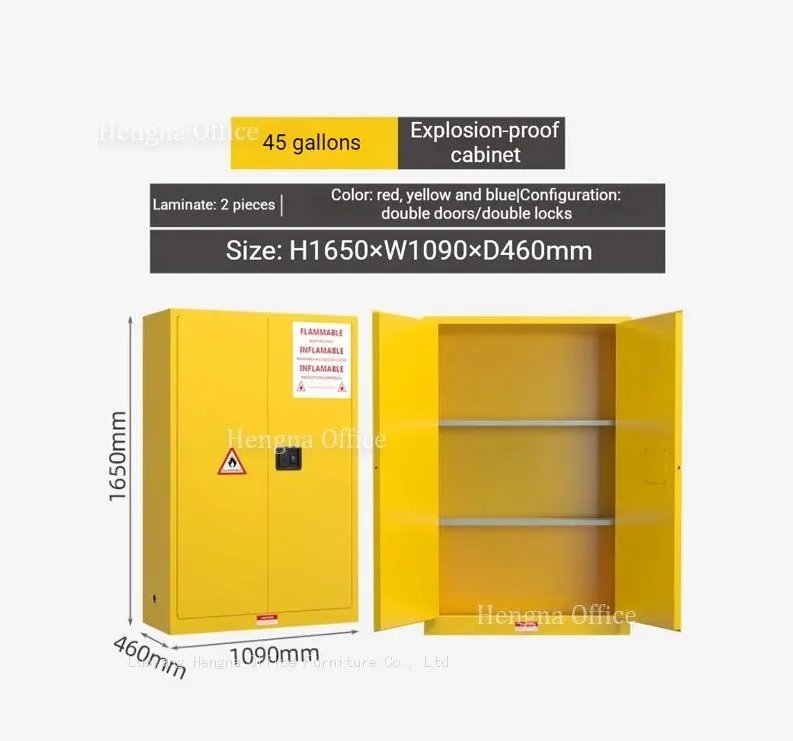
At roughly double the capacity of the 22 gallon model, the 45 gallon cabinet is designed for environments with large chemical inventories and enough floor space to accommodate a wider unit.
Ideal use cases:
- Large chemical or petrochemical plants consolidating 20+ chemical types in one location
- Warehouse and distribution centers serving as centralized hazardous material storage hubs
- Paint and coating manufacturing facilities with bulk raw materials
- Multi-department environments where a shared cabinet serves several work groups
- Operations planning for growth — a 45 gallon cabinet bought today leaves room for tomorrow’s expanding chemical inventory
Key advantages: Three adjustable shelves provide the most granular organization options. A single 45 gallon cabinet can replace multiple smaller units, freeing up floor space and reducing the number of cabinets that need to be inspected, maintained, and grounded. For high-throughput environments, this means fewer interruptions and less handling.
Things to keep in mind: At over 1 meter wide, the 45 gallon cabinet needs a dedicated placement — it won’t tuck into a corner or squeeze between existing equipment. When fully loaded, the combined weight of the cabinet and its contents can exceed 150 kg (330 lbs), so plan for adequate floor loading capacity and make sure you have enough personnel to position it safely during installation. It’s also worth implementing a clear shelf labeling system from the start — with that much storage space, finding a specific container can become a challenge without good organization.
5 Factors to Consider Before Choosing
1、Chemical types and volume
Start with a clear inventory: what chemicals do you need to store, and how much of each? Add up the container volumes to get a total. As a rule of thumb, plan to use no more than 70–80% of the cabinet’s rated capacity. This leaves room to access containers without knocking things over and allows for some growth. For example, if your total chemical volume is around 60 liters, a 22 gallon (83 liter) cabinet will work. Push past 70 liters, and the 30 gallon becomes the better choice.
2、Available floor space
Measure the width and depth of the area where you plan to place the cabinet. Don’t forget to account for the door swing — a single-door cabinet needs at least 600mm (24 inches) of clear space in front for full access. Also check that the floor can handle the weight: a fully loaded 45 gallon cabinet can weigh over 150 kg. If your available width is under 1 meter, you’re limited to 22 or 30 gallon models.
3、Regulatory requirements
Some jurisdictions impose limits on how much flammable liquid can be stored in a single cabinet within a given area. Additionally, best practice — and in many regions, regulatory requirement — dictates that flammable, corrosive, and combustible liquids be stored separately. This means you may need multiple cabinets regardless of total volume. Check your local fire codes and chemical storage regulations before finalizing your decision.
4、Future growth
If your operation is expanding, consider sizing up now rather than buying twice. A 30 gallon cabinet that barely meets today’s needs will be a bottleneck in six months. If you anticipate a 30–50% increase in chemical volume over the next year, move up one size category. The incremental cost is usually modest compared to the logistics of replacing an undersized cabinet later.
5、One large cabinet vs. multiple smaller ones
If you need to store flammable, corrosive, and combustible chemicals simultaneously, you’ll need at least three separate cabinets (yellow, blue, and red) regardless of total volume. In that scenario, it often makes more sense to deploy multiple 22 gallon units — one per chemical class — rather than a single large cabinet with everything mixed together. Chemical segregation is a non-negotiable safety principle, and color-coded cabinets make compliance straightforward.
Quick Sizing Reference
| Your Situation | Recommended Size |
|---|---|
| Fewer than 10 chemical types; total volume under 60 liters | 22 Gallon |
| 10–20 chemical types; total volume 60–100 liters | 30 Gallon |
| More than 20 chemical types; total volume over 100 liters | 45 Gallon |
| Available wall width under 1 meter (39 inches) | 22 or 30 Gallon |
| Storing 3 chemical classes (flammable, corrosive, combustible) | Multiple 22 Gallon cabinets (one per color) |
| Rapidly growing operation | One size larger than current need |
Final Thoughts
There’s no universally “right” size for a flammable safety cabinet — the best choice depends entirely on your specific chemical inventory, available space, and operational requirements. The 22 gallon works well for small-scale and supplementary storage, the 30 gallon hits the sweet spot for most mid-sized operations, and the 45 gallon is built for high-volume industrial environments.
Before placing an order, take the time to audit your chemical inventory, measure your available space, and think about where your needs will be six months from now. The right cabinet size pays for itself in safety, compliance, and day-to-day efficiency.
If you’re unsure which size is right for your facility, feel free to contact us with your chemical list and floor plan dimensions. We’ll provide a tailored sizing recommendation and a factory-direct quote.
Not sure which size fits your needs?
Send us your chemical inventory list and floor plan — we’ll recommend the right cabinet size and provide a factory-direct quote.