
What’s the right cabinet for storing strong acids and alkalis in your lab? It sounds like a simple question, but getting it wrong can lead to serious consequences — corroded metal cabinets, chemical leaks, safety incidents. None of these are things you want to deal with.PP (polypropylene) corrosive storage cabinets have become the go-to choice for laboratories and industrial facilities that handle aggressive chemicals. The 90-gallon size, in particular, hits a sweet spot — large enough capacity, reasonable footprint, and it’s often the first spec procurement managers look at.
This guide breaks down the key things you need to consider when selecting a 90-gallon PP acid and alkali cabinet, based on real-world selection experience rather than marketing fluff.
1. Why PP Material for Corrosive Storage?
Here’s the bottom line: for strong acids and alkalis, PP is the most reliable material available. Period.
PP (polypropylene) has excellent chemical resistance. It tolerates most strong acids and bases without degrading — sulfuric acid, hydrochloric acid, nitric acid, sodium hydroxide, you name it. Store them in a PP cabinet and the cabinet won’t be affected.
Compare that to traditional metal cabinets — even epoxy-coated steel ones. Prolonged exposure to strong acids and alkalis causes the coating to blister and peel, exposing the metal underneath to rapid rust and eventual perforation. That’s an unacceptable risk in any lab environment.
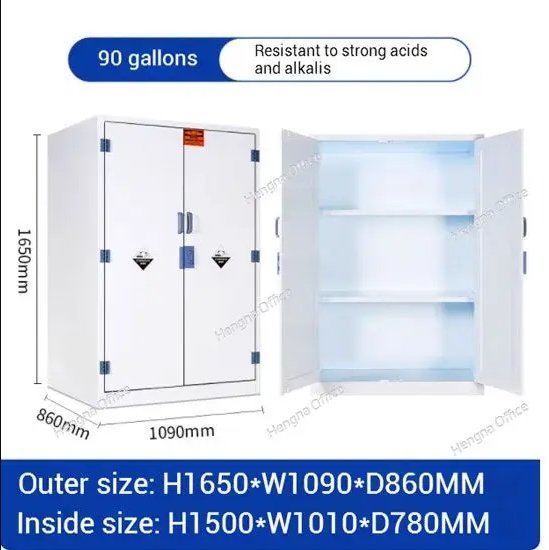
PP material also brings several inherent advantages:
- Never rusts — eliminates metal corrosion at the source
- Impact resistant — PP sheets are tough and resist cracking from bumps
- Chemically inert — doesn’t react with stored substances or produce harmful byproducts
- Easy to clean — smooth surface, chemical spills wipe right off
Important: PP cabinets are designed for corrosive chemicals, not flammable liquids. Fire protection is a separate requirement that calls for dedicated flammable storage cabinets.
2. Key Components of a 90 gallon PP corrosive chemical storage cabinet
Don’t just look at the exterior — the internal structure and hardware details are what separate a good cabinet from a mediocre one. Pay close attention to these components:
1. Seamless Welded Structure
The cabinet body should be constructed using PP sheet thermal welding, not mechanical fastening or adhesive bonding. A properly welded cabinet achieves 100% leak-proof seams at the bottom and joints, so even accidental spills stay contained inside.
2. Acid-Resistant Shelves
Shelves should feature spill-containment lips — raised edges that catch liquid if a bottle tips over, preventing it from dripping onto the shelf below. Shelf height should be adjustable to accommodate different container sizes.
3. All-Plastic Hardware
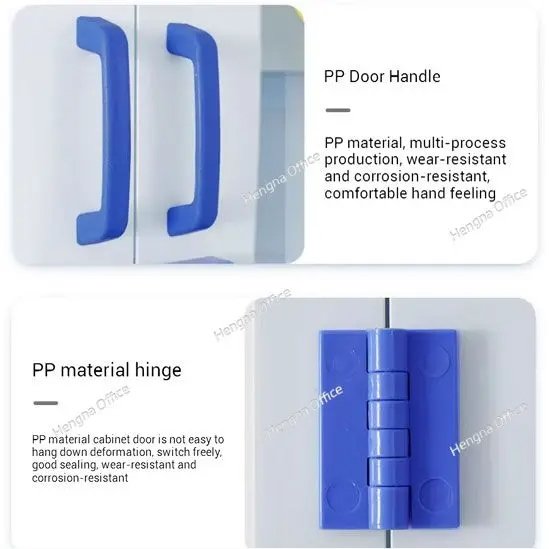
This is one detail many buyers overlook — hinges, door handles, and locks must also be made from PP. Metal hinges or handles will corrode quickly in an acid-alkali environment, leading to doors that won’t open or close properly. A quality PP cabinet doesn’t use a single metal screw.
4. Dual Ventilation Ports
The cabinet needs ventilation openings to prevent dangerous concentrations of volatile fumes from building up inside. Typically, there should be one vent on each side, with connections for external exhaust ducting to your lab’s ventilation system.
3. What Does the 90-Gallon Standard Mean?
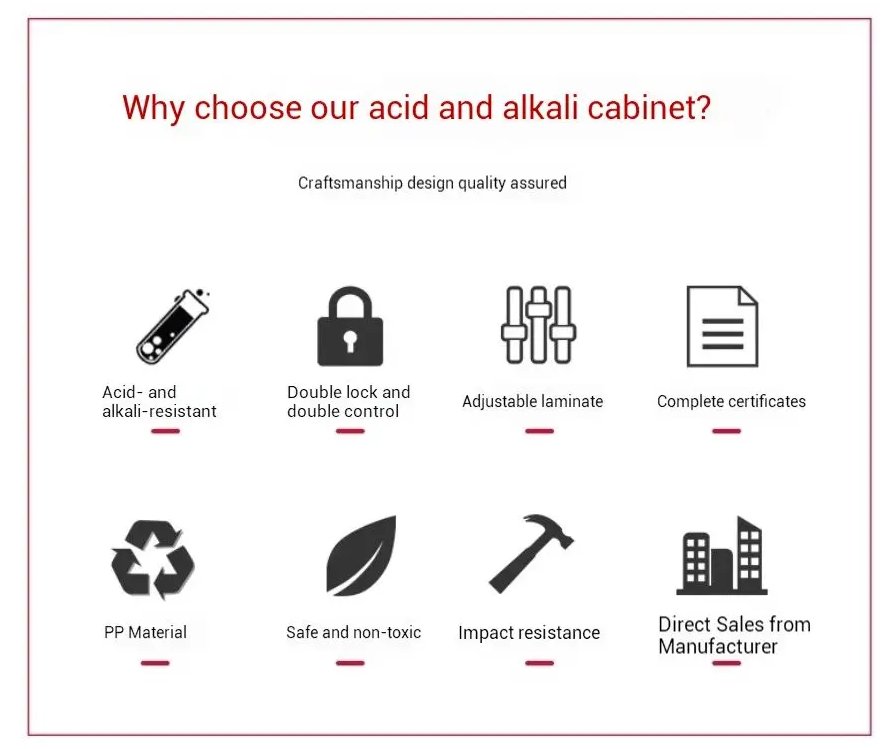
90 gallons (approximately 340 liters) is the mainstream large-capacity size for PP corrosive cabinets. The typical physical dimensions are:
| Specification | Dimensions |
|---|---|
| External (H × W × D) | 1650 × 1090 × 860 mm |
| Internal (H × W × D) | 1500 × 1010 × 780 mm |
The design logic behind these dimensions: enough capacity to store a large volume of reagents, while still allowing a single person to open doors and access contents without difficulty. For labs and factories with high chemical consumption, the 90-gallon cabinet is a cost-effective “workhorse” size.
Beyond dimensions, there are a few other specs to confirm:
- pH compatibility range — a proper PP cabinet should handle the full range from strong acids to strong bases
- Load-bearing capacity — shelf and cabinet load ratings should match what you actually plan to store
- Safety certifications — check whether the cabinet complies with OSHA guidelines or equivalent standards
Specific parameters vary by manufacturer, so it’s best to contact your supplier directly for confirmation.
4. PP Cabinets vs. Epoxy-Coated Steel Cabinets
Some buyers hesitate between PP cabinets and epoxy-coated steel cabinets. In reality, they serve completely different purposes:
| Feature | PP Corrosive Cabinet | Epoxy-Coated Steel Cabinet |
|---|---|---|
| Corrosion Resistance | Excellent (strong acids & bases) | Fair (weak acids & organic solvents only) |
| Lifespan | No rust or corrosion, long service life | Coating may peel, base metal can rust |
| Leak Protection | Seamless welded bottom, fully leak-proof | Welded joints vulnerable to corrosion |
| Best Used For | HCl, H₂SO₄, HNO₃, NaOH, etc. | Flammable liquids, weak acid solvents |
| Material | All-plastic construction, zero metal parts | Steel body with coating |
| Price | Relatively higher | Relatively lower |
Simple rule: PP cabinets for corrosives, fire-rated steel cabinets for flammables. They’re not interchangeable — each serves a specific purpose.
5. Where Is a 90-Gallon PP Cabinet Needed?
This size is most commonly used in the following settings:
University & Research Laboratories
Teaching and research labs handle a wide variety of chemicals in significant quantities. The 90-gallon capacity allows centralized storage, reducing the number of cabinets needed and saving valuable lab space.
Semiconductor & Electronics Cleanrooms
Cleanrooms have strict environmental requirements. PP material doesn’t generate metal ion contamination, and all-plastic hardware eliminates the risk of metallic particle shedding — making it the ideal choice for cleanroom chemical storage.
Pharmaceutical & Chemical R&D Centers
R&D processes frequently involve strong corrosive reagents that need safe, segregated storage. The chemical resistance and leak-proof design of PP cabinets meet these demands.
Industrial Electroplating & Surface Treatment Shops
Plating solutions, pickling baths, and related chemicals are highly corrosive and used in large volumes. 90-gallon PP cabinets are widely used for on-site storage in these workshops.
6. Frequently Asked Questions
Q1: Can I store flammable liquids in a PP cabinet?
Not recommended. PP cabinets are designed for corrosion resistance, not fire protection. Flammable liquids require FM-approved flammable storage cabinets.
Q2: Does the cabinet need self-closing doors?
PP corrosive cabinets generally don’t require self-closing doors by default. However, if your lab’s safety protocols mandate it, you can specify self-closing hinges when ordering.
Q3: Can the shelves handle large bulk chemical containers?
This depends on the specific model and shelf design. Tell your supplier what you plan to store and the approximate weight, and they’ll recommend the right configuration.
Q4: Do I need to connect exhaust ducting?
If you’re storing volatile acids or alkalis (such as hydrochloric acid or nitric acid), exhaust ducting is strongly recommended. Vent ports typically come with connections for external ventilation systems.
Q5: Can PP cabinets be used outdoors?
Not recommended for long-term outdoor use. While PP is corrosion-resistant, prolonged UV exposure accelerates material aging. Indoor installation is advised.
Q6: Does the cabinet require regular maintenance?
Routine cleaning with a damp cloth is sufficient. Periodically check that hinges aren’t loose, vents aren’t blocked, and the cabinet body has no cracks. Contact your supplier if you notice any issues.
Q7: Can I customize the size or internal layout?
Most manufacturers offer customization options. If you have specific dimensional requirements or need a particular internal configuration, just let your supplier know.
Conclusion
When choosing a PP corrosive cabinet, it comes down to three essentials: pure PP material, seamless welded construction, and all-plastic hardware. The 90-gallon size is a practical, cost-effective choice for labs and workshops with significant chemical storage needs.
If you’re sourcing acid and alkali storage cabinets for your lab or facility, or if you’re unsure which specs and configurations are right for your situation, get in touch with us. Tell us about your use case and the types of chemicals you need to store, and we’ll recommend the best solution for your needs.