
In the fast-paced world of car repair and professional spray painting, danger is often right in front of you. These everyday items, like the gallon of high-quality thinner on the workbench or the cans of flammable primer in the corner, are basically “liquid fire” waiting for something to set them off.
In today’s auto shops, the question isn’t whether you need professional storage; it’s whether your current storage would survive a flash fire. This is where the Explosion Proof Cabinet goes from being a “compliance checkbox” to a life-saving tool. In this guide, we go into great detail about the technical features that make these cabinets the best choice for handling dangerous materials.

Explosion Proof Cabinets for Automotive|Why “Good Enough” Storage is Dangerous
VOCs are often in the air in a spray booth or a 4S service center. A single static spark from a technician’s jacket or a rogue spark from a grinder can turn a workshop into a disaster zone in seconds.
The rules from OSHA (Occupational Safety and Health Administration) and the NFPA (National Fire Protection Association) aren’t just there to make your life harder with paperwork. They are based on the hard lessons learned from past industrial accidents. If you use an OSHA-certified explosion-proof cabinet, you can be sure that your most dangerous chemicals will stay safe even if a fire breaks out.
1.The Parts of Armor: Galvanized Steel and Double-Wall Construction
The material is the message when it comes to cabinets that won’t explode. 18-gauge high-strength galvanized steel is used to make high-quality industrial cabinets. But the double-wall design is what really makes it work.
The 38mm Wall
There is a 1.5-inch (38mm) insulating air space between the inner and outer walls of professional-grade cabinets. This isn’t just for the building’s strength; it also helps keep heat from moving. This air gap slows down the transfer of heat to the inside during an outside fire, keeping the chemicals stored inside below their auto-ignition temperature for a crucial amount of time.
Resistance to corrosion
Cabinets in cars are exposed to chemicals, grease, and moisture. The cabinet won’t rust or break down because it has a galvanized finish and an electrostatic powder coating. This will keep its protective seal for decades.
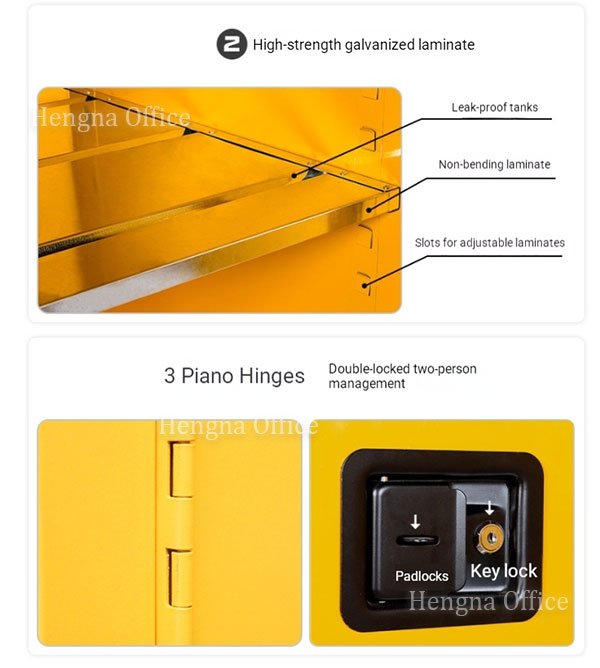
2.The 2-Inch Leak-Proof Sump: Keeping the Hidden Danger Inside
In a chemical storage setting, spills are almost never just “messes.” A gallon of gasoline or thinner that leaks can spread across a floor, get under heavy machinery, and make a huge surface area for evaporation, which raises the risk of a vapor explosion.
The 2-inch leak-proof sump at the bottom of the cabinet is your last line of defense.
Containment: It is made to hold the full amount of a standard container leak.
Safety: By keeping the liquid inside the fortified cabinet, you keep the flammable substance away from things that could start a fire outside.
Cleaning is easy: Most modern sumps are made to be easy to drain and clean, so a small leak won’t cause long-term corrosion inside the unit.
Comparison: Standard Storage vs. Explosion Proof Cabinets
| Feature | Standard Metal Locker | Explosion Proof Cabinet |
| Material | Single-sheet thin steel | Double-walled 18-gauge steel |
| Fire Resistance | Minimal (warps quickly) | High (thermal air gap) |
| Spill Control | None (leaks onto floor) | 2-inch integrated leak-proof sump |
| Ventilation | None or simple holes | Flame-arresting safety vents |
| Compliance | Non-compliant for flammables | OSHA & NFPA 30 Certified |
3. Passive Fire Control: Flame-Arresting Vents
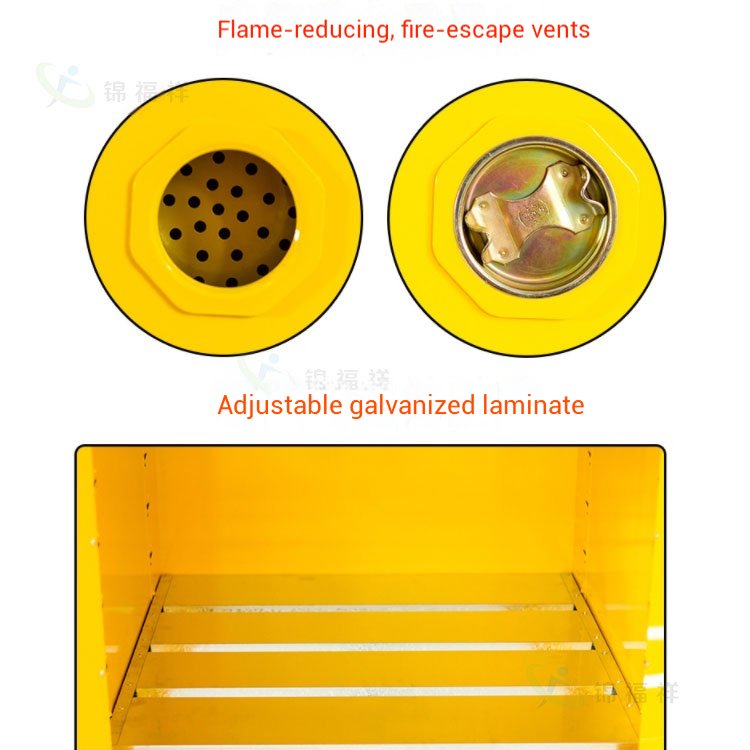
Vapors are often more dangerous than the liquids themselves. In a sealed cabinet, pressure can build up as chemicals volatilize. Professional explosion-proof cabinets utilize flame-reducing, fire-escape vents.
These aren’t just holes in the side of the box. They are equipped with flame arrestors—metal mesh screens that allow air and vapor to pass through but dissipate the heat of an incoming flame, preventing it from reaching the interior. This “active-yet-passive” system ensures the cabinet stays at a safe pressure without compromising its fire-resistant integrity.
4. Precision Hardware: 3-Point Piano Hinges & Self-Latching Doors
In an emergency, every second counts. If a fire breaks out, you don’t want to be fumbling with a door that sticks or won’t seal properly.
The Piano Hinge Advantage
Most industrial cabinets use three-point piano hinges. Unlike standard butt hinges, piano hinges run the length of the door, providing:
- Perfect Alignment: Ensures the door always hits the seal squarely.
- Durability: Can handle the weight of heavy, reinforced doors without sagging over time.
- Vapor Tightness: Provides a more consistent closure to keep fumes inside.
Self-Latching Mechanisms
Many high-end models feature a self-latching system. If the door is pushed shut, it automatically engages at three points (top, middle, and bottom), ensuring a secure seal without requiring the user to manually turn a handle—a vital feature during a hurried evacuation.
5. The Psychology of Security: Dual-Lock Systems
Safety is as much about management as it is about engineering. To prevent unauthorized access or the accidental mixing of incompatible chemicals, these cabinets utilize a Dual-Lock Mechanism.
- Key Locks: Ensures that only trained personnel with the proper credentials can access the materials.
- Padlock Hasps: Allows for “Lockout/Tagout” procedures or dual-person authentication. In high-risk environments, requiring two people to be present to open the cabinet is a proven way to reduce human error.
Industry-Specific Applications: Where You Need It Most
The Modern 4S Automotive Center
Automotive technicians deal with a cocktail of fluids: brake cleaners, fuel additives, and lubricants. A centrally located 90-gallon safety cabinet allows for the organization of these materials, keeping the “hot” chemicals away from the high-traffic service bays while staying within reach for efficiency.
High-Volume Spray Paint Booths
Spray painting is the “Perfect Storm” for fires: high-pressure oxygen, atomized flammable liquids (paint), and volatile cleaning agents (acetone).
- Solvent Management: Use the adjustable shelving to separate your base coats from your highly reactive hardeners and thinners.
- Visual Safety: The bright yellow “Safety Yellow” color is an international standard that alerts firefighters immediately to the location of the highest hazard in the building.
Checklist: How to Choose Your Cabinet
When you’re ready to invest in a safety cabinet, don’t just look at the price tag. Evaluate it based on these five criteria:
- [ ] Capacity: Do you need a 30, 60, or 90-gallon unit? (Always buy 20% more capacity than you currently use).
- [ ] Certification: Does it explicitly state it meets OSHA 1910.106?
- [ ] Shelf Strength: Can the shelves hold at least 200kg? (Crucial for bulk solvent storage).
- [ ] Sump Integrity: Is the sump welded and leak-tested?
- [ ] Color Coding: Is it Yellow (Flammables), Red (Paints/Inks), or Blue (Corrosives)?
Final Thoughts
In the automotive and painting industry, your equipment is your livelihood. You wouldn’t settle for a cheap, uncertified car lift or a low-quality paint gun—so why settle for subpar safety storage?
An Explosion Proof Cabinet is more than a piece of furniture; it is a silent sentry that stands guard over your shop. By investing in a high-quality, OSHA-certified unit with a leak-proof sump and flame-arresting vents, you aren’t just complying with the law—you’re ensuring that a small spark today doesn’t become a business-ending disaster tomorrow.
Is your workshop fully compliant? If you’re unsure about which capacity fits your spray center or automotive shop, contact our safety experts today for a free storage audit and a customized quote on our 90-gallon heavy-duty series.