
A pharma QC lab isn’t a school science room. The bench you put in there has to pass an audit.
Most lab furniture vendors don’t understand this. They sell you the same bench they’d sell to a high school chemistry teacher — and call it “lab grade.” But when your QA team runs through the supplier qualification checklist, and later when the auditor walks through your QC lab with a flashlight checking for gaps, rust, and surface contamination — that’s when the cheap stuff gets flagged.
This GMP compliant lab bench is built for exactly that standard. No gimmicks. Every detail is there for one reason: clean easily, don’t trap contaminants, resist chemicals, and pass inspection.
What “GMP Compliant” Actually Means for a Lab Bench
Let me be clear — we’re not a GMP-certified facility. What this bench is: the materials and construction meet the requirements GMP sets for pharmaceutical laboratory furniture. That breaks down to three things.
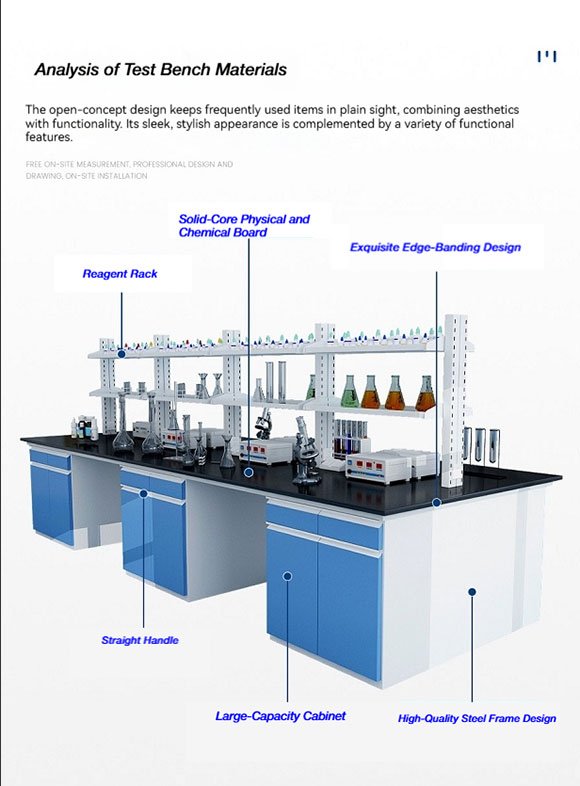
1. The worktop must be non-absorbent.
In a QC lab, the work surface sees methanol, ethanol, acetonitrile, dilute hydrochloric acid, sodium hydroxide — daily. A cheap laminate top absorbs spills at the edges and along any scratch. Once liquid gets into the core, it swells. The surface bubbles. The auditor runs a cotton swab along the edge seal and sees discoloration. That’s a finding.
Solid phenolic resin doesn’t have this problem. It’s one homogenous slab — multiple layers of kraft paper impregnated with phenolic resin, fused under high heat and pressure. No separate core and surface layer to delaminate. Spill acid on it, leave it for 24 hours, wipe it off. No stain, no swelling. The auditor’s swab stays clean.
2. The casework must have no dead zones for contamination.
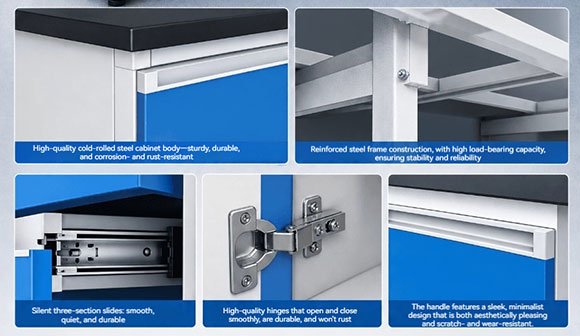
Pharma QC areas are often classified. Dust and residue settle inside cabinets and on exposed screw heads — places a cleaner might miss. Our casework uses concealed hinges and capped adjustment holes. Every screw hole in the cabinet interior has a plastic cap. No bare metal edges, no exposed particleboard core, no gaps where residue builds up.
Drawers run on three-section ball-bearing slides. They pull out fully and can be removed for cleaning — unlike cheap roller runners that collect dust inside the track and eventually jam. Cabinet doors have magnetic catches that close flush. Gap tolerance is tight.
3. All metal parts must resist corrosion.
The frame is 1.2mm cold-rolled steel. Two-stage protection: phosphate pre-treatment, then electrostatic powder coating. Not wet paint. Wet paint chips off cabinet corners after two years of cleaning wipes. Powder coating bonds to the metal — normal scrubbing with disinfectant won’t take it off.
Hinges and drawer slides pass neutral salt spray testing. They won’t rust after a year of daily exposure to the humid, solvent-laden environment of a QC lab.
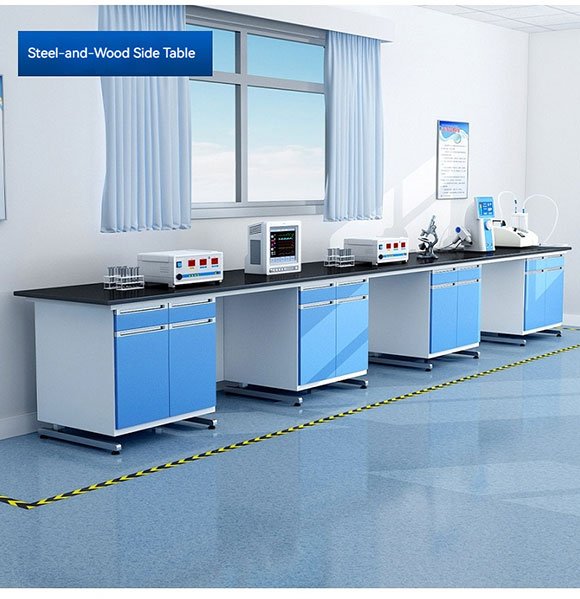
19mm Solid Phenolic Resin Worktop — Standard
You’ll see 12mm and 16mm tops on the market — they’re cheaper, but for pharma use they come up short.
- 12mm is too thin for load-bearing QC equipment. An analytical balance, pH meter, auto-titrator — each costs thousands. If the worktop flexes, your readings drift.
- 16mm works for light duty, but over time the unsupported span bends under constant load.
- 19mm is the industry standard in pharma QC. Rigid enough for heavy instruments, thick enough that edge profiles stay sealed.
Colors: black or dark grey. Both hide minor staining while still making residue easy to spot.
Frame and Finish
The under-frame is welded 1.2mm cold-rolled steel. Not 0.8mm, not 1.0mm.
All welds are ground smooth. No burrs, no sharp edges. After powder coating the surface is slick — one pass with a wet wipe and you’re done.
Cabinet colors: white and light grey are the most common in pharma. They keep the lab bright and make dust visible during inspections.
Each leg has a leveling foot. Pharma facility floors are often epoxy-coated or PVC — not raw concrete. When the floor settles, you dial the feet in. No cardboard shims needed.
GMP Compliant Lab Bench Options (Order by Need)
- Lockable drawers and doors — essential when reagents need dual-control access per GMP
- PP sink with gooseneck faucet — PP resists acids better than stainless steel
- Reagent rack or overhead cabinet — frees up the work surface
- IP-rated power modules — can be integrated into the worktop or side panel
Why Pharma Buyers Choose This Bench
- Compliant construction — solid phenolic top, sealed casework, corrosion-resistant metalwork. Built to pass audit scrutiny.
- Steel frame — 1.2mm cold-rolled steel understructure. Holds instruments steady.
- Custom and OEM — dimensions, colors, accessories all configurable. Silk-screen logo, custom packaging, custom manuals. If you’re a contractor bidding on a pharma lab project, this is the supply partner you want.
- Fast response — quote within 24 hours.
FAQ
MOQ? No fixed minimum. A single sample is fine. Volume orders get better pricing.
How do you prove GMP compliance? We provide material certificates, CE certification, and chemical resistance test data. If your third-party auditor needs to verify the bench meets GMP equipment standards, these documents cover it.
What chemicals can the worktop handle? Common QC solvents — 70% ethanol, isopropanol, methanol, acetonitrile, 5% HCl, 1M NaOH, acetic acid, phosphoric acid. Tested — no surface attack under normal daily use. Full chemical resistance chart available on request.
Can you do custom sizes? Yes. Standard widths 1000–4500mm. Non-standard dimensions, corner units, integrated sinks — all doable. Send a floor plan with your requirements.
Lead time? Standard sizes 15–20 days. Custom 20–30 days.
Packaging? KD knock-down. Moisture-proof film wrap, corner protectors, components packed by part number matching the assembly drawing.
Warranty? one year. Wear parts available at cost for the lifetime of the bench.
Are you a trading company? No. We are Luoyang Hengna Office Furniture Co., Ltd. — own brand, directly partnered with production facilities. Factory-direct pricing, no middleman markup.