
A reference lab is not a hospital pathology department. The work is different. The volume is different. The classification logic is different.
Hospital pathology departments process cases in-house, one patient at a time, indexed by case number. Reference labs receive samples from outside — hospitals, health centers, screening clinics, insurance claim reviewers. Multiple sources, multiple numbering systems, and volume that swings with seasonal demand.
A slide cabinet designed for a hospital will not work in a reference lab. It needs to be designed the other way around.
The Problem with Hospital-Style Cabinets in Reference Labs
Most reference labs start with the same 4-5 drawer cabinet the hospital uses. Six months in, two problems appear.
First, not enough drawers. A mid-size reference lab receives 200–500 cases per day. Each case generates 2–3 slides. Daily intake runs 500–1,500 slides. A 4-drawer cabinet fills in two weeks. Within six months, you have replaced the cabinet twice.
Second, classification breaks down. Hospital cabinets work on single-axis classification — case number, organ system, or date. Reference labs need three-axis classification: submitting organization + sample type + workflow status. Hospital-style label holders do not have enough room for that level of detail.
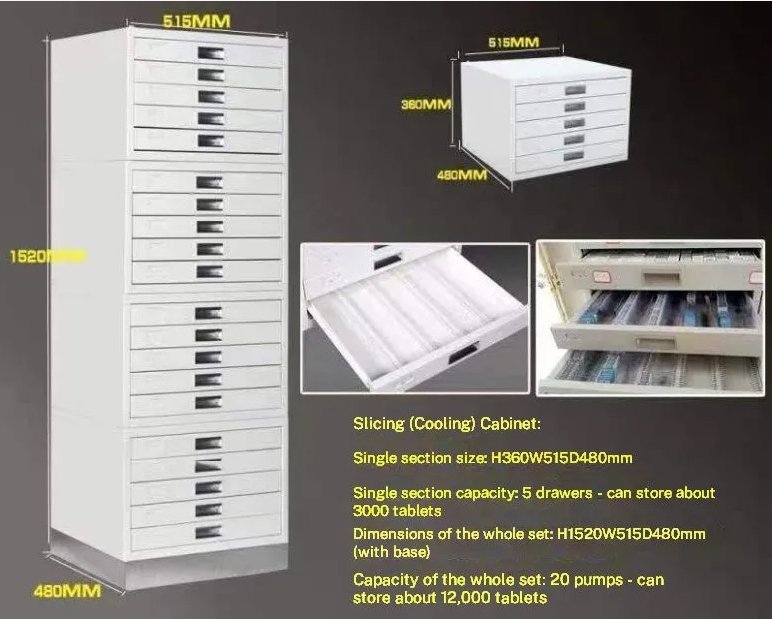
A 20-drawer cabinet solves both. Each drawer is one classification slot. The 4-section stack holds 33,000 slides — about a full year of intake for a mid-size lab.
What 33,000 Slides Actually Means
For a mid-size reference lab running 800 slides per day (200 cases × 4 slides each), 33,000 slides covers 40 days of intake.
For a high-volume reference lab running 2,000–3,000 slides per day, 33,000 slides covers two weeks of intake.
That number sounds modest until you understand how reference labs actually archive. The workflow is cyclical — weekly report batch, monthly summary, quarterly transfer to long-term storage. Each cycle, finished slides are moved out, new slides come in.
So 33,000 slides is not “annual capacity.” It is “one archival cycle capacity.” The cabinet supports the rhythm of the lab, not just the volume.
This is also why drawer count matters more than single-drawer capacity. 20 drawers means 20 fine-grained categories — submitting organization, sample type, report status, transfer timeline — each gets its own drawer.
High-Capacity Pathology Slide Cabinet for Reference Lab Drawer Classification for Reference Labs
Here is a reference classification layout. Adapt it to your own workflow.
| Drawer | Category | Capacity |
|---|---|---|
| 1–4 | Slides in process (this week) | 6,600 slides |
| 5–8 | Reported slides (this month) | 6,600 slides |
| 9–12 | Pending transfer (this quarter) | 6,600 slides |
| 13–16 | Long-term hold (within 6 months) | 6,600 slides |
| 17–20 | Re-test / disputed samples | 6,600 slides |
This is workflow-based classification. If you prefer submitting-organization-based classification, that works too — Hospital A gets one drawer, Hospital B gets another, screening clinic C gets a third. Every reference lab has its own archive logic, but 20 drawers covers the common cases.
More drawers, finer classification. This is the opposite of how hospital pathology cabinets are designed. Reference labs classify by workflow status. 20 drawers fits a full workflow cycle.
Construction Details
The cabinet body is cold rolled steel with electrostatic powder coating. Reference labs are denser than hospitals — biochemistry, immunology, molecular, and pathology platforms often share the same room. Humidity is high. Chemical fumes are constant.
A standard painted-steel cabinet will rust through at the base within two years in this environment. This cabinet uses a stainless steel base. Water on the floor, mop buckets, occasional spills — none of it corrodes the base.
Full unit dimensions: H1520 × W515 × D480 mm (including base). This height sits below eye level for most lab workers, so it does not block sightlines when placed against a wall.
Drawer Mechanics
Every drawer is full extension — pull it all the way out and place it on the benchtop. No crouching, no reaching into the back of a half-open drawer to find a slide.
The drawer front has a removable label holder. Reference lab numbering rules change frequently — new submitting organizations, new test codes, new compliance requirements. When the classification shifts, swap the label sheet. No need to replace the cabinet.
About Our Supply Experience
We work with reference laboratories and clinical testing centers across multiple regions, providing slide and wax block storage equipment.
Our supply range covers small independent labs processing 200 slides per day, up to high-volume testing centers processing 3,000+ slides daily. We understand the operational differences between a single-specialty lab and a multi-platform testing facility.
Internationally, we have supplied pathology storage equipment to reference labs in Southeast Asia, the Middle East, and Africa, including projects supporting national reference laboratory standards.
We can reverse-engineer the drawer classification and label template from your own workflow. Whether your archive is organized by submitting organization, by report status, or by sample type, we configure the cabinet to match.
Who Should NOT Buy This Cabinet
Honest scope limits:
- High-volume reference labs running 2,000+ slides per day will outgrow a single 20-drawer unit in under two weeks. We recommend ordering 2–3 units side by side.
- Labs requiring automated slide storage — this is a manual filing cabinet. Automated slide libraries are a different category.
- Labs handling primarily tissue sections — this cabinet fits standard cytology, hematology, microbiology, and immunology slides. Tissue sections are thicker and may require modified slot spacing (customization available).
Suitable Settings
| Setting | Fit |
|---|---|
| Mid-to-large independent reference lab | ⭐⭐⭐⭐⭐ |
| Regional medical laboratory consortium | ⭐⭐⭐⭐⭐ |
| Independent pathology diagnostic center | ⭐⭐⭐⭐ |
| Hospital laboratory with external intake | ⭐⭐⭐⭐ |
| Insurance claim review laboratory | ⭐⭐⭐⭐ |
| Research service company receiving external samples | ⭐⭐⭐⭐ |
Specifications
| Parameter | Single Section (5 Drawers) | Full Unit (4 Sections, 20 Drawers) |
|---|---|---|
| Height | 360 mm (14.17″) | 1,520 mm (59.84″) |
| Width | 515 mm (20.28″) | 515 mm (20.28″) |
| Depth | 480 mm (18.90″) | 480 mm (18.90″) |
| Slide Capacity | 8,250 slides | 33,000 slides |
| Drawer Count | 5 | 20 |
| Slide Orientation | Horizontal, grooved tracks | Same |
| Material | Cold rolled steel, powder coated | Same |
| Base | Stainless steel | Stainless steel |
| Drawer | Full extension, label holder | Same |
| Assembly | No tools, stackable | No tools |
| Shipping | Fully assembled per section | Sections stacked, ready to use |
Packaging & Shipping
Each section ships fully assembled. Open the box, place it on the base, stack the next section. No screws, no brackets, no assembly time.
Packing details:
- Foam corner protectors
- Moisture-barrier wrapping for sea freight
- Cardboard outer carton with handling marks
A full 4-section set fits on a standard shipping pallet.
Frequently Asked Questions
Q: For 800 slides per day, how long will this cabinet last? A: 33,000 slides covers about 40 days. Most reference labs archive monthly, so 40 days matches one monthly cycle.
Q: Can I change the drawer classification after purchase? A: Yes. Drawer classification is soft — labels are removable and replaceable. Reconfigure as your workflow changes.
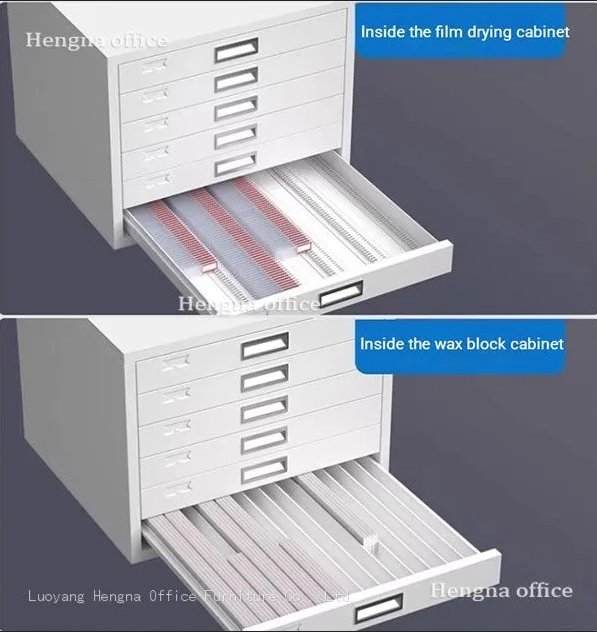
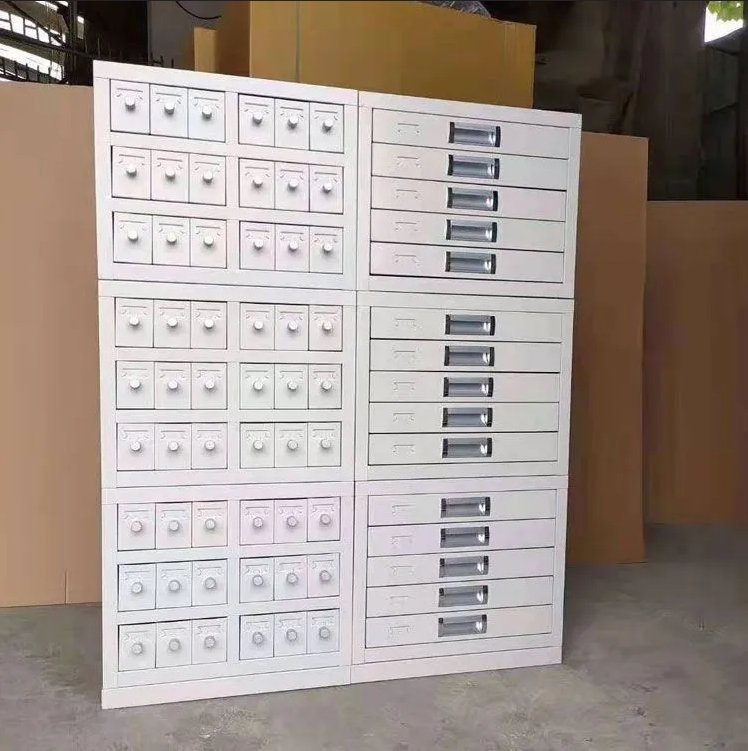
Q: Can I store slides and wax blocks in the same cabinet? A: No. Slide cabinets use grooved tracks (horizontal). Wax block cabinets use partitioned grid slots (vertical). Both cabinets share the same external dimensions, so you can place them side by side or stack them.
Q: Can labels be pre-printed with my submitting organization names? A: Yes. We offer label pre-printing based on your organization list and numbering system. Contact us for details.
Q: Can drawers be locked? A: Default is unlocked. Locking drawers are available as a custom option — minimum quantity required.
Q: How is the cabinet packed for international shipping? A: Moisture barrier + edge protectors + cardboard carton. Fully assembled per section. A standard pallet holds a full 4-section set.
Request a quote — tell us your daily slide intake, your archival cycle (weekly / monthly / quarterly), and any custom label requirements. We will configure the right drawer layout and label system for your workflow.