What students touch every day shouldn’t be bottom-tier.
Walk into most school labs and look at the workbenches. The laminate top is peeling at the edges, the particleboard underneath has swollen from water spills, and the drawer slides grind like there’s sand in them. After five years, you’re either patching them up every semester or replacing the whole lot. The worst part for a school procurement officer? It’s not that you can’t afford better — it’s that buying cheap means owning the blame when it falls apart.
Our steel-wood lab bench isn’t some breakthrough. Cold-rolled steel for the frame, solid phenolic resin for the worktop, acid-resistant fittings. That’s it. But once you take the construction apart, every detail lines up with how a school lab actually gets used.
Frame: 1.2mm Cold-Rolled Steel, Not Paper-Thin Sheet Metal
Cheap lab furniture uses 1.0mm or even 0.8mm steel — thin enough that you can feel the flex when you lean on it. Looks fine on day one. Two years later? Drawer tracks are crooked, doors won’t close flush, the whole bench wobbles when someone sets a microscope down. Students aren’t gentle. Instruments, beakers, reagent bottles — the weight adds up, and the bench takes it year after year, class after class.
Our frame is 1.2mm cold-rolled steel, welded, then electrostatic powder coated. Knock on it — you’ll hear a solid thud, not a hollow ring. Four leveling feet at the corners let you dial out uneven floors. Classroom floors are rarely perfectly flat; this handles it without shims.
Worktop: Solid Phenolic Resin, Not a Laminate Veneer
Here’s what matters — there are two kinds of “lab bench tops” on the market, and they’re not the same thing:
Laminate-faced tops are MDF or particleboard with a thin decorative layer glued on top. Looks decent out of the box. A student spills diluted hydrochloric acid during a titration, wipes it up a few minutes later — by then, the acid has already seeped through the surface and into the core. The top starts bubbling, the edge banding separates, and there’s no fixing it.
Solid phenolic resin is different. Multiple layers of kraft paper are saturated with phenolic resin, then pressed under high heat and pressure. The result is one solid slab — no separate core and skin to delaminate. Spill diluted acid or alkali on it, leave it for 24 hours, wipe it off — no stain, no swelling. Heat-resistant, scratch-resistant, waterproof. This is what a chemistry lab actually needs.
We use 19mm as standard. You’ll see 12mm and 16mm out there — they’ll work for a while, but in a school setting, ask yourself: how long does this need to last? Five years? Ten?
Why Steel-Wood Beats All-Wood and All-Steel for Schools
- All-wood benches — cheap up front, but in a humid climate they swell and warp within six months. Chemical spills soak straight through. And the kicker: formaldehyde off-gassing. Thirty students in one room for two periods a day — you don’t want to gamble with indoor air quality.
- All-steel benches — solid, but expensive. One all-steel unit costs what two or three steel-wood units cost. They’re also prone to static buildup, which doesn’t play well with sensitive instruments. For a school working within a fixed budget, all-steel is overkill.
- Steel-wood benches — steel skeleton for load-bearing stability, phenolic resin worktop for chemical resistance. Cost lands between the two, lifespan stretches past a decade. For school procurement, this is the sweet spot.
STEM Lab Workbench — Modular Steel Frame Specs and Customization
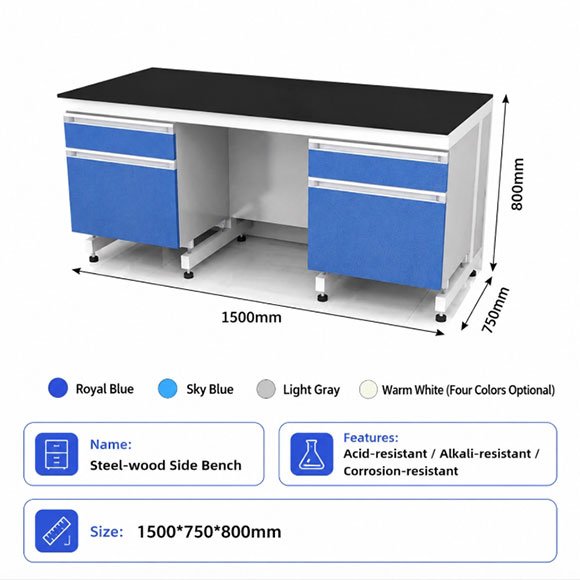
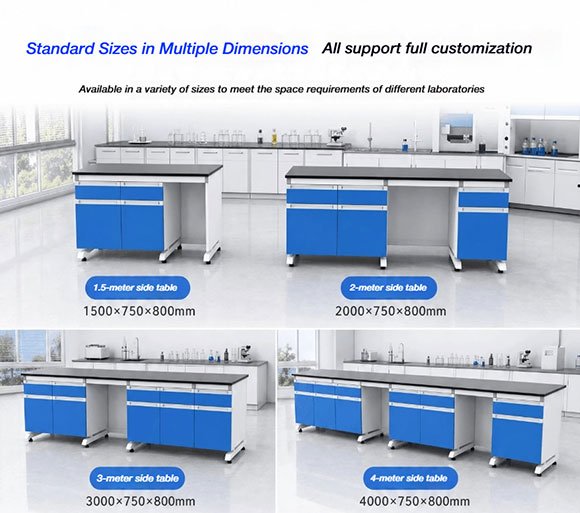
Nine standard widths: 1000mm to 4500mm. 750mm deep, 800mm high. Fits most classroom layouts. Need something unusual? Irregular room shape, corner joinery, integrated sink and reagent rack — we’ll build it.
Drawers and cabinet doors are lockable — essential when you’re storing reagents in a classroom. Doors use silent magnetic catches; no slamming when students open and close them. Drawer slides are three-section ball-bearing tracks — smooth pull, no jamming.
Surface Finish
The frame is electrostatic powder coated, not wet-painted. Wet paint chips at the edges after two years of backpacks scraping past and chairs bumping into cabinet doors. Powder coating bonds to the steel — it stays on. Color is your choice, no extra charge.
Sink and Accessories (Optional)
The worktop can be cut out for a PP sink. PP handles acids and alkalis better than stainless steel — stainless actually corrodes with concentrated acids over time. Paired with a gooseneck faucet, the curved spout keeps water from splashing when students wash glassware. Pipework behind the sink is concealed with a back panel — no exposed plumbing, looks clean.
Reagent racks can be added above the bench. Keeps common reagent bottles and test tube racks within reach without eating into the work surface.
FAQ
MOQ? No hard minimum. A dozen benches for one classroom is fine. A whole batch for a new science building is also fine. Larger volumes get better unit pricing. Single sample orders are welcome.
Do you handle installation? We supply KD knock-down packaging — each component is labeled with a part number and comes with assembly drawings. A local crew can set up a full classroom in half a day. If you need it, we can recommend installation partners in your region.
How do I get a quote? You’ll hear back within 24 hours. Send us a floor plan with your requirements — number of benches, whether you need sinks, reagent racks, power outlets — and we’ll return a full proposal with FOB or CIF pricing.
Warranty? Two years on the steel frame, one year on the worktop. Accidental damage isn’t covered. Wear parts — drawer slides, hinges, handles — we’ll ship replacements at cost, for as long as you need them.
Can you print our school logo? Yes. OEM and ODM are standard for us. Silk-screen your logo on cabinet doors or the worktop edge, custom packaging, custom assembly manuals — all doable. If you’re a lab contractor bidding on government tenders, this is the kind of supply partner you need.
Lead time? Standard specs: 15–20 days. Custom dimensions: 20–30 days. Peak season — let us know early.
Packaging? KD knock-down: moisture-barrier film wrap, corner protectors, components packed separately by part number. Each number matches the assembly drawing. When the container arrives, you unbox and build — nothing gets mixed up.
Are you a trading company? No. We’re Luoyang Hengna Office Furniture Co., Ltd. — our own brand, directly partnered with production facilities. What you pay is factory-direct; no middleman markup.
Reach out directly. You’ll get a response within 24 hours. Send the floor plan — we’ll send the proposal.