The order arrives as a two-cylinder cabinet. Oxygen and acetylene, one of each, the buyer writes. Two bottles, one box, done.
That cabinet cannot be built. Not because of the steel, and not because of the price. It cannot be built because of twenty feet.
Oxygen and acetylene are not two gases that happen to be flammable. One is the fuel. The other is what makes fire burn hotter and faster than it would in plain air. Store them side by side and you have put the match next to the petrol, then built a steel box around both.
The rule, in its own words
US federal code 29 CFR 1910.253(b)(4)(iii) is short and specific:
Oxygen cylinders in storage shall be separated from fuel-gas cylinders or combustible materials (especially oil or grease), a minimum distance of 20 feet (6.1 m) or by a noncombustible barrier at least 5 feet (1.5 m) high having a fire-resistance rating of at least one-half hour.
Two ways to comply. Twenty feet of clear floor, or a barrier 1.5 metres tall that holds fire back for thirty minutes.
Note the word storage. This applies to bottles standing in the corner waiting to be used, not just the ones connected to a torch. That is where most workshops fail the check, because the bottles in service live on a cart and nobody thinks of a cart as storage.
Why this pair is worse than any other in the shop
Acetylene is unstable on its own. Above roughly 15 psi in a pipe it can decompose without oxygen, which is why regulators for acetylene are never rated that high.
Oxygen does not burn. It makes everything else burn. A pool of oxygen on a workshop floor turns a spark into a fire that spreads along the floor instead of rising.
Put the two together in one sealed box and a leaking valve does the rest. The acetylene pools at the bottom of the cabinet — it is slightly lighter than air but mixes readily — and the oxygen enriches the atmosphere inside. One spark at the door hinge is enough.
There is a second hazard that has nothing to do with fire. Oxygen under pressure reacts with oil and grease. Not slowly. A jet of oxygen onto an oily rag can ignite it at room temperature. That is why the same code forbids handling oxygen cylinders with oily gloves, and why a cabinet shared with greasy workshop equipment is a bad idea even if the gases inside are compatible.
Three layouts that pass inspection
| Layout | What it takes | Floor space | Fits |
|---|---|---|---|
| Separate positions | Two cabinets, 20 feet (6.1 m) apart, measured between the stored cylinders | About 20 feet of wall or floor | Workshops with a long wall and no shared corner |
| One cabinet plus barrier | A noncombustible barrier at least 5 feet high, 30-minute fire rating, no openings | One cabinet footprint plus the barrier | Tight rooms where 20 feet does not exist |
| Separate rooms | Two compartments, or one indoors and one outside | A wall | Fixed installations, larger sites |
The barrier option sounds cheaper until you price it. A 1.5-metre noncombustible panel with a half-hour rating, fixed to the floor, sealed at the joints, with no gap around the pipes — that is a construction job. In most small workshops, two single-cylinder cabinets placed apart cost less and take less time.
So what is a two-cylinder cabinet actually for?
Plenty, just not this pair. A double cabinet is built for two bottles of the same family:
- Two oxygen cylinders, for a shop that goes through gas quickly and wants a spare on hand
- Two acetylene cylinders, both stored valve-up
- Oxygen plus an inert gas — nitrogen or argon — which is the most common pairing in a lab
- Two inert cylinders, argon and nitrogen together, no separation needed
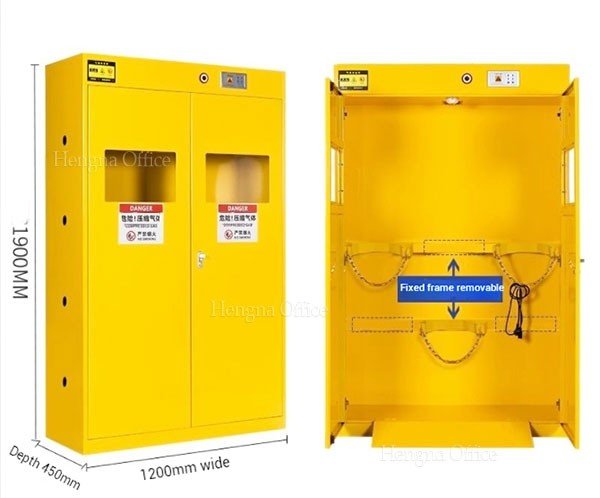
The table below is the short version of what can share a box. It applies to storage, not to bottles connected to a manifold in active use.
| Pair | Same cabinet | Why |
|---|---|---|
| Oxygen + acetylene | No | Oxidizer with fuel gas. 20 feet or a barrier, no exception. |
| Oxygen + propane | No | Propane is a fuel gas. Same rule applies. |
| Oxygen + nitrogen or argon | Yes | Inert gas does not react with oxygen. Keep oil and grease out. |
| Acetylene + propane | Usually | Both are fuel gases. Ventilation and valve-up storage still apply. |
| Acetylene + nitrogen | Usually | No reaction between them, but check what your gas supplier and local authority expect. |
| Any gas + empty cylinder | Treat as full | An empty cylinder still holds gas and pressure. |
The detail that gets missed: acetylene stands valve-up
1910.253(b)(3)(ii) says it in one line — acetylene cylinders shall be stored valve end up.
The reason is inside the bottle. Acetylene is dissolved in acetone held in a porous mass. Lay the cylinder on its side and acetone can migrate into the valve and the hose. At best the gas quality drops. At worst you get a solvent slug in a line that was designed for gas.
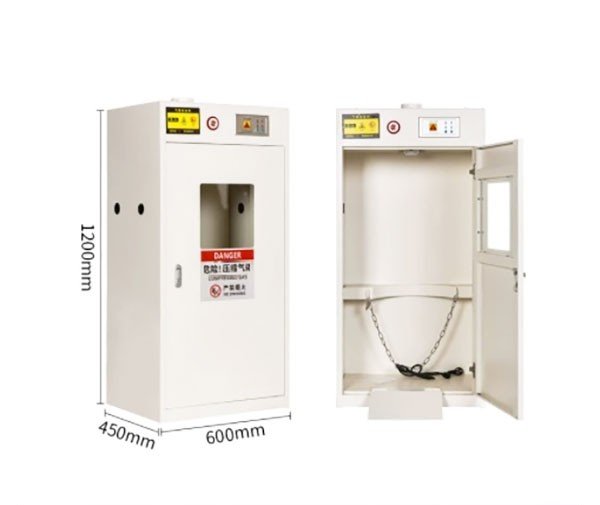
This matters when you choose the cabinet. A cabinet sized for 800mm bottles will not take a 1900mm acetylene cylinder standing upright. Height, not width, is the first dimension to check — and the reason tall single and multi-bottle lockers exist in the first place.
What actually gets cited
These are published enforcement cases, not hypotheticals. The pattern matters more than the fine.
| Year | What the inspector found | How it was handled |
|---|---|---|
| 2024 | Four 100 lb oxygen cylinders and three 50 lb acetylene cylinders stored about 10.5 feet apart. The requirement is 20 feet. | Cited as a serious violation. Corrected on site. |
| 2020 | Oxygen cylinders stored alongside acetylene and propane. Repeat violation at the same site. | Cited as a repeat violation, which carries a higher penalty band. |
Both cases involved bottles that were sitting still, not being used. Neither involved a fire. The violation was the arrangement itself.
Frequently asked
Can I build one cabinet with a divider inside?
Only if the divider is noncombustible, at least 5 feet high, rated 30 minutes, and closes the gap completely. By the time you build that inside a cabinet, you have built two cabinets with a shared outer skin. It is usually cheaper and simpler to buy two.
Do empty cylinders count?
Yes. An empty cylinder still contains gas and pressure. Inspectors treat empties the same as fulls unless they are valve-closed, capped, and marked empty.
Is the 20 feet measured from the cabinet or the cylinders?
From the stored cylinders. Putting each gas in its own cabinet does not reduce the distance requirement if the two cabinets sit side by side.
What if they are only together while I am working?
Bottles in active use on a cart follow the operating rules, and those still require separation or a barrier. Storage rules apply the moment the torch is off.
Does a ventilated cabinet change anything?
Ventilation reduces gas accumulation inside the cabinet. It does not replace the separation requirement. You still need 20 feet or a barrier.
Working out what to order
Four numbers decide the layout: which gases, how many cylinders of each, the standing height of the tallest cylinder, and how much clear floor you actually have.
Send us those four and we will tell you what to order — and just as often, what not to order. If your list includes oxygen and acetylene, the answer will be two separate positions, and we will say so before you spend money on a cabinet that cannot legally hold both.
For the cabinet side, see how a double-cylinder gas cabinet is configured, the 1900mm three-cylinder locker for tall bottles, and the ventilated single-bottle cabinet for labs that need airflow.