Two bottles on the same shelf. That is all it takes.
Nothing happens for weeks. Then a cap fails, the acid runs along the shelf, and the room fills with a yellow-green gas nobody ordered.
That gas is chlorine. It comes from nitric acid meeting hydrochloric acid — the same reaction that produces aqua regia, the mixture that dissolves gold.
So can the two acids share a cabinet? Yes. In the same cabinet, on separate trays, each bottle in its own secondary containment. Get that wrong and you have built a slow-release gas generator with a door on it.
Why the advice you find online contradicts itself
Search this question and you get two answers. One says never store oxidizing acids with other acids. The other says both belong in a corrosive cabinet, so put them together.
Both are half right, which is why so many labs get it wrong in opposite directions.
Nitric acid is an oxidizing acid. It gives up oxygen readily, and it will attack organic material, paper, wood, and other acids. Hydrochloric acid is a volatile mineral acid. Put them in the same tray and a spill mixes them. You do not need a fire for this. A cracked bottle and a tilted shelf are enough.
The reaction produces nitrosyl chloride and chlorine. Both attack the lungs. Chlorine is heavier than air, so it settles at bench height and in low corners. If the cabinet sits in a closed room, the concentration builds instead of clearing.
The rule that actually governs storage: same cabinet, separate trays
Standard EHS guidance allows nitric and hydrochloric acid in the same corrosive storage cabinet, provided each sits in its own secondary containment — a drip tray, a tub, a deep pan.
The reason is simple. A cabinet is a box, not a barrier. Vapors mix inside it. Liquids pool on the same shelf. What keeps two acids apart after a spill is a physical wall between them, and the tray is that wall.
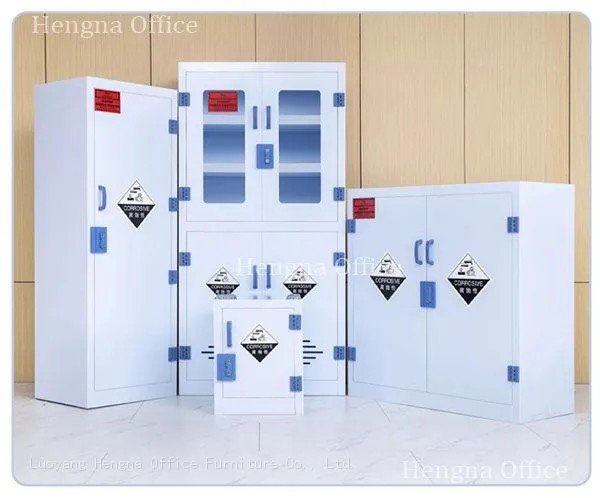
Three conditions make one cabinet acceptable:
- Separate trays per acid group. One tray for nitric, one for hydrochloric and its compatible neighbours. Never one tray for both.
- Trays that hold the full volume of the largest bottle. A tray that overflows on a one-litre spill is decoration, not containment.
- Polypropylene or high-density polyethylene. Metal trays corrode. Stainless steel is not a corrosion barrier for nitric acid, whatever the sales sheet says.
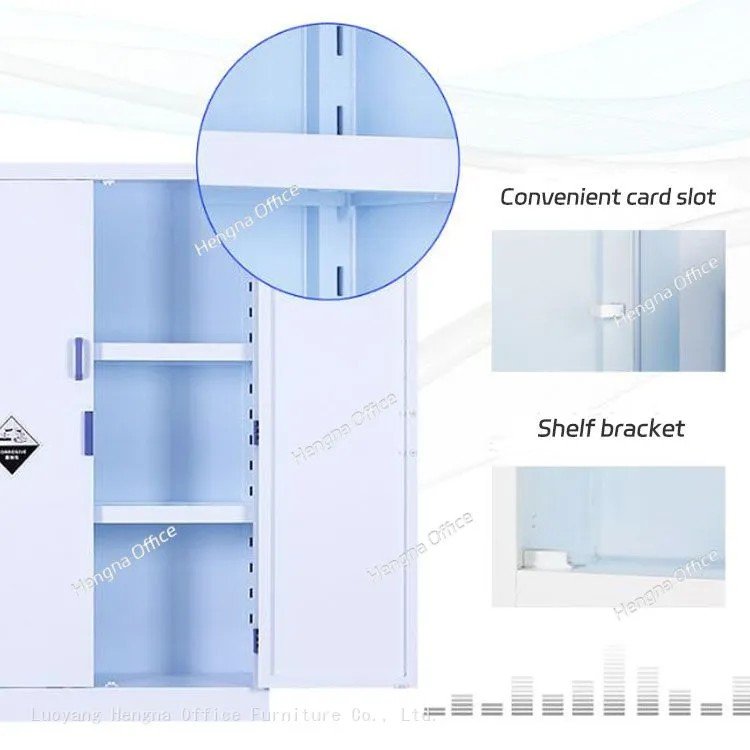
If the cabinet itself is polypropylene, you are ahead on the cabinet body but still need the trays. A PP cabinet slows corrosion. It does not stop two spilled acids from finding each other on the shelf floor. What the PP body itself does and does not tolerate is a separate question, covered in which chemicals a polypropylene acid cabinet can take.
Which acids can share a tray
Group them by behaviour, not by name. The table below follows the pattern most university EHS plans use.
| Acid | Behaviour | Tray rule |
|---|---|---|
| Nitric acid | Strong oxidizer | Own tray, always. No exceptions. |
| Hydrochloric acid | Volatile mineral acid, not an oxidizer | Can share a tray with phosphoric acid and dilute sulfuric |
| Sulfuric acid, concentrated | Oxidizing when concentrated, generates heat on dilution | Own tray in most EHS plans |
| Acetic acid, 80% and above | Flammable | Flammable cabinet, not the acid cabinet |
| Perchloric acid | Very strong oxidizer | Dedicated cabinet. No wood, no paper, no organics. |
| Hydrofluoric acid | Acute toxin | Own containment, restricted access, trained staff only |
One line in that table catches people out. Glacial acetic acid is an acid by name and a flammable liquid by behaviour. Stored with hydrochloric it does two jobs badly: it corrodes the cabinet and it adds a fuel load next to an oxidizer.
Choosing the tray: the two numbers that matter
Most people buy a tray that looks the right size. Two numbers decide whether it works.
| Specification | What it means in practice |
|---|---|
| Material | Polypropylene or HDPE. Both resist nitric, hydrochloric and sulfuric. Metal and ABS are out. |
| Capacity | Full contents of the largest container, or 10% of the total volume stored in that tray, whichever is larger. |
| Depth | Deep enough that a second bottle leaking beside the first does not push liquid over the rim. |
| Base | Flat, with no gap underneath. Liquid that runs under a tray is liquid outside containment. |
The capacity rule is the one people skip. A 2.5-litre bottle in a 3-litre tray looks fine until the 2.5-litre bottle next to it also leaks. Then the tray holds 3 litres and the shelf holds the rest.
If you are working out how many trays a cabinet needs, count bottles, not acid types. Two hydrochloric bottles need a tray sized for both, or two trays.
When one cabinet is not enough
Sharing works up to a point. Past it, you need separate cabinets, and no amount of tray discipline fixes it.
- The volume exceeds the cabinet. If the trays cannot hold everything, the excess is not stored, it is parked.
- Nitric acid is opened daily in quantity. Volatile acids release fumes continuously. A dedicated or vented cabinet keeps those fumes away from everything else.
- Perchloric acid is in the building. It goes in its own cabinet, away from organic material of any kind. Wood shelving and paper labels are fuel to it.
- Hydrofluoric acid is in use. Separate containment, restricted access, and calcium gluconate on hand. This one is not a storage question, it is an emergency response question.
Six mistakes that pass a walk-through and fail in practice
- Two acids sharing one tray because “they are both acids”.
- A tray shallower than the largest bottle it holds.
- Metal or stainless trays inside a polypropylene cabinet.
- Acetic acid filed under acids instead of flammables.
- Bottles standing directly on the shelf with no tray at all.
- A cabinet pushed into a sealed corner where fumes accumulate instead of dispersing.
None of these show up on a visual inspection. They show up after a spill, or when an auditor asks to see the secondary containment under each bottle.
Frequently asked
Can they sit on the same shelf if both bottles are sealed?
No. The rule exists for the moment a seal fails, not for the days it holds. Sealed bottles are also not identical bottles — a cap that survived a year of hydrochloric acid may not survive the same year of nitric.
Does a fume hood change the rule?
It changes where the fumes go. It does not change what happens when a bottle tips over. Trays are still required.
The cabinet has only one shelf. What then?
Split the shelf with two trays, not one. A single large tray under both acids defeats the purpose — that is exactly the shared pool you are trying to avoid.
Does nitric acid need a vented cabinet?
It degrades and releases fumes even when sealed, and it attacks the metal fittings inside cabinets not built for it. Many EHS plans require either a dedicated cabinet or mechanical ventilation for nitric. Check what your local authority expects before you buy.
Can acids and bases share a cabinet?
No. Not in separate trays, not on separate shelves. Acids and bases neutralise violently and generate heat. They belong in separate cabinets, full stop.
What this means when you are buying the cabinet
The cabinet is the easy part. The tray configuration is what decides whether the setup passes or fails.
Before you order, know three things: which acids you actually store, the largest single container size, and whether any of them are opened daily. Those three answers determine cabinet capacity, tray count, and whether you need a vented model.
If you send us the chemical list and the bottle sizes, we will come back with a tray and shelf layout that fits the cabinet — usually within 24 hours. If your list includes an oxidizer like nitric, we will tell you plainly whether one cabinet is enough or whether you need two.
For the material side of the decision, see what five years of PP versus steel storage actually looks like. If your current cabinet is steel and already showing rust at the seams, this is how to tell when it is time to replace it.