
 Email:sarahhnl@atoolcabinet.com
The Problem with Unsecured Gas Cylinders
A full gas cylinder carries enough energy to level a small building if it fails. Acetylene, hydrogen, and propane are not “handle carefully” materials; they are explosion hazards that demand containment, ventilation, and secure anchoring. Yet in many welding shops and labs, cylinders sit in open corners with nothing between them and the nearest ignition source except a chain and a warning sign.
A dedicated gas cylinder cabinet changes that picture. This 3-cylinder unit from Hengna Office Furniture holds three standard cylinders up to 1.7m tall, locks them in place, vents the interior, and sounds the alarm the moment gas escapes. It is built for welding shops, laboratories, and industrial plants where compressed gases are part of the daily routine.
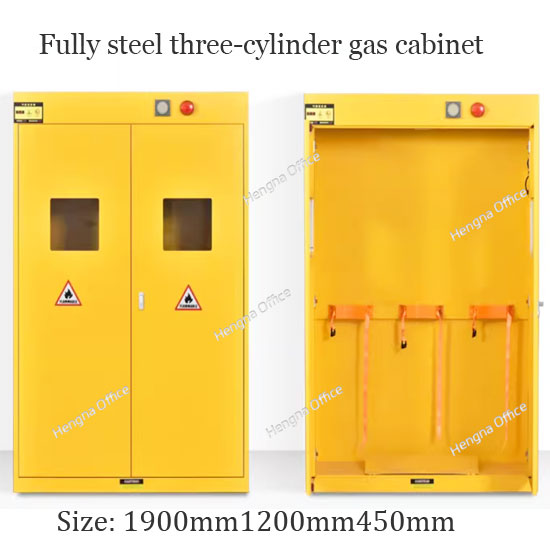
Built Around Three Cylinders
The cabinet measures 1900(H) 脳 1200(W) 脳 450(D) mm, sized for three standard cylinders standing side by side. The 450mm depth gives clearance for regulators and valves, so you are not fighting the cabinet every time you swap a cylinder.
Construction is 1.2mm cold-rolled steel with a 60渭m epoxy coating, finished in OSHA-alert yellow (RAL 1023). The color is not decoration; it tells everyone in the building that this enclosure holds hazardous gas, matching the same visual language as flammable storage cabinets.
What holds the cylinders in place:
- Aircraft-grade alloy buckles secure each cylinder vertically
- Two detachable anti-tip straps anchor tanks to the cabinet frame
- A 3-point door latch seals the front and keeps the door rigid under load
Cylinders do not move during normal use, during forklift traffic, or in the event of an earthquake. That anchoring is the difference between a cabinet and a metal box.
The Leak Alarm: The Feature That Pays for the Cabinet
Gas leaks are invisible. A slow leak from a valve seat fills a room with a flammable mixture long before anyone smells it, and by then the concentration may already be inside the ignition range.
This cabinet is equipped with a gas leak alarm that samples the air continuously. It detects methane, carbon monoxide, propane, butylene, butane, hydrogen, and LPG-type gases, and responds within 20 seconds of reaching the alarm threshold:
- Audible and visual alarm sounds on the cabinet
- Built-in exhaust activates automatically to pull gas out of the enclosure
- The alarm can be wired to an external exhaust fan or a solenoid valve for remote shutoff
The sensor connects to the cabinet through left and right duct ports, which also serve as pass-throughs for gas supply lines. A ventilated enclosure with an active alarm is the difference between a leak that gets caught at 20 seconds and a leak that builds all night.

Designed for Daily Cylinder Handling
Swapping cylinders is a two-person job on a good day. The cabinet includes a galvanized adjustable foot platform, so a cylinder can be rolled onto the platform and lifted into position instead of dragged across the floor. The platform is slip-resistant and easy to clean.
Inside, a phosphated cylinder base and heavy-duty metal chain straps keep each tank located. The front panel includes an explosion-proof glass viewing window, so staff can check regulators and valve positions without opening the door and exposing themselves to whatever is inside.
Where Three Cylinders Earn Their Keep
Welding and fabrication shops
The classic pairing: acetylene and oxygen, with argon for TIG work. Keeping the three side by side in one locked, ventilated cabinet puts the whole gas supply in one place, clearly marked, away from sparks.
Laboratories
Hydrogen and nitrogen are common in analytical labs. A locked cabinet keeps cylinders out of corridors and away from student traffic, and the alarm gives early warning before hydrogen concentration approaches a dangerous level.
Manufacturing plants
Argon and CO2 for shielding gas, plus a spare, stored at the line. The RAL 1023 yellow finish and alarm tie into plant safety signage, and the lock prevents unauthorized cylinder handling during off shifts.
What This Cabinet Is Not
It is not a fire-rated flammable storage cabinet, and it should not be used as one. If you also store flammable liquids, those belong in a double-wall steel safety cabinet with a 10-minute fire rating. Gas cylinders and flammable liquids have different hazards and different containment requirements; a facility that handles both should run both cabinet types.
FAQ
How many cylinders fit? Three standard cylinders up to 1.7m tall. The 450mm depth clears most regulators and valve assemblies.
What gases does the alarm detect? Methane, carbon monoxide, propane, butylene, butane, hydrogen, and similar combustible gases. Response time is under 20 seconds.
Does the alarm need wiring? The alarm runs on the cabinet’s power supply. It has terminals to connect an external exhaust fan or solenoid valve for automatic ventilation and shutoff.
Can the cabinet be anchored to the floor? Yes. The frame includes anchor points for floor bolting, and the anti-tip straps secure the cylinders themselves.
Do you make single- and double-cylinder versions? Yes. The same construction and alarm package is available in 1-, 2-, and 3-cylinder configurations. Custom colors and gas detection configurations are available on OEM orders.
Cylinders that are chained to a wall are not safely stored. If your facility handles compressed gas daily, the 3-cylinder cabinet with leak alarm is the upgrade that pays for itself the first time the sensor catches a leak. Contact Hengna Office Furniture for specifications, pricing, and lead times.