A lab manager sends the same question every few weeks. The used acetone goes back into the cabinet it came out of — same yellow box, same shelf, same bottle style. That has to be fine, right?
The cabinet is fine. The rules around it are not the same ones.
The moment solvent becomes waste, three things change: how much of it can sit next to the bench, how the containers have to be marked, and what may share a shelf. None of that has anything to do with the steel. All of it is what an inspector checks first.
The cabinet follows fire code. The waste follows a different code.
Two sets of rules touch the same cabinet, and most buyers learn the first one and stop there.
The first is fire code. OSHA 1910.106 and NFPA 30 describe how a flammable cabinet has to be built — double wall, 18-gauge steel, three-point latch, 2-inch sill — where it may stand, and how much liquid one fire area can hold. That rule set exists to stop a fire from starting or spreading. The full checklist is in what OSHA 1910.106 and NFPA 30 actually require.
The second is waste regulation. In the US that means RCRA, and the section that applies here is 40 CFR 262.15 — the rule for a satellite accumulation area, which is the container sitting near the point where the waste is generated.
262.15 does not care what colour the cabinet is. It cares about volume, container condition, closure, and labels.
| Fresh solvent | Spent solvent | |
|---|---|---|
| What governs it | OSHA 1910.106 / NFPA 30 | 40 CFR 262.15 (RCRA) |
| What it limits | How the cabinet is built, where it stands, gallons per fire area | Gallons per generation point, container condition, labeling |
| Time limit | None | None below 55 gallons; three days once the limit is passed |
| Who checks | Fire marshal | Environmental inspector |
The 55-gallon ceiling
40 CFR 262.15(a) allows up to 55 gallons of non-acute hazardous waste at or near each point of generation. For acute hazardous waste the number drops hard: one quart of liquid, or one kilogram of solid.
Cross that line and the clock starts. The excess has to leave the area within three consecutive calendar days, and the container gets dated with the day the limit was passed.
One detail catches most people out: below 55 gallons there is no accumulation time limit at all. A container of spent solvent can sit by the bench for a year, as long as it stays closed, labeled, and under the ceiling. The deadline only exists above the limit.
What 55 gallons looks like in practice:
| Container | How many fit in 55 gallons |
|---|---|
| 4 L glass bottle | about 52 |
| 20 L plastic jerry can | about 10 |
| 55-gallon drum | exactly one |
That last row changes purchase decisions. A lab collecting into a single 55-gallon drum hits the ceiling the day the drum is full, and everything after that is a three-day scramble. Collecting into 20-litre containers gives the same total volume with room to move.
Three things that change inside the cabinet
Every container gets labeled. The words “Hazardous Waste,” plus an indication of the hazard — ignitable, corrosive, reactive, or toxic. A bottle marked “waste acetone” and nothing else is not compliant. Neither is an original reagent label with the old contents crossed out.
Containers stay closed. The rule requires the container closed except when waste is being added or removed. A funnel left sitting in a bottle is one of the most common findings in a lab inspection.
Incompatible waste does not share a container or a shelf. The regulation points to Appendix V of Part 265 for the list. In practice: acid waste and caustic waste do not sit in the same tray, and neither do oxidizers and solvents.
Why the cabinet still matters
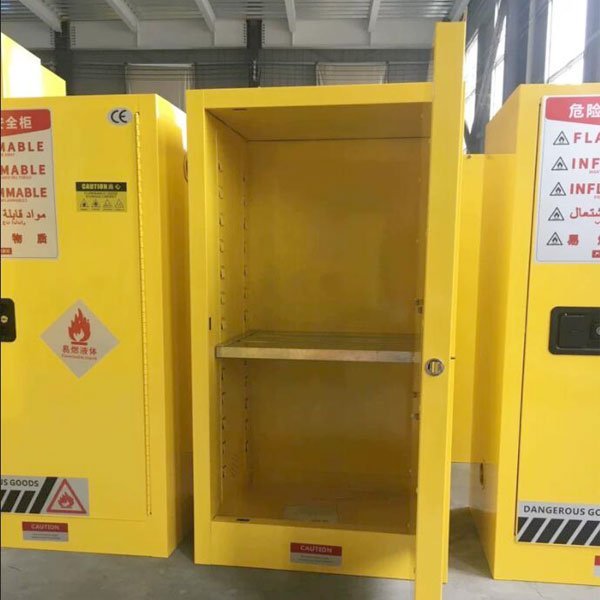
None of the above is a reason to skip the cabinet. The cabinet is there for the fire risk, and waste carries more of that risk than fresh reagent does — a half-empty bottle has vapour space above the liquid, and vapour is what ignites.
What to check on the cabinet itself, if it is going to hold waste:
- Sill depth. The raised sill is the spill dam. Measure it against the largest container on the bottom shelf, not against the cabinet’s gallon rating.
- Shelf load. A full 20-litre container is around 25 kg. Three per shelf is 75 kg, and most cabinets are rated well above that — but check the number rather than assume it.
- Grounding. Pouring solvent from one container into another builds static. The grounding lug exists for that and has to be connected, not just present.
- Locking. A waste cabinet anyone can open collects everything the lab wants gone. A three-point latch with a padlock is the minimum.
PP or steel? Decide by what is in the waste
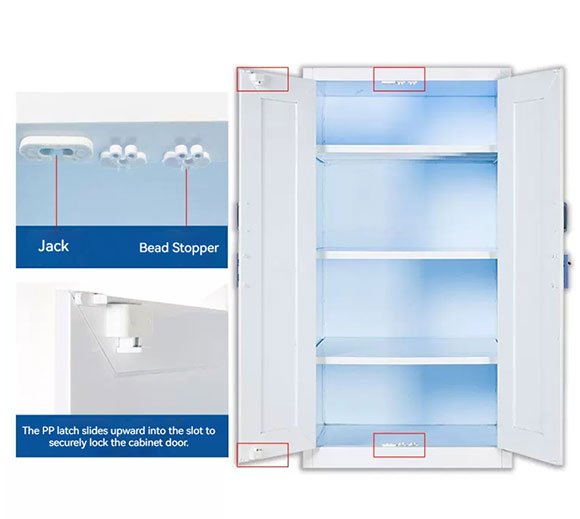
The rule of thumb is short. If the waste is corrosive, polypropylene. If the waste is flammable, steel.
Waste acid, waste caustic, spent developer, spent fixer — these eat the coating off a steel cabinet and then go after the steel. The vapour is heavier than air, so it pools at the base and attacks the sill first. A welded polypropylene cabinet does not have that problem. What five years does to a steel acid cabinet is worth reading before choosing steel for corrosive waste, and which chemicals a PP cabinet can actually hold is the other half of the decision.
Flammable waste is the opposite case. Acetone, toluene, hexane, xylene — these need the double wall and the fire rating. Polypropylene does not burn slowly, it melts, and a melted cabinet leaves an open pool of solvent on the floor.
The mistake turns up in labs that consolidate everything into one cabinet “because it is all waste.” A PP acid cabinet holding waste acetone is a fire risk with no fire protection around it.
Halogenated and non-halogenated do not share a drum
Spent dichloromethane or trichloroethylene poured into a drum of ordinary solvent turns the whole drum into halogenated waste. Disposal cost roughly doubles, some haulers will not take the mix, and in several jurisdictions the mixture moves to a different waste code entirely.
Two options: separate containers in separate trays, or two cabinets. The second is usually cheaper than one shipment of mixed halogenated waste, which is the argument that settles it in most budget meetings.
Quick answers
Can waste and fresh chemicals share one cabinet? Not recommended. The 55-gallon count gets murky, the labels get confusing, and nobody can tell which bottle is which at a glance. If floor space is the constraint, a 12- or 22-gallon cabinet dedicated to waste costs less than the argument does.
Does a waste cabinet need venting? No. Vent bungs stay sealed on a flammable cabinet during normal use, and opening them defeats the fire rating. Flammable versus explosion-proof cabinets covers the cases where ventilation is genuinely required.
How full should the containers be? Leave roughly 10 percent headspace. Solvent expands with temperature, and a bottle filled to the neck pushes liquid through the cap in a warm room.
What size for a small lab? 12 or 22 gallons. The 55-gallon ceiling arrives before the cabinet fills, and a small cabinet emptied on schedule beats a large one that turns into a storage problem. Sizing between 22, 30, and 45 gallons explains where the break points sit.
Size the cabinet around the waste stream
Tell us what the waste is — solvent type, container size, litres per week — and the cabinet size follows from that, not from a catalogue page. HNJUNTUO supplies flammable and polypropylene cabinets from 4 to 110 gallons, and sizing questions come back within 24 hours.
If the waste stream is mixed, say so. It usually is, and it usually means two cabinets rather than one.