
Lead Section
Flammable paint and solvent storage built for auto body shops, industrial coating lines, and furniture finishing rooms. 110-gallon capacity, constructed to FM certification standards, shipped factory direct.
Why Paint Shop Solvent Storage Keeps Failing Inspections
Small shops get away with stacking paint cans in a corner. Once you’re running through thinners, activators, primers, and topcoats every day — that corner becomes a code violation waiting to happen.
Paint solvents give off vapor that’s heavier than air. It pools along the floor. One motor spark, one metal-on-metal impact, one static discharge from someone walking across the room — that invisible vapor layer is all it takes.
NFPA and OSHA don’t leave this to guesswork. Flammable liquids in spray booth environments must go into a rated storage cabinet. Not on the floor, not on a shelf, not in a metal locker from the hardware store.
This 110-gallon cabinet was built to solve that exact problem.
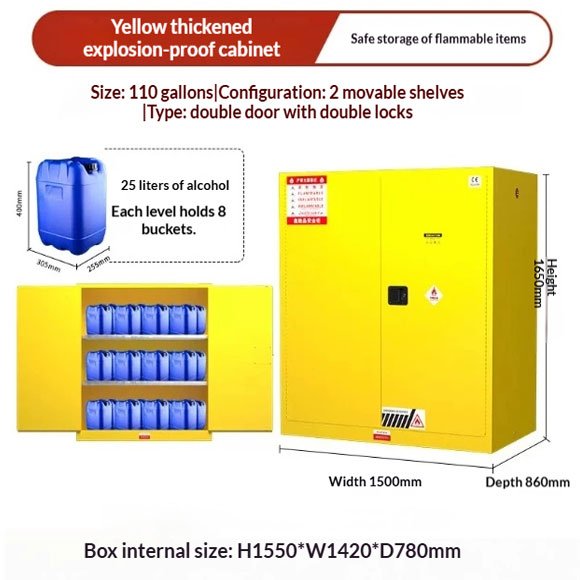
110 Gallon Paint & Solvent Cabinet for Paint Shops Specifications
| Parameter | Value |
|---|---|
| Model | HNJL-110 |
| Capacity | 110 gallons (~416 liters) |
| External (W×D×H) | 1650 × 860 × 1650 mm |
| Internal (W×D×H) | 1490 × 700 × 1420 mm |
| Body material | Cold-rolled steel, double-wall welded |
| Insulation layer | 38 mm fireproof insulation |
| Shelves | 2 adjustable, 250 kg capacity each |
| Empty weight | ~185 kg |
| Operating temp | -20°C to +60°C |
| Ground resistance | ≤ 4 Ω |
| Finish | Epoxy powder coating, safety yellow |
| Standards met | Built to FM certification standards / OSHA 29 CFR 1910.106 compliant / NFPA 30 design requirements |
4 Design Details That Matter in a Paint Shop
1. Double-wall steel with 38 mm fire insulation — 30+ minutes of passive fire protection
Two layers of cold-rolled steel sandwiching 38 mm of fire insulation, fully welded. If a fire breaks out in the shop, the cabinet keeps internal temperature within safe limits for 30+ minutes. Most fire departments respond in 15 to 20 minutes. That window is enough.
2. Built-in grounding lug — the ignition source most shops forget
Paint and solvents build up static charge during pouring and transferring. An ungrounded cabinet means opening the door can generate a spark — right where solvent vapors collect. This cabinet has an internal grounding stud and grounding cable clip, with resistance below 4 ohms. Bolt it to the shop’s grounding system during installation.
Cheap cabinets skip this. OSHA 29 CFR 1910.106 doesn’t.
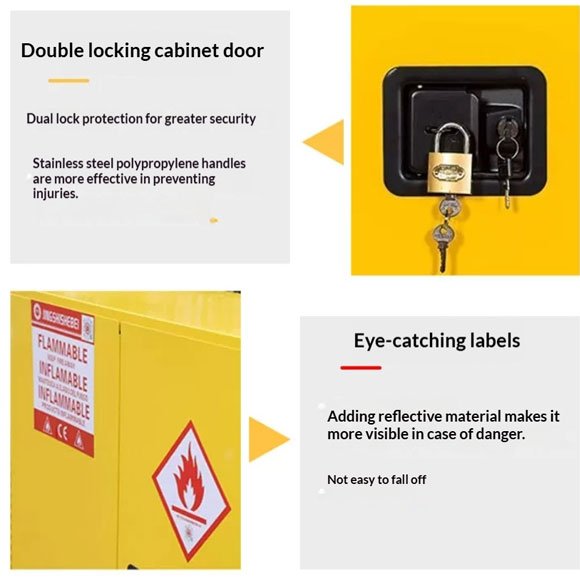
3. Dual adjustable vents with flame arrestors — for high-evaporation solvents
When you’re storing lacquer thinner, reducer, or fast-cure activators, vapor output is way higher than standard paint. Vents on both sides with stainless steel flame arrestor screens, opening adjustable. For high-volatility solvents, open vents fully and route to the shop’s exhaust system. Keeps vapor below the lower explosive limit (LEL).
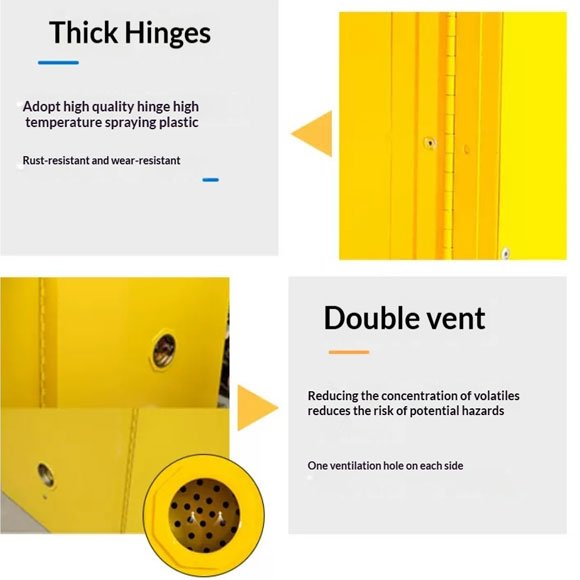
4. Three-point lock with spill containment sump — leak control that matters for insurance
Three locking bolts engage at once when the door closes. If a can gets punctured or a lid isn’t tightened, the bottom sump catches the leak. It stays inside the cabinet, off the shop floor. This also matters for insurance — documented spill containment can lower your premium.
What Goes In This Cabinet
- Paints: automotive finish, industrial coating, wood lacquer, floor epoxy
- Thinners & reducers: lacquer thinner, naphtha, toluene, xylene
- Activators: two-component paint activators, epoxy hardeners (containers must be sealed)
- Cleanup solvents: acetone, IPA, MEK, gun wash
- Oils: mineral spirits, white spirit, rust preventive oil
Do not store: explosives, strong oxidizing acids (nitric, sulfuric), compressed gas cylinders, or radioactive materials. Those need dedicated storage built for those hazards.
Who Uses This Cabinet
Auto body & paint shops Multiple paint lines, different container sizes, constant turnover. 110 gallons holds a full batch of materials, and adjustable shelves fit everything from quart cans to 5-gallon pails. When the fire inspector walks in, this cabinet speaks for itself.
Industrial coating facilities Bulk thinners and coatings arrive in drums. You need a staging area that’s code-compliant. Double-wall construction, grounding, ventilation — this cabinet checks every box on an EHS auditor’s list.
Furniture manufacturing Wood lacquers and PU finishes are no less regulated than automotive paint. Spray areas are often adjacent to woodshop zones — dust plus flammable liquids means a rated storage cabinet isn’t optional, it’s the entry requirement.
Standards Compliance
This cabinet is manufactured to Factory Mutual (FM) certification standards. Cabinet structure, insulation thickness, ventilation, and locking systems all follow FM technical specifications.
It also meets the full requirements of OSHA 29 CFR 1910.106 for flammable liquid storage cabinets — fire resistance rating, static grounding, ventilation, and labeling.
Construction complies with NFPA 30 (National Fire Protection Association) design requirements for flammable and combustible liquid storage equipment.
Compliance documentation is available on request.
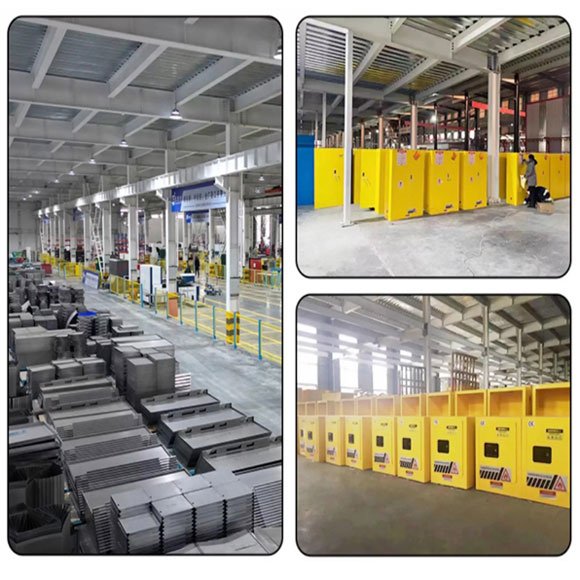
Shipped Direct From the Factory
No distributor in between. Every unit goes through three tests before it ships — seal integrity, lock function, ground resistance. Test reports travel with the cabinet.
OEM options: custom colors, dimensions, and labeling for chains and corporate accounts with standardized procurement specs.