
Quick answer: A chemical resistant lab bench pairs a non-reactive worktop — solid phenolic resin, epoxy resin, 304 or 316 stainless steel, or welded polypropylene — with a protected steel frame. The worktop absorbs the abuse from acids, alkalis and solvents; the frame stays dry under a sealed coating. General chemistry labs do well with a phenolic top. Daily strong corrosives call for PP or 316 stainless.
Spilled sulfuric acid should not end a worktop’s life. Yet in many labs, a bench that handles glassware and daily experiments starts swelling at the edges within a year. The failure is rarely the steel frame. It is the surface. A chemical resistant lab bench is specified from the top down: worktop material first, then frame protection, then the seals around every opening. This page explains how our factory builds them and how to pick the right combination for your lab.
What Is a Chemical Resistant Lab Bench?
A chemical resistant lab bench is a laboratory workbench built to withstand acids, alkalis, solvents and stains without swelling, blistering or corroding. It combines three protections: a non-reactive worktop, a powder-coated or stainless steel frame, and sealed joints around sinks and reagent outlets. It is standard equipment in chemistry teaching labs, quality control labs and industrial testing stations.
Where the Chemical Resistance Comes From
The worktop does the heavy lifting
Solid phenolic resin worktops come in 12.7mm, 16mm and 19mm thicknesses. The material resists acids, alkalis and impact, and the panels carry an E1 formaldehyde rating. Edges are sealed with PVC banding so liquids cannot wick into the core. For labs that need more heat and solvent headroom, epoxy resin worktops are available on request.
The frame stays dry
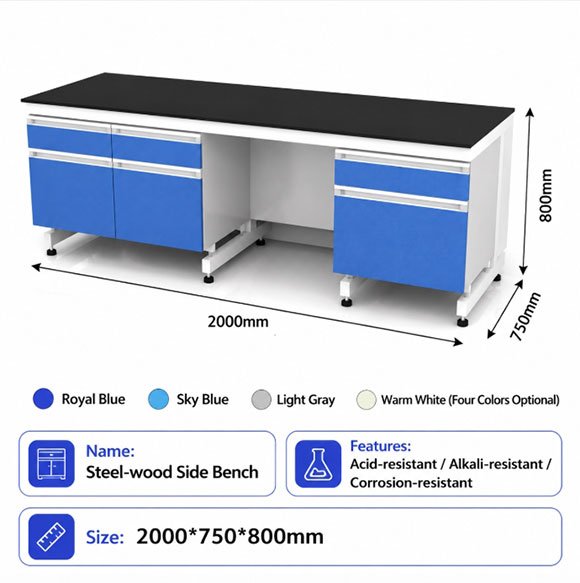
Cabinet bodies are made from 1.0mm, 1.2mm or 1.5mm cold-rolled steel with electrostatic powder coating cured at high temperature. Our steel-wood line uses 40 by 60 by 1.2mm galvanized steel tubes, welded into a frame and finished with epoxy powder coating. The coating is the frame’s rust shield, which is why coating thickness matters as much as steel thickness.
Sealed openings finish the job
Sink cutouts and reagent outlets are the weak points on any bench. We seal them at assembly, and a welded polypropylene sink is available so drain water never meets coated steel.
Worktop Options: Four Materials Compared
Solid phenolic resin is the default choice for chemistry teaching and testing labs. It handles acids, alkalis and impact at a reasonable cost, which is why it appears on most of the benches we ship.
Epoxy resin worktops add headroom for solvents and hot equipment. Labs that regularly set hot plates or solvent baths on the surface tend to pick epoxy.
Stainless steel worktops in 304 or 316 serve two cases: frequent washing and hygiene-first rooms, and chloride-heavy environments where 316 holds up better.
Welded polypropylene is the strongest defense. The 8mm pure PP sheets are joined with same-color welding rods, so the finished surface has no glued joints to peel, and the material handles strong acids and alkalis up to about 100 degrees Celsius. Above that temperature limit, discuss the application with us first.
Frame Options: All-Steel, Steel-Wood, All-Wood or PP Cabinet
The cabinet body is where the price and the durability trade off. All-steel cabinets use cold-rolled steel with powder coating and are the mainstream pick for corrosive environments. Steel-wood cabinets pair an 18mm E1 melamine-faced particleboard body with PVC waterproof banding and a welded frame of 40 by 60 by 1.2mm galvanized steel tube finished in epoxy powder coating, which keeps the cost down while the frame still resists rust. All-wood cabinets suit dry, low-risk rooms on tight budgets. Full PP cabinets with 8mm welded sheets are reserved for the harshest chemical work. Tell us the chemicals and the budget, and the choice usually makes itself.
Standard Sizes and Layouts
Bench lengths run from 1000mm to 4500mm, in steps of 1000, 1200, 1500, 1800, 2000, 2400, 3000, 3600 and 4500mm. Depth is 750mm. Height is 800mm or 850mm. Longer runs are assembled by joining modular cabinet units, so a 4500mm bench ships as sections and lines up on site.
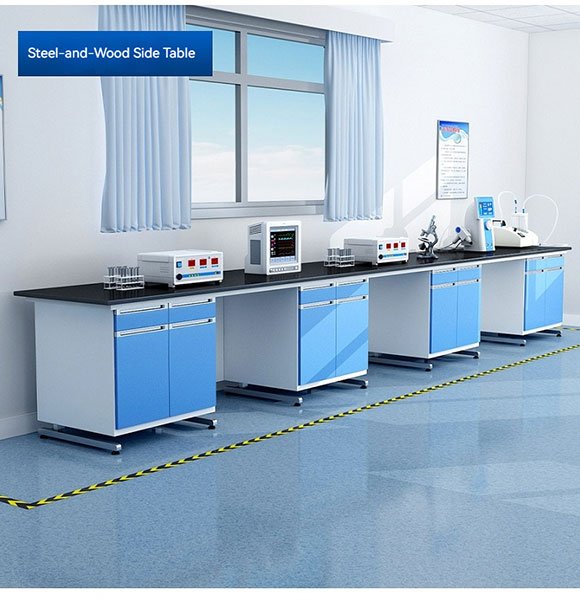
Four layouts cover most floor plans: island benches for open labs, wall benches along a single wall, peninsula benches for shared access, and mobile benches on locking casters. Cabinet modules start at a 300mm base unit and step up in 25mm increments, with optional wall cabinets, drawer units, sink units and reagent racks.
Utilities and Accessories: What Can Go Into the Run
Each bench run is assembled from cabinet modules, so utilities slot in where you need them. Common additions include reagent racks over the worktop, sink units with polypropylene basins, drawer packs, wall cabinets, keyboard trays, and blind base modules that carry service connections. Because the modules step in 25mm increments, the run can absorb odd wall lengths without custom shells. Adjust the 8mm nylon feet through a 15mm range to level the run on uneven floors, and the worktop splice lines stay tight.
Frame and Construction Details
The production line is straightforward to describe. Laser cutting for the flat patterns, CNC bending for the panels, spot welding and argon arc welding for the frames, then automatic powder coating with high-temperature curing. Hardware includes 16-inch silent slides, 115-degree hinges, and 8mm nylon adjustable feet with a 15mm leveling range. Handles are either an aluminum U-shape or a recessed PP pull.
How to Choose: Three Common Configurations
Teaching labs usually take the steel-wood line with a 12.7mm or 16mm phenolic top. It balances budget and durability for student use. Quality control labs step up to all-steel cabinets with a 19mm phenolic worktop and a PP sink. Labs that store and pour strong corrosives daily should move to a welded PP bench or a 316 stainless worktop. Send us the chemical list and the room layout, and we will return a configuration with reasons.
FAQ
Phenolic or epoxy worktop, which is more chemical resistant?
Phenolic handles most acids, alkalis and daily stains, which covers the majority of chemistry labs. Epoxy adds resistance to stronger solvents and higher surface temperatures. If your process includes hot solvent baths, pick epoxy; otherwise phenolic is the better value.
How are the benches packed for shipping?
Knock-down flat packing in wooden crates with foam cushioning. Roughly 30 to 40 benches fill a 20-foot container and 70 to 80 fill a 40-foot container.
Can I order a length beyond 4500mm?
Yes. Benches are modular, so longer runs are built by joining sections with a continuous worktop splice. Tell us the wall length and we will plan the joints.
Related reading: Lab Bench Rusting? 7 Proven Ways to Prevent Rust on Steel Lab Benches in Humid Climates · All-Steel Lab Bench — 304 Stainless Steel Frame & 19mm Phenolic Resin Worktop · Steel Wood Lab Bench — Chemical Resistant Phenolic Resin Top
Need a configuration drawing? Send your room dimensions, the chemical list, and the utilities you need at the bench. The factory returns a layout, a specification, and a quotation from the source.