
Quick answer: Phenolic resin worktops are the default for most labs — they resist acids, alkalis and impact at a reasonable cost, in 12.7mm, 16mm and 19mm thicknesses. Epoxy resin worktops win when solvents, sustained heat and constant moisture dominate: hood-adjacent benches, digestion stations, wash areas. Both pair with the same steel frames, so the decision is the worktop — and it pays to make it once, correctly, because redoing a worktop costs more than the gap between the two materials.
Buyers ask us this every week, and the honest answer depends on what touches the surface. Choose the wrong worktop and it swells, stains or cracks within a year; choose the right one and it outlives the cabinets under it. Here is how the two materials actually behave, from a factory that machines both.
What Phenolic Resin Worktops Handle Well
Solid phenolic resin is a dense composite — the surface color runs through the core, so scratches do not show a white line. Our phenolic tops come in 12.7mm, 16mm and 19mm thicknesses with an E1 formaldehyde rating and PVC edge banding that seals the core from moisture. Against the daily chemistry of a working lab — dilute acids, alkalis, salt solutions, stains and impacts from glassware — phenolic holds up for years.

It is also the lighter and more economical of the two materials, which is why it appears on most of the benches we ship to schools, QC labs and research facilities. For a typical chemistry teaching lab or a quality control bench, phenolic is not the budget compromise — it is the correct specification.
Where Epoxy Resin Wins
Epoxy resin is a cast, homogenous material with broader resistance to solvents and higher sustained temperatures. Three situations justify the upgrade: benches next to fume hoods where solvent splash is routine; digestion and hotplate stations where hot glassware contacts the surface; and wash-down areas that stay wet through the shift. Epoxy shrugs off all three where phenolic would slowly dull, stain or soften at the edges.
The trade-offs: epoxy is heavier, harder to machine on site, and costs more per bench. It is the right material — not a status upgrade.
Side-by-Side: How the Two Surfaces Compare
Acids and alkalis. Both resist the common dilute range. For concentrated oxidizing acids left in contact for long periods, epoxy holds an edge.
Solvents. Epoxy is clearly stronger — acetone, toluene and similar solvents can haze phenolic over time.
Heat. Hot glassware briefly placed: phenolic survives with care, but repeated hotplate contact asks for epoxy.
Impact. Phenolic flexes slightly and resists chipping; epoxy is denser and can chip under sharp impact, though it does not swell.
Moisture. Both have sealed edges (PVC banding on phenolic); epoxy is effectively waterproof through the section, so constant wet zones favor it.
Cost and weight. Phenolic is lighter, easier to ship and install, and friendlier to the budget. Epoxy’s premium buys the chemical and thermal headroom described above.
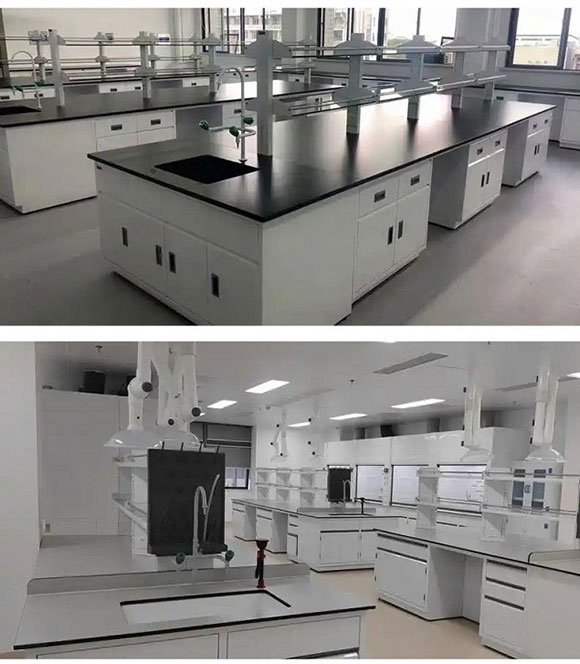
Which One for Which Lab
Teaching and university labs: phenolic — impact resistance and value fit student throughput.
Quality control benches: phenolic for sample prep; move to epoxy at the stations where hot digestion or solvent-heavy testing happens.
R&D and industrial labs: epoxy at hood-adjacent and wash-down positions; phenolic elsewhere.
Extreme corrosives: neither — step up to a welded PP bench or a PP storage cabinet for the strong-acid inventory, and keep phenolic or epoxy for the general benchtop.
How We Build Both
Both worktops mount on the same steel platforms: 1.0mm to 1.5mm cold-rolled steel cabinets with electrostatic powder coating, adjustable shelves and leveling feet. Worktop thickness is specified at order time (12.7mm, 16mm or 19mm phenolic; epoxy in matching thicknesses), edges are PVC-banded, and every batch of panels is checked before crating. Because the frames are identical, a lab can mix — epoxy at the wet positions, phenolic everywhere else — within one bench run.
FAQ
Can phenolic worktops handle hot flasks?
Brief contact with warm glassware is fine with a trivet or rack. Repeated direct contact with hotplate-hot vessels is where epoxy earns its place — or use a hotplate pad either way.
Is epoxy worth the extra cost for a teaching lab?
Usually not. Student labs see dilute reagents and impact, not sustained solvents and heat — phenolic handles that profile at a lower cost. Spend the difference on drawer count or a better frame.
Can I mix phenolic and epoxy in one lab?
Yes, and it is the smart layout: epoxy at hood-adjacent and wash positions, phenolic across the general benches. The steel frames are identical, so the two surfaces line up in one run.
How We Size the Worktop Thickness
Thickness is the second decision after material. 12.7mm is the standard for teaching labs and light QC benches — plenty for daily reagents and glassware. 16mm suits industrial testing benches where heavy equipment sits on the surface. 19mm is the specification for high-traffic labs and any bench carrying sinks, balances or mounted instruments — the extra section stiffness reduces flex across wide spans. All three thicknesses are available in phenolic, and epoxy follows the same logic: choose by load and span, not by habit.
Do the two materials look different?
Yes, noticeably. Phenolic has a colored core with a matte industrial finish — black is the most common in labs. Epoxy is cast in solid black or gray with a denser, stone-like feel and molded edges. If the lab aesthetic matters to your project, ask for samples of both — we ship material swatches with quotations so the decision is made on what you can touch, not on a catalog photo.
Related reading: All-Steel Lab Bench — 304 Stainless Steel Frame & 19mm Phenolic Resin Worktop · Steel Wood Lab Bench — Chemical Resistant Phenolic Resin Top · Lab Bench Rusting? 7 Proven Ways to Prevent Rust on Steel Lab Benches
Send your chemical list and bench layout, and the factory will specify the worktop material in writing — phenolic where it works, epoxy where it must be.