
Quick answer: Six factors move the price of a lab bench: the worktop material and thickness, the steel gauge, the length and configuration, the fittings (sinks, racks, valves), the coating and color, and the order quantity with its shipping mode. A factory-direct quotation prices all six openly — send the chemical list and dimensions and the number comes back in writing.
Most buyers overpay in one of two ways: they over-specify a bench for chemicals it will never touch, or they buy through layers that each add a margin. Both are avoidable. This page breaks down what actually drives the cost of a laboratory bench, from a factory that builds every unit on its own line.
The 6 Factors That Move the Price
1. Worktop material and thickness. A 12.7mm phenolic top is the value baseline. 16mm and 19mm phenolic add section stiffness for heavy loads and wide spans. Epoxy resin adds solvent and heat headroom at a premium. Stainless steel and welded PP sit at the top of the range for special applications — order them only when the chemical list calls for it.
2. Steel gauge. Cabinet bodies run 1.0mm, 1.2mm or 1.5mm cold-rolled steel. The jump from 1.0 to 1.2mm buys deformation resistance for loaded drawers and long spans; 1.5mm is for heavy instrument duty. Matching the gauge to the load avoids paying for strength the lab does not use.
3. Length and configuration. Bench length runs 1000mm to 4500mm in modular steps. Drawer packs, door cabinets and open bays price differently — a drawer-heavy configuration costs more than a door-heavy one of the same length.
4. Fittings. Sink units with polypropylene basins, reagent racks, service valves and power outlets each add cost. Planning utilities at the drawing stage is cheaper than retrofitting later.
5. Coating and color. The standard powder-coated finish is included in the base price. Custom RAL colors are available — they add a finishing step, which adds cost.
6. Quantity and shipping mode. Knock-down (KD) flat packing cuts freight sharply: about 30 to 40 benches fill a 20-foot container and 70 to 80 fill a 40-foot. Fully assembled units ship in lower densities and cost more to move.

Where Labs Overspend
Three common misses: a 19mm epoxy top specified for a teaching lab that only handles dilute reagents; a 1.5mm frame ordered for a bench that carries balances and notebooks; and assembled shipping for a lab that has a technician who can follow a numbered part map. None of these survive a chemical-list-and-load review — which is why we ask for both before quoting.
Why Factory-Direct Changes the Math
Buying factory-direct removes the reseller layer from the price and puts the specification conversation on the same call as the quotation. The coating line, the welding cell and the inspection bench are in one building, so a change to the specification does not restart the process with a third party. It also means the salt spray report, the material certificates and the packing list come from the same source as the bench.
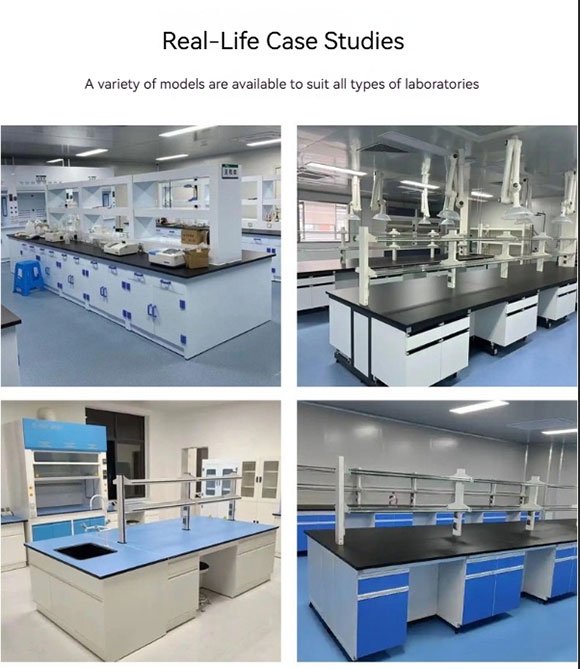
How to Get an Exact Quotation
Three inputs produce a firm number: the room dimensions, the chemical list, and the utilities the bench must carry. Send those and the quotation comes back with the specification in writing — worktop material and thickness, steel gauge, drawer count, fittings and the shipping mode, each priced as a line you can accept or adjust.
FAQ
Is knock-down packing cheaper than fully assembled?
Yes on freight, because flat-packed benches use container space efficiently. Assembly on site follows a numbered part map. If your team cannot assemble, quote fully assembled units and compare the landed totals — the answer varies by destination.
Does a custom length cost much more?
Lengths run in modular steps from 1000mm to 4500mm, so most rooms are covered by standard modules joined on site. True custom lengths are quoted by the drawing — the modular system usually closes the gap without the premium.
What does the quotation include?
The bench specification (worktop, steel gauge, configuration), the fittings list, the packaging mode, and the coating test documentation. No hidden lines added after the fact.
Price Factors Buyers Often Forget
Beyond the six headline factors, three line items surprise buyers at quotation stage. Delivery mode to the final site: flat-pack reaches further for less, but remote sites pay for the last mile. Installation labor: assembling on site with your own team is the economical route; factory-supervised installation is quoted separately. Documentation: tender files and compliance paperwork are prepared with the quotation package when the project needs them — ask at the start so the documents match the build.
Can we phase the order across rooms?
Yes — and it usually saves money. Multi-room labs can phase the build in identical module sets: room one validates the configuration, later rooms repeat it with the same modules and colors. Phasing also spreads freight across quarters instead of one container bill.
Budget logic also differs by lab type. A teaching bench spends its budget on the frame and an impact-resistant worktop — drawers and fittings stay lean. A pharmaceutical QC bench shifts the money into the worktop upgrade and the storage that keeps standards organized. A corrosive-handling lab moves it again into welded PP or stainless surfaces. Same product family, three different specifications — which is why the chemical list, not the catalog, decides the final number.
Can other lab furniture be supplied to match?
Yes — the same line builds matching storage cabinets, shelving and fume hoods, so the bench, the cabinets and the ventilation run share one finish and one supplier. Matching furniture in one quotation usually lands at a better total than mixing suppliers, and the finish matches exactly.
Related reading: GMP Compliant Lab Bench — Phenolic Resin Top for Pharmaceutical QC Labs · All-Steel Lab Bench — 304 Stainless Steel Frame & 19mm Phenolic Resin Worktop · Lab Bench Rusting? 7 Proven Ways to Prevent Rust on Steel Lab Benches
Send the room dimensions, the chemical list and the utility requirements. The factory returns a priced specification you can defend to procurement — line by line.