
 Email:sarahhnl@atoolcabinet.com
The 5-Drawer Answer to Small-Lab Slide Storage
Not every lab needs a wall of storage. A teaching lab, a clinic pathology room, or a small research group typically holds a few thousand slides, not tens of thousands. For those spaces, a full-size archive cabinet is overkill, and a cardboard box is underkill.
The 5-drawer microscope slide cabinet sits exactly in that middle ground. It stores up to 5,080 standard slides in five drawers, takes about a third of a square meter of floor space, and costs a fraction of what a large archive system does. This is the cabinet for labs that need order without needing an archive department.
5,080 Slides in a Compact Column
Each of the five drawers holds 1,300+ slides in vertical slots. The full cabinet stores up to 5,080 slides, which covers most teaching labs for a full academic year and most clinic pathology rooms for several years of routine work.
- 5 drawers, 5,080 slides 鈥?vertical slots keep every slide separated and protected
- 1,300+ slides per drawer 鈥?vertical storage keeps slides separated and edges protected
- Up to 5,080 slides total 鈥?a year of production in one footprint
- 450 脳 480 脳 1600 mm 鈥?fits under a bench, in a corner, or beside a scope station
Slides stand vertically in numbered rows, so finding one does not mean digging through a box. Standard 75脳25mm and 78脳25mm slides fit the slots directly.
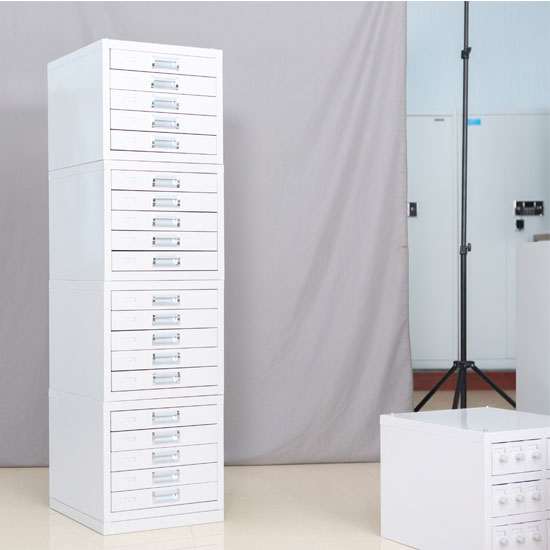
Space That Fits Where Big Cabinets Cannot
The footprint is 450mm deep by 480mm wide, with a height of 1600mm. That profile slides into the gap beside a lab bench, the corner of a prep room, or the end of a corridor cabinet run. For rooms where floor area is measured in centimeters, the difference between this and an 18-drawer unit is the difference between “fits” and “rearrange the room.”
The raised base keeps the cabinet off floor moisture and makes sweeping underneath a non-event. At 1600mm, the top drawer is still comfortably reachable without a step stool for most users.
Cold-Rolled Steel and a Matte White Finish
The cabinet body is cold-rolled steel with a matte white powder finish. The finish does three jobs: it resists the wear of daily drawer use, it does not show fingerprints the way gloss finishes do, and it wipes clean with a damp cloth, which matters in any room where reagents are handled nearby.
Steel construction means the cabinet does not sag, warp, or soften over time. Drawer slides are the wear point in any cabinet, and this one uses smooth-running slides rated for daily opening and closing under full load.
Who This Cabinet Is For
Teaching laboratories
Student slides accumulate fast and get handled roughly. Numbered slots and vertical storage keep semester projects separated, and the compact footprint leaves bench space for the actual work.
Clinic and small hospital pathology rooms
A single technician processing a few hundred slides a month does not need a 56,000-slide archive. This cabinet holds several years of routine material in a footprint that fits a prep room corner.
Research groups and start-up labs
New labs collect slides faster than they expect. Starting with a 5,080-slide cabinet costs little, and when the archive outgrows it, the next step up is the 18-drawer model rather than another box tower.
5 Drawers or 18 Drawers: Pick by Volume, Not by Habit
If you are choosing between this cabinet and the 18-drawer unit, size it by annual slide production, not by what is on sale. Under 5,000 slides a year in a space-constrained room: 5 drawers. Over 15,000 slides a year, or any forensic/QA archive requirement: the 18-drawer cabinet with independent tier locks. Between those numbers, buy the smaller one and add a second unit when the first fills; two 5-drawer cabinets side by side still beat one oversized cabinet that never gets filled.
Keeping the Drawers Honest
Assign each drawer a range (by month, by case number, or by student cohort) and write the range on the drawer face. Slides go in numbered slots in order; retrieval becomes a two-step process of drawer, then slot. Once a quarter, pull one drawer at random and spot-check labels, because a label that peels in a flat box stays put in a vertical slot, and that is the whole point.
Daily Care: Five Minutes a Month
This cabinet asks for very little. Wipe the exterior with a damp cloth when it picks up dust. Pull each drawer once a month and give the slides a quick visual check while they are out; a crack or a lifting cover slip is easier to fix in a monthly pass than in an end-of-year panic. Keep the slots free of cardboard shims and rubber bands, because the vertical design does the holding that those improvised fixes used to do.
If the cabinet lives in a room that gets humid, give it the same treatment you would give a scope: keep it away from sinks and exterior walls, and let the air move. Steel and glass slides both last longer when the room’s humidity does not swing wildly.
Migrating from Cardboard in One Afternoon
Moving a teaching lab’s slides from boxes to this cabinet is a one-afternoon job if you sort before you load. Spread the boxes out by semester, course, or case range, then load drawer by drawer with a written range on each drawer face. Use the numbered slots as numbered. Slides that are cracked, unstained, or from classes long since graded can be culled right there, which is the quiet bonus of any migration day: the archive gets smaller and the cabinet gets full of material you actually keep.
One more tip: keep the old boxes for a week after migration, then recycle them. If someone swears a slide is missing, you want to know it was not the cabinet move that ate it.
A Drawer Plan That Survives Contact with Students
Here is one plan that works in teaching labs: drawer one holds the current semester’s stained slides by week; drawer two holds reference slides from previous semesters; drawers three through five hold graded class sets by course code. Write the range on each drawer face with a label maker, not tape and marker. When a student needs their own slide back for review, they check the drawer face, pull the slot number, and return it to the same slot. It works because the system is visible, not because anyone remembers it.
FAQ
How many slides does the cabinet hold? Up to 5,080 standard slides across five drawers, with each drawer holding 1,300+ slides in vertical slots.
What are the dimensions? 450(D) 脳 480(W) 脳 1600(H) mm. It fits beside a bench or in a narrow corner.
Do non-standard slide sizes fit? Standard 75脳25mm and 78脳25mm slides fit the slots directly. Contact us about custom divider configurations for other sizes.
Can the drawers handle full loads easily? Yes. The drawers use smooth-running slides that open and close easily even when fully loaded.
Can I store labware or instruments in this cabinet? Yes. Besides slides, the drawers work well for small labware and instruments, keeping them dust-free and organized.
How does this compare to the 18-drawer cabinet? The 18-drawer model stores 56,592 slides with four independent tier locks and humidity-controlled ventilation. This 5-drawer unit is the space-saving choice for smaller volumes.
Can I order custom colors or drawer configurations? OEM options are available. Contact Hengna Office Furniture with your requirements.
If your slides are still living in cardboard, a 5,080-slide cabinet with numbered slots is the upgrade that fits the room you actually have. Contact Hengna Office Furniture for specifications, pricing, and lead times.