Last month I talked to an EHS manager at a chemical plant. He said something that stuck with me: “I replace my steel cabinet every two years. I’m used to it.”
He stores HCl and sulfuric acid. By year two, the bottom panel starts leaking. So he swaps it out. He didn’t think twice about it — “it’s cheap enough, just replace it.”
I get that logic. But the math doesn’t add up. Replace a steel cabinet every two years. Add the labor of transferring chemicals, disposing of the old unit, and the risk of one leak hitting the floor before you catch it. By the time you add it all up, you’re not saving anything.
The real problem is: most people don’t know when their steel cabinet is past its limit. This post gives you four clear signs — plus a self-check to tell you whether it’s time to switch.
4 Signs It’s Time to Replace — If You Have Two, Replace It
Sign 1: Hinges feel stiff and show rust dust
This is the earliest sign. Steel hinges oxidize fast in acid vapor. First the door feels “sticky” when you open it. Then brown rust dust shows up in the hinge gap. Leave it too long and the door won’t seal properly — corrosive gas leaks from the gap.
Some people oil the hinges. That doesn’t fix anything. The hinge is still steel, the acid vapor is still attacking it. Oil is a band-aid, not a fix.
Sign 2: Bottom panel shows blisters or rust spots
HCl and H2SO4 vapor is heavier than air. It sinks and collects at the bottom. This is the first place a steel cabinet fails. Get down and look at your cabinet floor. If you see quarter-sized blisters, rust spots, or paint bubbles — the acid has already broken through the coating and is eating the metal underneath. Puncture is weeks away.
Sign 3: Shelf edges are chipping and warping
Shelves take more abuse than the cabinet body. Bottles and beakers get moved around, scraping the coating. Once bare metal is exposed, corrosion starts there. Paint peeling at the shelf edges. Shelves starting to warp. Bottles don’t sit flat anymore. That’s your sign.
Sign 4: Your EHS audit flagged it
If your EHS audit report says “chemical storage cabinet shows severe corrosion — replace immediately,” it’s no longer a choice. If something happens, that audit report becomes liability evidence.
Self-Check: Can Your Steel Cabinet Keep Going, or Should You Switch?
Grab a pen. Walk over to your cabinet. Check these three:
☐ No strong corrosives. Your cabinet stores non-corrosive solids, neutral liquids — no HCl, H2SO4, HNO3, or NaOH.
☐ Good ventilation. Your lab has normal airflow. You don’t smell acid vapor when you walk in.
☐ Short-term use. This cabinet is temporary — a one-to-two-year setup.
All three checked? Your steel cabinet is fine. Inspect it regularly, don’t overthink it.
One unchecked? Corrosion is speeding up. Keep an eye on signs 1, 2, and 3.
Two or more unchecked? Don’t wait for a leak. Switch to PP. It’s cheaper in the long run.
Steel Acid Cabinet Rusting ? What to Look for When Switching to PP
If you’ve decided to make the switch, here’s a quick checklist pulled from years of seeing what works and what doesn’t.
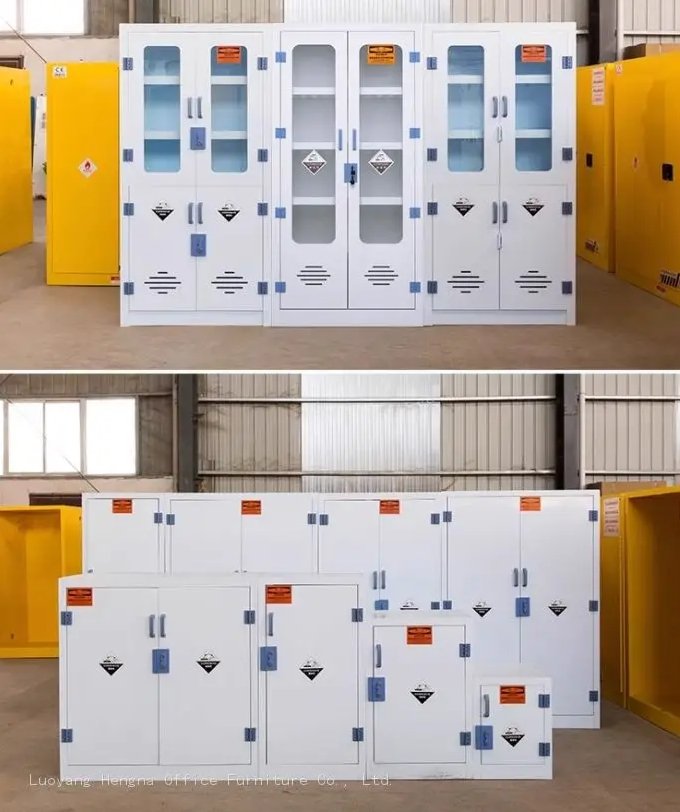
Capacity — 22-gallon single door fits most labs (about shoulder height, standard bottles). 90-gallon double door for chemical plants and bulk storage. 4-gallon benchtop for daily-use small bottles.
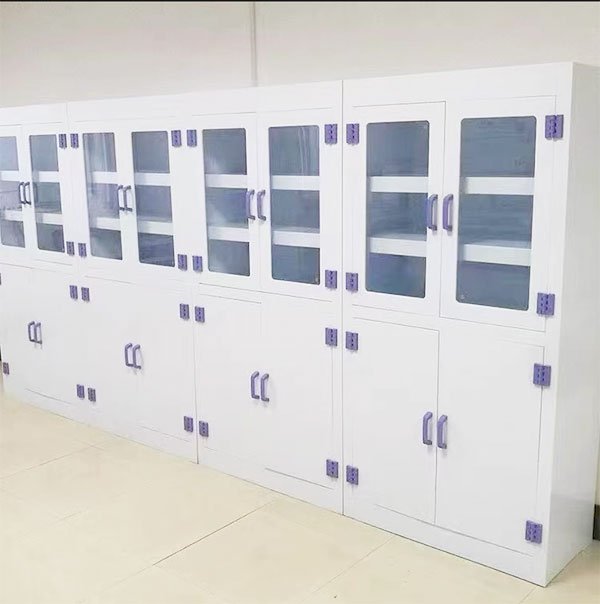
All-PP construction — Body, hinges, shelves, handles — all PP. Some cabinets labeled “PP” use steel hinges. That just moves the rust problem to a new spot. Ask before you buy.
Spill-containment shelves — Raised edges, about 2cm deep. A tipped bottle stays on the shelf, doesn’t drip to the level below. Shelves should adjust in height and pull out for cleaning.
Dual lock — Two independent cylinders, two different keys, two people to open. EHS auditors check this.
Exhaust port — Volatile acids need exhaust. Check if your lab ceiling has a vent hookup before buying.
FAQ
| Question | Answer |
|---|---|
| MOQ | 1 unit for standard models. Custom orders — larger volumes get better pricing |
| Warranty | 1 year, non-human damage — free replacement parts |
| OEM/ODM | Silk-screen logo, custom packaging, custom manuals |
| Lead time | Standard 7-15 days. Custom 20-30 days |
| Packaging | Moisture film + corner protectors + partitioned packing |
| Certification | CE certified |
| Quote response | Within 24 hours |
The Bottom Line
Replace a steel cabinet every two years → five swaps in a decade → plus labor, disposal, and risk.
Buy PP once → five to eight years of use → one purchase, zero worry.
The math clears things up fast.
Luoyang Hengna Office Furniture Co., Ltd. has built PP acid cabinets for 9 years. CE certified. MOQ 1 unit. OEM available. Not sure if your steel cabinet needs replacing? Send us what you store and a photo. We’ll tell you straight — within 24 hours.