
Last year I got an email from an EHS manager at a university chemistry lab in the Middle East. Their steel acid cabinet was less than 3 years old. The hinges had rusted shut. The bottom panel had perforated from hydrochloric acid vapor. One shelf had collapsed. He asked a simple question: keep replacing steel, or try PP?
If you’re weighing PP vs steel acid cabinet for long-term lab storage, this post gives you a real 5-year comparison. Not spec-sheet theory. What actually happens in a working lab, month by month.
What happens to a steel acid cabinet after 5 years
Steel cabinets aren’t useless. For non-corrosive chemicals, they do the job fine. But store hydrochloric, sulfuric, nitric acid, or sodium hydroxide — the strong stuff — and the lifespan drops fast.
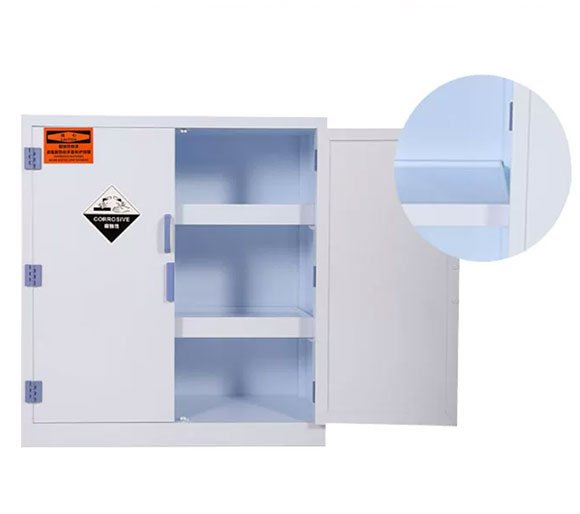
Year 1: Looks perfect. The epoxy coating keeps metal off the acid. But one dent that exposes bare steel starts the clock. Corrosion begins the day the coating breaks.
Year 2: Hinges go first. Metal hinges oxidize in acid vapor. Doors start squeaking, then jam. Rust spots show up at the weld seams on the bottom panel.
Year 3: Bottom perforates. HCl and H2SO4 vapor is heavier than air. It sinks and pools at the base, eating the metal long-term. We saw this at a chemical plant QC lab in Southeast Asia — a 90-gallon steel acid cabinet storing HCl and nitric acid. Bottom rusted through in 3 years. Acid hit the floor. Only the spill tray caught it.
Year 4-5: Shelf load drops. Rust weakens the frame. Shelves sag and warp. Opening the door becomes a risk — the shelf and its bottles might come down together.
Steel fits when: you store non-corrosive solids, the lab has good ventilation, the cabinet gets replaced within 1-2 years, or the budget is locked tight and regular replacement is acceptable.
What happens to a PP acid cabinet after 5 years
PP (polypropylene) doesn’t rust. There’s no metal in it. That’s the root difference — not a coating on top, the material itself shrugs off corrosion.
Year 1: Cabinet intact, white porcelain color holds. Splash acid on it, wipe it off, no trace left behind.
Year 2: Hinges still smooth. PP molded hinges have no metal part, so no oxidation, no jam. Pull the shelves out and rinse them with water.
Year 3: This is exactly when the steel cabinet starts perforating. The PP base shows zero change — PP resists HCl, H2SO4, nitric acid, and NaOH on contact, year after year. A pharma QC lab in Eastern Europe ran a 22-gallon PP acid cabinet storing sulfuric acid and NaOH. After 3 years, the structure was intact. Just some chemical staining inside. Wiped clean, mostly gone.
Year 4-5: Structure stays stable. PP’s chemical stability means there’s no “aging corrosion” phase like metal has. Stay under the temp limit (PP long-term use stays below 80°C), don’t store incompatible chems like fuming sulfuric or some strong oxidizers, and 5 years is just the baseline. Many labs run them 8-10 years.
PP fits when: you store strong acids and bases, the space is humid or poorly ventilated, you need stable use for 5+ years, or your EHS audit requires compliant storage.
When to keep steel, when to switch to PP
Not every lab needs PP. Honestly, steel still works in these cases:
- Storing non-corrosive solid chemicals
- Lab has good airflow, low acid vapor buildup
- Cabinet gets swapped within 1-2 years (temporary setup)
- Budget is locked and you accept replacing it regularly
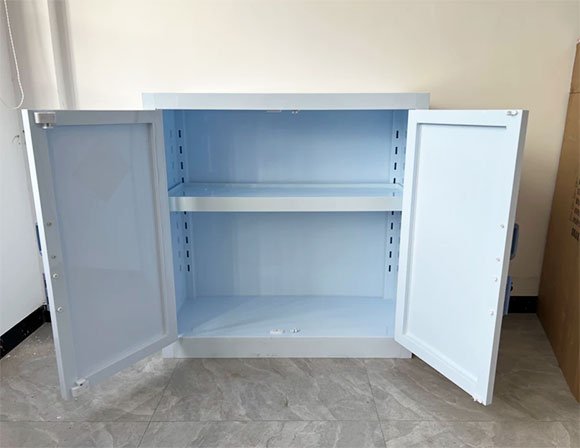
But in these situations, go PP. Don’t cheap out on this:
- Storing HCl, H2SO4, nitric, NaOH — the strong corrosives
- Ventilation is average, acid vapor builds up
- You need to pass an EHS audit or GMP / FDA inspection
- Coastal or high-humidity site — metal corrosion runs roughly double
- Long-term use (3+ years), where total cost of ownership favors PP
Total cost reality: Steel is cheaper per unit. But you replace it every 3 years — that’s two swaps in five. PP costs more upfront and needs zero replacement in that window. Add the downtime, the reagent transfer, the possible leak cleanup — PP’s 5-year total usually lands lower.
PP vs Steel Acid Cabinet|5 things to check when buying a PP acid cabinet
- All-PP construction. Body, shelves, hinges, handles — all PP. Some cabinets are PP body but use metal hinges. That just moves the rust problem to a new spot. Ask what the hinges are actually made of.
- Spill-containment shelves. Raised edges, tray-style, at least 2cm deep. A tipped small bottle won’t run down to the lower shelf. Shelves should adjust and pull out for cleaning.
- Dual-lock system. Two independent locks, keys don’t match. Two-person lab management — a hard requirement in many EHS audits, not a nice-to-have.
- Ventilation port. The louvered vent must connect to your exhaust. Storing volatile acids (HCl, nitric) needs airflow, or vapor builds up inside the cabinet.
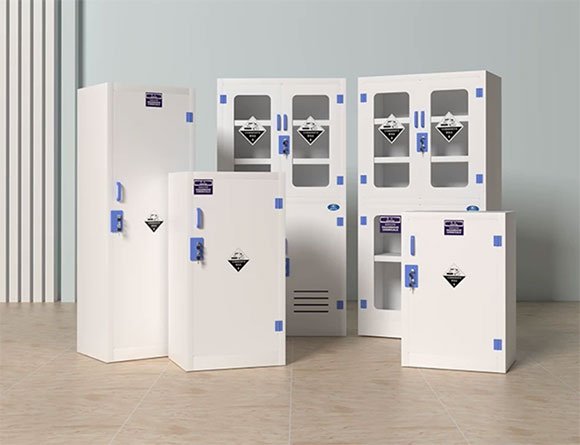
- Capacity choice. 22-gallon fits small-to-mid labs. 60-90 gallon suits chemical plants and QC rooms. The 200L glass-door model works for pharmacy and prep rooms — you see inventory without opening the door.
Thinking about making the switch?
If you’re evaluating whether to replace a steel acid cabinet with PP, or you want specs and pricing on specific models — tell me your setup. What chemicals, daily volume, ventilation condition, and whether you need to pass an EHS audit.
Luoyang Hengna Office Furniture Co., Ltd. has built PP acid cabinets for 9 years. CE certified. OEM custom logo and packaging available. Regular models start from 1 unit. We reply with a quote within 24 hours. Reach out, tell me what you need, and I’ll give you a straight plan — not filler.