
Quick answer: A 6-drawer tissue block storage cabinet is a steel archiving unit that sorts paraffin-embedded tissue blocks into six labeled drawer sections, protecting blocks from misplacement and damage while keeping retrieval fast. It is the standard storage format for pathology labs and clinics that handle FFPE blocks daily.
Tissue blocks contain irreplaceable histological data. A pathology lab handles thousands of paraffin-embedded blocks, and any one of them can be referenced months or years later for review, additional staining, or molecular testing. Loose shelving and shared drawers are where blocks get misplaced, misidentified or chipped. A dedicated 6-drawer cabinet turns that risk into a sorted, labeled system.
Why Pathology Labs Use a 6-Drawer Format
Six drawers map naturally onto how pathology labs actually sort blocks: by year, by department, by specimen type, or by case-number range. Each drawer becomes one category, so a technician goes straight to the right drawer instead of searching a mixed shelf. The benefits show up in daily work:
Segmented storage keeps sample categories separate and traceable. Retrieval time drops because the search space is one drawer, not a whole wall. Misplacement risk falls since every block has one assigned section. And compliance audits get easier, because the storage logic matches the documentation.
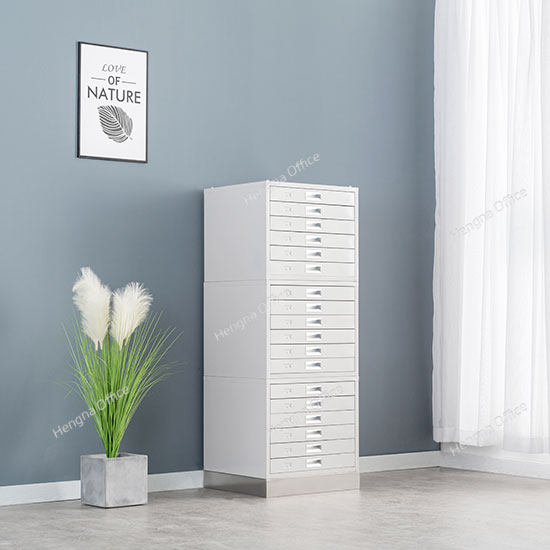
What an Ideal 6-Drawer Block Cabinet Must Have
Not all block cabinets are equal. Before ordering, check these six points:
Lab-grade steel construction. The body should be corrosion-resistant steel, not wood or thin sheet metal. Steel survives disinfectant wiping and does not absorb formaldehyde odors.
Smooth-glide drawers. Precision slides let a fully loaded drawer open with one hand. A drawer that jams under load gets emptied by shaking, and blocks get damaged.
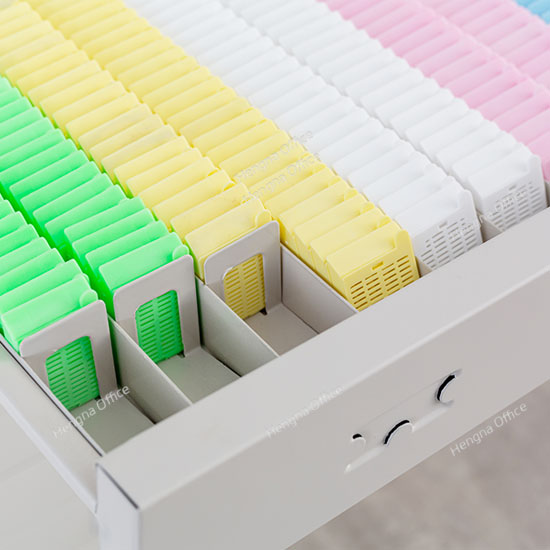
High-density capacity. A 6-drawer steel unit should hold thousands of paraffin blocks, sorted neatly by section. Ask the supplier for the per-drawer block count, not just the total.
Optional locking. Blocks are patient-derived material. Drawers with lockable mechanisms protect sensitive samples and support medical storage protocols.
Compact vertical footprint. The cabinet should use height, not floor area — labs never have spare floor.
Easy disinfection. Smooth powder-coated surfaces wipe clean; wood and porous finishes do not.
Practical and Visual Fit in Clinical Spaces
The Model 515 6-drawer cabinet from Luoyang Hengna is built for exactly this use. The body is lab-grade steel with a corrosion-resistant powder-coated finish in white or neutral tones that blends into modern clinical interiors. Dimensions stay compact so the unit fits alongside embedding stations or under worktop overhangs where every square inch counts. Locking options, drawer divider layouts and colors can be specified at order time.
Built by a Factory, Not Assembled From Catalog Parts
Luoyang Hengna Office Furniture manufactures laboratory and medical-grade furniture in Luoyang, China’s steel furniture industrial base. The production line covers laser cutting, CNC bending, welding and powder coating, so drawer tolerances stay consistent from unit to unit. Orders are accepted as single units or bulk quantities for lab build-outs, and color, configuration and locking options are customized at the factory.
FAQ
How many paraffin blocks does a 6-drawer cabinet hold?
Capacity depends on drawer depth and divider layout. Ask for the per-drawer count with your block cassette size, and request a layout drawing so the divider plan matches your case-number system.
Can the drawers be locked separately?
Yes. Locking mechanisms are optional and can be specified per drawer or per cabinet, which is useful when blocks from different departments or projects share one unit.
Steel or plastic block cabinets — which is better?
Plastic units are lighter and cheaper for small benchtop use. Steel wins on load capacity, disinfection, fire behavior and long-term rigidity once a lab archives thousands of blocks in fixed positions.
How to Organize the Six Drawers
The six-drawer format works best when each drawer answers one question. Three sorting systems cover most labs: by year of embedding, by department or unit of origin, and by case-number range. Pick one system and label every drawer face — mixing systems inside one cabinet is how retrieval slows down. Inside each drawer, keep the divider layout consistent with your labeling so a missing block becomes visible at a glance instead of at the next audit.
A practical starter plan: drawer one for the current year, drawer two for the previous year, drawers three through five by specimen type or department, and drawer six as overflow or for reference sets. Labs with high block volumes usually move to a two-cabinet tower after the second year, which is where the stackable steel format earns its keep.
Ordering, Packaging and Lead Time
Orders are placed factory-direct as single units or bulk quantities for lab build-outs. Each cabinet ships in a wooden crate with foam cushioning and corner protection, and arrives with hardware and the drawer set installed. Lead time depends on the customization level — standard color and configuration units move fastest, while custom locking or divider layouts add production time. Confirm both the drawer layout and the lock options before the order is placed, because those two choices shape everything downstream.
What is the lead time for bulk orders?
Single units ship from available production slots; bulk orders for lab build-outs are scheduled on the production line with a confirmed lead time at order placement. Because the cabinet is steel with a powder-coated finish, custom colors add a finishing step — standard white and neutral tones move fastest. Ask for the current lead time with the order specification and the factory confirms it in writing.
Can the finish match our existing lab furniture?
Yes. White and neutral tones are standard, and custom powder-coat colors are available so the cabinet blends with existing furniture or a department color scheme. Provide the color reference when ordering.
Related reading: Professional Tissue Block Archiving Unit — 6 Drawer Paraffin Block Cabinet · 6-Drawer Pathology Paraffin Block Cabinet JUNTUO-26 · 51,840-Slide High Capacity Histology Storage Cabinet
Upgrading your block storage? Send your annual block volume and available floor space, and the factory will spec the drawer layout for you.