
A 90-gallon cabinet does not mean you can store 90 gallons of chemicals inside. Interior space, shelf spacing, and drum shape all limit the real storage amount.
This article runs the numbers so you do not find out after delivery that your drums do not fit.
What 90 Gallons Actually Means
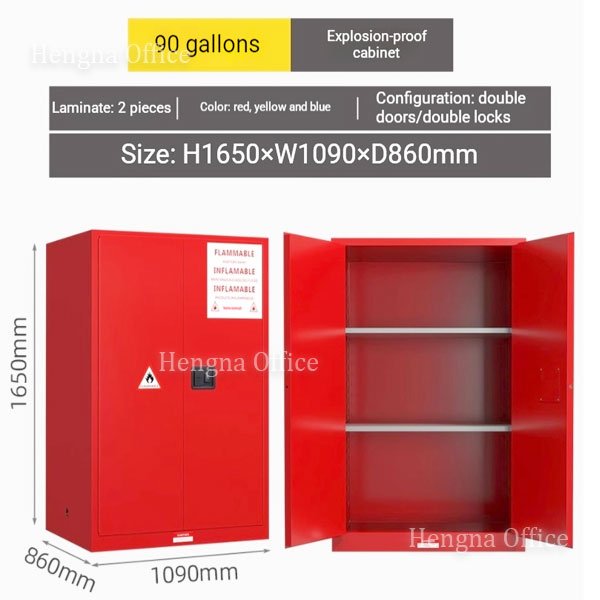
90 gallons is about 340 liters. Cabinet body size is roughly H1650 × W1090 × D860 mm. Double-door design. Standard setup includes two adjustable shelves.
Note: 90 gallons is the total cabinet volume, not the liquid volume you can load. Real storage depends on drum size, shelf spacing, and ventilation clearance.
55-Gallon Drums: One Per Shelf
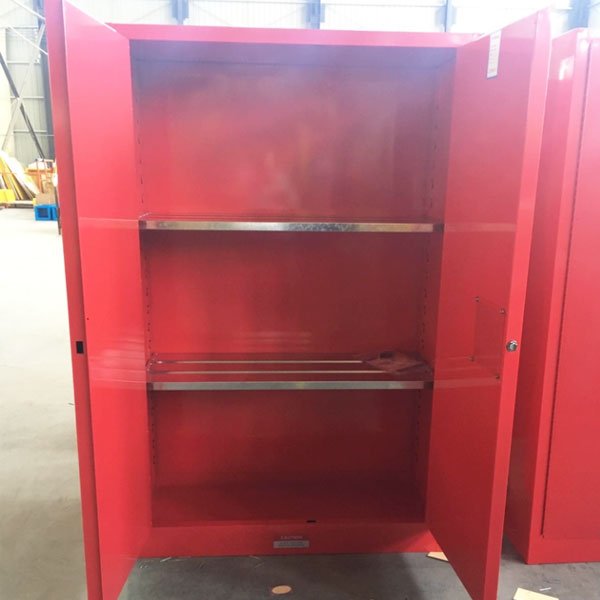
A standard 55-gallon drum is about 570 mm in diameter and 890 mm tall. Interior cabinet height is around 1500 mm. After shelf thickness, one shelf space barely fits a vertical 55-gallon drum.
Here is the problem: shelf spacing is fixed. If the bottom shelf holds a 55-gallon drum, the upper shelf gets pushed to the top position. There is almost no room for a second 55-gallon drum above.
Bottom line: a 90-gallon cabinet holds one 55-gallon drum.
If your main storage is 55-gallon drums, a 90-gallon cabinet is too small. Go up in capacity or buy a dedicated single-drum model.
5-Gallon Drums: Four to Six Per Shelf
A 5-gallon drum is about 280 mm in diameter and 350 mm tall. This is the most common size in labs and workshops.
Interior width is about 1000 mm, depth about 800 mm. Four drums per shelf is comfortable. Six fits but is hard to access.
Two standard shelves create three levels. Four drums per level gives you twelve total. Five per level gives you fifteen. This is the most practical setup.
Bottom line: 5-gallon drums are the best match for a 90-gallon cabinet.
1-Gallon Cans: More Per Shelf
A 1-gallon can is about 160 mm in diameter and 200 mm tall. One shelf holds a dozen or more, depending on layout.
But small cans have one issue: they tip over easily. Shelves are flat with no retention slots. If a can falls and leaks, the sump may not catch it.
If you store many 1-gallon cans, add polyethylene trays or anti-tip racks on the shelves. Most suppliers stock these. Ask when you order.
How to Adjust Shelf Spacing
Standard shelves usually have five to seven adjustment holes, spaced about 75 mm to 100 mm apart. Before adjusting, measure your tallest drum and add 50 mm clearance.
Suggested steps:
- Measure the tallest drum height
- Add 50 mm handling clearance
- Set the shelf to the matching hole
- Test one drum first. Check door swing and access
Do not lock all shelves in place permanently. Drum sizes change in real use. Leave room for adjustment.
Sump Capacity Requirements
Yes, there are rules. OSHA 29 CFR 1910.106 requires the cabinet bottom sump to hold at least the volume of the largest container inside, or 10% of total capacity, whichever is larger.
For a 90-gallon cabinet, 10% is 9 gallons. If you store one 55-gallon drum inside, the sump must hold at least 55 gallons.
Manufacturers design for this, but confirm when buying. This matters especially for blue corrosive cabinets. Sump material must resist acid and base damage.
Three Common Mistakes
Mistake 1: Assuming rated capacity equals usable capacity
It does not. Ninety gallons is theoretical. Real use is limited by drum shape, shelves, and spacing. In my experience, actual utilization runs between 60% and 80%.
Mistake 2: Thinking more shelves are better
Two shelves are enough for a 90-gallon cabinet. Too many shelves limits level height, so large drums will not fit. If you store mostly small cans, you can ask for one extra shelf. Do not go beyond three.
Mistake 3: Packing it full
Leave ventilation and handling space inside. Overstuffed cabinets are hard to open. In an emergency, seconds matter. Stop at about 70% to 80% full.
FAQ
Q: Can a 90-gallon cabinet hold two 55-gallon drums?
No. Height and shelf spacing are both insufficient. If you must store two 55-gallon drums, buy two cabinets or move up to a larger capacity.
Q: Can I lay 5-gallon drums on their side?
Not recommended. Horizontal storage increases liquid contact area and leak risk. Vertical is safest. If you must lay them down, confirm the lid seal and place a containment tray underneath.
Q: Can I fill a shelf completely with drums?
Yes. Standard shelves are designed for a full load of 5-gallon drums. Normal use will not cause issues. Avoid placing heavy items in the center only. Keep weight near both side supports.
Q: Can I mix different drum sizes in one cabinet?
Yes, but plan shelf spacing first. Large drums go on the bottom. Small drums go on top. Do not mix different chemicals even if the cabinet color is correct.
Q: What scenarios suit a 90-gallon cabinet?
Small to mid-size factories, labs, and auto repair shops use them most. For daily 5-gallon drum storage, twelve to fifteen drums usually covers about one week of use for most workshops.
90-Gallon Flammable Cabinet Capacity Summary
| Drum Size | Per Shelf | Total | Best For |
|---|---|---|---|
| 55 gallon | 1 drum | 1 drum | Not recommended, cabinet too small |
| 5 gallon | 4–6 drums | 12–15 drums | Labs, workshops |
| 1 gallon | 12–16 cans | 36–48 cans | Sample storage |
Before ordering a 90-gallon cabinet, count your drums and measure their sizes. Calculate capacity first. It saves the hassle of discovering they do not fit after delivery.
Not sure how to calculate your storage needs? Send us your drum dimensions and quantities. We will match them for you.