
Quick answer: A benchtop fume hood sits on the lab worktop and captures vapors at the source — no floor space required. Our ducted benchtop models come in 1200mm, 1500mm and 1800mm widths with a design face velocity of 0.5 m/s, built in steel with tempered-glass viewing panels for labs that have ductwork but no room for a full-height hood.
Full-height fume hoods assume one thing: floor space. In teaching labs, school chemistry rooms and compact QC benches, that assumption fails — the floor is already spoken for, but the worktop has a free meter. A benchtop fume hood turns that meter into a contained working zone: vapors from stains, solvents and etching steps are captured at the source and ducted out, while the operator works behind tempered glass.
Ducted, Not Filtered: Why We Build Ducted
Benchtop hoods come in two families: ductless units with carbon filters, and ducted units connected to exhaust ducting. We build ducted. The reason is performance over time — a ducted hood keeps constant capture because the airflow does not depend on a filter that saturates and needs replacing on a schedule. For labs with existing ductwork or a wall exhaust route, ducted is the version that never asks you to remember a filter change.
Three Widths, One Line
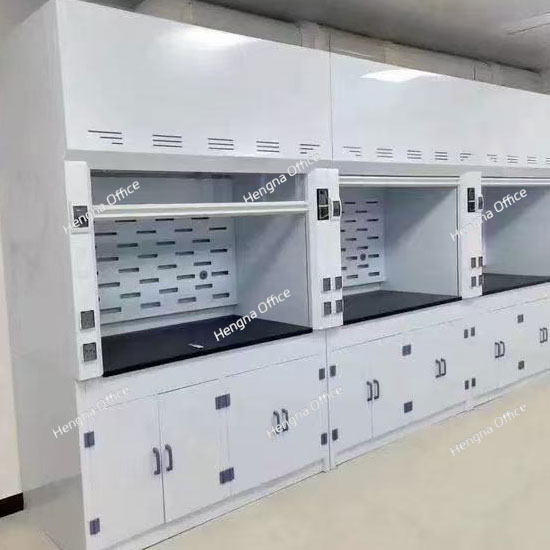
The benchtop line comes in 1200mm, 1500mm and 1800mm widths, so the hood matches the work zone rather than the other way around. The body is steel with a powder-coated finish; the viewing panels are tempered glass for clarity and impact resistance. The sash opens for loading and closes to the working height during operation — the containment envelope is designed around a 0.5 m/s face velocity, the airflow benchmark labs and inspectors recognize.
What to Check Before Ordering a Benchtop Hood
Four confirmations make the order right. The duct route — a benchtop hood needs an exhaust path; confirm where the duct runs before ordering. The worktop — the surface must be level and load-bearing; the hood and the samples it protects weigh more than a shelf of notebooks. The chemicals — send the list; the internal lining and the fan selection follow the chemistry. And the width — match the hood to the working zone, not to the wall.
Who a Benchtop Model Suits
School chemistry rooms use benchtop hoods at the demonstration station — one contained zone for the experiments that produce vapor. Small QC and R&D labs use them for the daily wet tasks that a full-height hood would occupy wastefully. Universities use them as supplementary capture points at fixed positions along a bench run. In all three cases the buyer has ductwork or a duct route, and no floor space — which is exactly the benchtop’s job.
FAQ
Does a benchtop fume hood need ducting?
Our models are ducted — the exhaust connects to the lab ventilation route. If your room has no duct path at all, a ductless filtered unit is the alternative product class, and the chemical list decides whether a filter unit is acceptable for your application.
Which width should I choose?
Match the hood to the working zone: 1200mm covers a single operator position, 1500mm adds shared equipment space, 1800mm serves two adjacent positions or a wider apparatus footprint.
Can it sit on any worktop?
It needs a level, load-bearing surface and a clear duct route. Chemical-resistant worktops are the natural pairing — the hood protects the operator, and the worktop protects the furniture from the same chemistry.
Face Velocity: The Number Inspectors Ask For
Face velocity is the speed of air moving into the hood opening, and 0.5 m/s is the benchmark that laboratory inspectors and design guides recognize as effective containment. Too slow and vapors escape back into the room; too fast and turbulence disturbs the work inside. Our hoods are engineered to that figure, and the fan spec is matched to the duct run at the planning stage — which is why the duct route and length are the first things we ask for.
Installation Requirements
Three things must exist before the hood arrives. A duct route: the exhaust path from the hood collar to the outside, with the length and bends confirmed — every elbow costs airflow. A worktop: level, load-bearing, and made of a surface that tolerates the chemistry around the hood. And power: the fan and lighting need a standard connection at the position. Send photos of the room and the duct exit, and the factory confirms the fan specification for the actual run.
Can two people share one hood?
The 1800mm width supports two adjacent working positions, though not two operators working simultaneously at full sash height — the face velocity is calculated for the working opening. For shared rooms, two narrower hoods on separate duct runs avoid the contention entirely.
Cleaning and Care
The chamber wipes down with water or a mild laboratory cleaner after vapor-heavy sessions — residue that sits on the walls eventually tracks onto gloves and samples. The tempered-glass panels clean with standard glass cleaner for full visibility, and the sash track stays smooth with an occasional wipe of the channel. No special chemicals are needed for the hood itself; the aggressive chemistry is what goes inside it, under containment.
Does the hood ship assembled?
The benchtop body ships as an assembled unit in a reinforced crate — position it on the worktop, connect the duct and the power, and the installation is mostly planning rather than building. The duct connection hardware ships with the unit; the duct run itself is typically sourced or fabricated locally to match the room.
Related reading: Standard Laboratory Fume Hood — Safe Ventilation for Professional Labs · Laboratory Fume Hood Category · All-Steel Lab Bench — 304 Stainless Steel Frame & 19mm Phenolic Resin Worktop
Send the worktop dimensions, the chemical list and the duct route, and the factory will confirm the benchtop model and the fan specification for your room.