
Quick answer: A lab bench with a reagent rack keeps daily-use bottles and stains on two epoxy shelves above the worktop — off the wet surface, at hand height, labeled and organized. It is the single configuration upgrade that frees the most worktop space in a chemistry lab.
Watch any working chemistry bench for an hour and count the bottles on it. Reagents, buffers, staining solutions, waste beakers — all sharing the same surface where the actual work happens. Every square centimeter under a bottle is a centimeter not available for the task. A reagent rack moves that inventory up and back, and the bench underneath stays clear for real work.
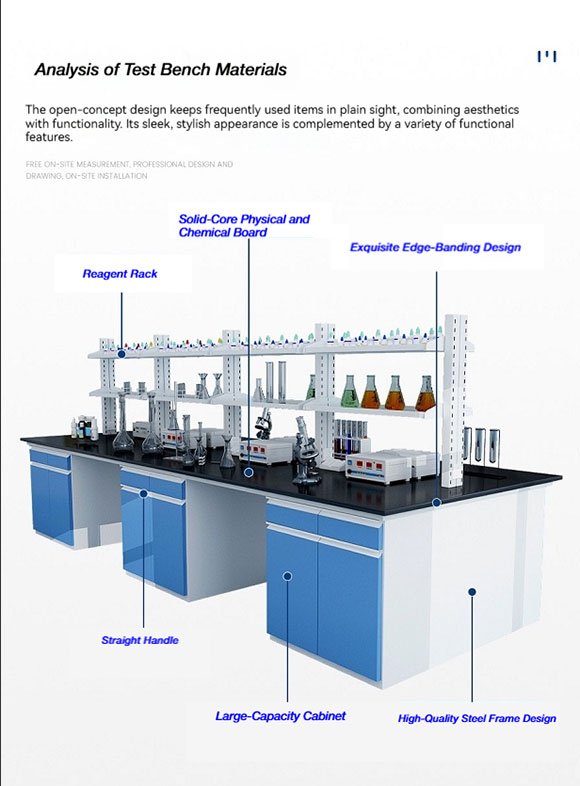
What a Reagent Rack Adds to a Lab Bench
Three things, in the order buyers mention them. Organization: every bottle has a slot, so missing stock is visible the moment it happens. Space: the worktop regains the strip along the back wall that racks occupy — typically 250 to 300 mm of depth. Safety: reagents sit above and behind the working zone, away from open flames, moving elbows and the edge of the bench.
Two-Tier Epoxy Shelving: The Configuration We Build Most
Our standard reagent rack is a two-tier epoxy shelving unit mounted on the bench frame. The lower shelf sits roughly 500 mm above the worktop and carries the daily-use bottles; the upper tier takes backup stock and larger containers. Epoxy shelving is specified for chemistry duty because it resists the same reagents as a chemical-resistant worktop — a spilled stain or acid drip wipes off the shelf the same way it wipes off the bench. Shelf depth and tier spacing follow the bottle heights on your chemical list, confirmed at the drawing stage.
Built With the Bench, Not Bolted On After
The rack is part of the bench frame in our construction: the same 1.0-1.5mm steel posts that carry the worktop carry the shelves, cut and coated in the same production run. That matters for two reasons. The rack cannot wobble loose the way clamp-on shelf units do after a year of loading. And the finish matches — posts, shelves, worktop and cabinets come out of the same coating batch.
Sizes follow the bench: racks are built for bench lengths from 1000mm to 4500mm, with the two-tier layout standard and single-tier or three-tier versions quoted on request. A sink or utility zone can be planned into the same run — the rack spans the dry section while the sink occupies the wet end.
Which Labs Order This Configuration
Chemistry teaching labs use reagent racks to keep class sets visible and separated per session. Quality control benches use them for the reagents and standards that run every day. R&D labs use them for working solutions, with the second tier carrying bulk stock. If the chemical list includes strong acids that live on the bench, the rack shelves are specified in the same chemical-resistant material as the worktop — the chemical list decides, the same way it decides the worktop.
FAQ
Can a reagent rack be added to an existing bench?
Clamp-on racks exist, but they wobble, they scratch the worktop finish, and they are the first thing to fail under load. If your bench is from our production, a matching rack can be built to the same frame dimensions. For other brands, send the bench measurements and we will quote a freestanding floor model instead — that is the honest answer for most third-party benches.
Epoxy or phenolic shelving?
Epoxy shelves for chemistry duty — they take the solvent and heat exposure that reagent storage sees. Phenolic shelves suit milder storage above general benches. The chemical list decides, the same way it decides the worktop.
Is the shelf height adjustable?
The tiers are set at fixed heights in the standard build, chosen from your bottle heights at the drawing stage. Height-adjustable variants are quoted on request for labs that share a bench between different teams.
Sizes and Configuration
The rack follows the bench: lengths from 1000mm to 4500mm in the same modular steps as the cabinet run, so one rack or a continuous shelving line spans the full wall. The two-tier layout is standard; single-tier suits lower benches and three-tier suits high-ceiling rooms with larger bottle stock. Under the bench, drawer packs and door cabinets can be specified in the same order — the reagent rack above and the storage below are planned as one drawing, not two purchases.
Delivery and Installation
Benches with integrated racks ship knock-down in wooden crates with foam cushioning — the rack posts and shelves are crated separately from the cabinets to protect the shelving surfaces. Assembly follows the numbered part map: frame, worktop, then the rack posts and shelves last, because they sit highest and handle easiest. Spare shelves and posts are available as parts after delivery.
How deep is the shelf?
The standard shelf depth is 250 to 300mm — enough for reagent bottles and staining jars without stealing worktop depth. Deeper shelves are quoted on request for labs that store larger carboys on the lower tier.
Is the reagent rack only for bottles?
No — the shelves carry whatever the workflow puts on them: staining jars and coplin jars, wash bottles, PPE, documentation holders, and small instruments between uses. Many chemistry labs keep the daily protocol sheets clipped to the rack uprights so the method stays in view. The shelf load is engineered for fully loaded reagent bottles, which are heavier than most of that list — confirm the heaviest item at the drawing stage and the shelf spec follows.
Related reading: All-Steel Lab Bench — 304 Stainless Steel Frame & 19mm Phenolic Resin Worktop · GMP Compliant Lab Bench — Phenolic Resin Top for Pharmaceutical QC Labs · Lab Bench Rusting? 7 Proven Ways to Prevent Rust on Steel Lab Benches
Send the bench length, the bottle heights and the chemical list. The factory returns the rack configuration with the bench drawing — shelves, tiers and spacing sized to what actually sits on them.