
Quick answer: For acid digestion and corrosive-vapor work, choose a fume hood whose every surface resists the chemistry: a welded 8mm polypropylene body for the strongest acids, or a steel hood with an anti-corrosion sync-belt sash drive that is third-party tested. Both are in our fume hood line — this guide explains which suits which acid workload, and what the third-party testing covers.
Acid digestion attacks fume hoods from the inside: hot acid vapors condense on every surface they touch, and a standard powder-coated steel chamber starts showing corrosion at the seams within months. Two construction routes survive it — and the right one depends on the acids, the temperatures and how often the work runs.
Route One: Welded PP Body for the Strongest Chemistry
Our PP fume hood uses an 8mm polypropylene body with welded, same-material joints — no coating to chip, no base metal to rust, no seams glued with anything that solvents can open. Polypropylene shrugs off the strong acids and alkalis that digest samples for analysis: aqua-regia-class work, hydrofluoric processes and daily hot acid duty are the cases we route to PP. The trade-offs are temperature limits and surface hardness — PP is the corrosion specialist, not a general workhorse.
Route Two: Steel Body with an Anti-Corrosion Sync-Belt Sash Drive
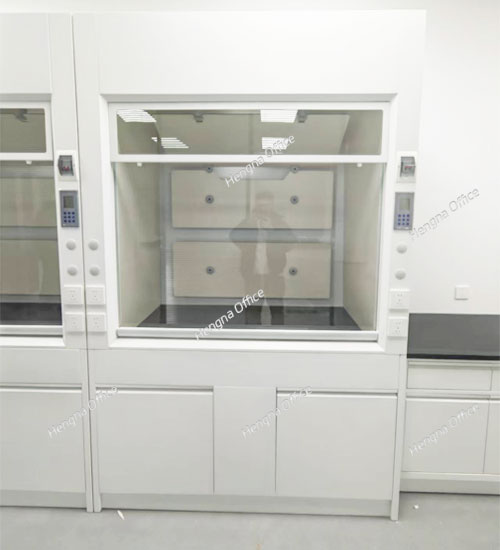
Our steel fume hood line (F2 and F4 models) solves a different failure point: the sash drive. Conventional fume hoods move the glass sash on rollers and cables that corrode and jam in acid environments — maintenance becomes a recurring cost. The F2 and F4 use a self-developed anti-corrosion sync-belt drive: a 0.65mm galvanized steel-wire belt rated for 35KG sash load, tested against sulfuric acid exposure by a third party for anti-corrosion performance and tensile strength. The belt needs no lubrication, and the rollers are 26mm silicone — quieter, and without the wobble that worn nylon develops.
What the Third-Party Testing Covers
The sync-belt assembly is tested by a third party on two axes: anti-corrosion performance under acid exposure, and tensile strength under load. For a buyer, that documentation answers the question a product sheet cannot — how the moving parts behave after years of acid vapor, not just on delivery day. The test reports are provided with the quotation for labs that need them in the tender file.
Which Route for Which Lab
Semiconductor and mining-assay labs running daily hot acid digestion: full PP chamber. Pharmaceutical and university chemistry labs with mixed workloads — acid work some days, solvent and general work others: the steel F2/F4 with the anti-corrosion sync-belt drive, paired with the worktop material that matches the chemical list. Storage of the strong acid stock itself belongs in a welded PP acid cabinet beside the hood — the hood handles the vapors, the cabinet handles the inventory.
FAQ
Why does the sash drive corrode before the chamber?
The chamber walls are flat and coated or welded; the sash drive is a mechanism — rollers, cables, bearings — with moving contact points where coatings wear first. That is why the drive material matters more than the chamber material for long-term acid environments.
Can the sync-belt drive be retrofitted to an older hood?
The F2/F4 drive is designed into the frame at production. For retrofit questions on existing hoods, send the model and photos — the factory assesses case by case rather than promising a universal kit.
What face velocity do these hoods run?
Our fume hood line is engineered around a 0.5 m/s face velocity design target — the containment benchmark used by labs and inspectors. Confirm your room’s ducting and fan setup at the drawing stage.
Inside the PP Chamber
The working chamber is built from the same 8mm polypropylene as the body, with welded joints throughout — including the corners and the baffle edges, which are where lower-grade hoods start to fail. The working surface and the baffle system are PP as well, so condensation running down the walls collects in a chamber that resists it everywhere. There is no coating anywhere in the airflow path, because there is no substrate under it — the material is the protection through the full section.
Fan and Ducting for Acid Vapors
The hood handles the vapors; the ducting carries them out. For strong-acid lines, the duct material matters as much as the hood body — PP ducting is the standard pairing with a PP chamber, because galvanized duct corrodes from the inside exactly like a coated steel hood would. The fan specification follows the duct run length and bends; send the route and the factory confirms the fan and ducting materials together with the hood.
What maintenance does a PP hood need?
Wipe the chamber with water or mild detergent after acid work, rinse the sump or basin if your model includes one, and inspect the welded joints annually. There is no coating to repair and no paint to touch up — the maintenance schedule that a steel hood demands does not exist on a PP body.
Sash and Viewing Panels
The sash raises for loading and closes to the working height during operation — the containment envelope exists at the closed position, which is why the drive quality matters as much as the chamber material. Viewing panels keep the work visible at the closed position: digestion reactions can be observed without opening the sash and releasing vapor into the room. On the F2/F4 models, the sync-belt drive moves the sash with one hand even when the panels are lowered — the usability detail that operators mention after the first week.
What sizes does the PP model come in?
Chamber dimensions and the external footprint are confirmed at quotation — PP chambers are built to the application rather than pulled from a fixed catalog. Send the digestion vessels, the acid volumes and the available space, and the factory returns the chamber sizing with the drawing.
Related reading: Benchtop Fume Hood — 1200-1800mm Ducted Models for Lab Countertops · Standard Laboratory Fume Hood — Safe Ventilation for Professional Labs · 45-Gallon PP Acid Storage Cabinet
Send the acid list, the temperatures and the daily duty cycle, and the factory will route the project to the PP chamber or the anti-corrosion steel line — with the reasoning in writing.