
Most buyers pick a flammable storage cabinet the same way they pick anything else: compare sizes, compare prices, order the one that looks right. Then a fire marshal walks in, and the question changes — not “was it cheap?” but “does it comply?”
Here is the plain version of what OSHA 1910.106 and NFPA 30 require — construction, labeling, capacity, and placement — so you can hold a quotation against the standard instead of guessing.
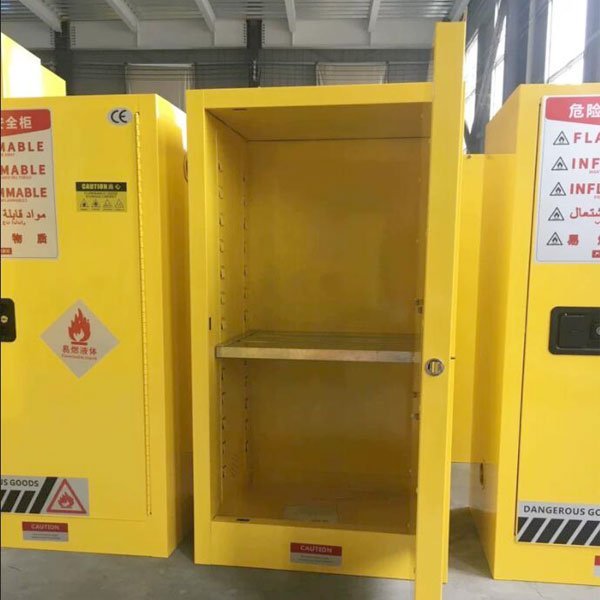
The four requirements, in order of what gets checked first
- Construction — how the steel is built (18-gauge minimum, double-walled, 1.5-inch air gap, three-point latch, 2-inch sill)
- Labeling — the wording on the door and its letter height
- Capacity — how many gallons, and how many cabinets per fire area
- Placement — where it can and cannot stand
Venting comes up in almost every inquiry, and it is the one requirement most buyers get backwards. More on that below.
Construction: what the steel has to be
OSHA 1910.106(d)(3)(ii)(a) spells out the construction for a metal cabinet, and it is specific enough to measure a unit against: at least No. 18 gauge sheet iron on the bottom, top, door, and sides, double-walled with a 1.5-inch air space, joints riveted or welded, a three-point lock, and a door sill raised at least 2 inches above the cabinet bottom to hold a spill inside.
The double wall is the part cheap cabinets cheat on. It is what keeps the internal temperature down during a fire — a single-wall box with a powder coat looks identical from the outside and gives you none of the fire performance.
| Requirement | Standard | What to check on a quotation |
| Steel gauge | No. 18 gauge minimum (bottom, top, door, sides) | Ask for the gauge in the spec sheet, not a photo |
| Wall structure | Double-walled, 1.5-inch air space | Ask for a section drawing or cutaway photo |
| Door latch | Three-point lock | Visible on the door edge; a single latch is not compliant |
| Door sill | Raised at least 2 inches (approx. 51 mm) above the cabinet bottom | Measure it — this is the spill sump |
| Self-closing doors | Required by NFPA 30 and the International Fire Code on new cabinets | Not an OSHA requirement, but most jurisdictions enforce it |
OSHA’s general industry standard does not explicitly require self-closing doors, but NFPA 30 does, and many local fire marshals enforce it. A cabinet with manual doors can pass a federal review and still fail a local inspection.
Labeling: what has to be on the door
Every cabinet has to carry the words “Flammable — Keep Fire Away” in conspicuous lettering. NFPA 30 sets the sizes: “FLAMMABLE” in letters at least 2 inches tall and “KEEP FIRE AWAY” at least 1 inch. Commercially built cabinets come pre-labeled — but if a cabinet is repainted or the label is damaged, the label has to be replaced before the cabinet goes back into service.
Color coding is a convention rather than a code requirement, but inspectors read it together with the label — yellow for flammable liquids, red for combustible, blue for corrosive, white for strong corrosives. A repainted cabinet in the wrong color invites questions during an audit.
Capacity: how much you can actually store
Capacity is where most misunderstandings start, because the limit is not “as much as fits.” Under 29 CFR 1910.106(d)(3), a single cabinet holds no more than 60 gallons of Category 1, 2, or 3 liquids, or 120 gallons of Category 4 — and that higher allowance applies only when the cabinet holds Category 4 exclusively.
| Category | Flash point | Boiling point | Typical liquids |
| 1 | Below 73.4 °F (23 °C) | At or below 95 °F (35 °C) | Diethyl ether, pentane |
| 2 | Below 73.4 °F (23 °C) | Above 95 °F (35 °C) | Gasoline, acetone, ethanol |
| 3 | 73.4–140 °F (23–60 °C) | — | Xylene, turpentine, some paints |
| 4 | 140–199.4 °F (60–93 °C) | — | Diesel, heavier oils |
There is also a limit on the number of cabinets. Not more than three may sit in a single fire area. Beyond that, storage moves to an inside storage room with its own construction, ventilation, and electrical requirements — a facilities decision, not something solved by ordering a fourth cabinet.
Venting: the requirement most buyers get backwards
Neither OSHA 1910.106 nor NFPA 30 requires a flammable storage cabinet to be vented. This surprises people, because the cabinet ships with two plugged openings and the instinct is to open them.
Do not. Opening the vents without ducting them to an approved exhaust system lets vapors exchange with the room, which reduces fire protection rather than improving it. The plugs stay in.
If local code does call for venting, both openings have to be ducted to run directly outdoors, typically from the bottom of the cabinet, with a spark-resistant fan. Venting one side only breaks the fire rating.
One contrast worth remembering: corrosive cabinets are normally vented, flammable cabinets normally are not. That difference decides how a chemical storage room gets plumbed.
Placement: where the cabinet can and cannot stand
A compliant cabinet becomes a violation in the wrong spot. Flammable liquids cannot be stored in areas used for exits, stairways, or normal safe passage — a cabinet parked in a corridor because that was the only free floor space is among the most commonly cited violations. Keep it away from ignition sources: welding areas, open flames, electrical panels, hot plates.
Place it on level ground — the raised sill only works as a spill dam if the cabinet sits flat. For Category 1 and 2 liquids, bonding and grounding matter too: static discharge during pouring is a real ignition source, and 1910.106(e)(6)(ii) requires containers to be bonded and grounded during transfer.
A short checklist before you approve a quotation
- Steel gauge stated in writing: No. 18 gauge or heavier, all four sides
- Double-walled construction with a 1.5-inch air space, confirmed by drawing
- Three-point latch and a sill raised at least 2 inches
- Self-closing doors if the site falls under NFPA 30 or the IFC
- Label “Flammable — Keep Fire Away” in the required letter sizes
- Stated capacity within the 60-gallon (Cat 1–3) or 120-gallon (Cat 4) limit
- Vent openings delivered plugged, with bungs included
- Grounding lug present for static control
- Support documentation for CE marking if the cabinet is bound for Europe
Hengna supplies flammable storage cabinets built to OSHA 1910.106 construction requirements, CE marked, in sizes from 22 to 110 gallons with single-door and double-door configurations. Sizes, colors, and internal layouts are confirmed against your chemical list before an order is scheduled, and quotations go out within 24 hours.
FAQ
Does OSHA require a flammable storage cabinet to be vented?
No. Venting is not required for fire protection, and the vent openings should remain sealed with their bungs. If a cabinet is vented, both openings must be ducted to an approved exhaust system running outdoors.
How many gallons can one cabinet hold?
Up to 60 gallons of Category 1, 2, or 3 flammable liquids combined. A cabinet holding only Category 4 liquids can go up to 120 gallons. Mixing Category 1–3 with Category 4 drops the whole cabinet back to the 60-gallon limit.
Can I store acids in a flammable storage cabinet?
No. Acids attack steel, and a flammable cabinet is built for flammable liquids only. Corrosives need a dedicated corrosive storage cabinet — typically a polypropylene cabinet — kept separate from the flammable cabinet.
What if the site needs more than three cabinets in one room?
Three is the limit per fire area. Beyond that, the storage moves to an inside storage room that meets its own fire-resistance, ventilation, and electrical requirements. Check the limit against your local fire code, because it is enforced locally rather than by OSHA directly.
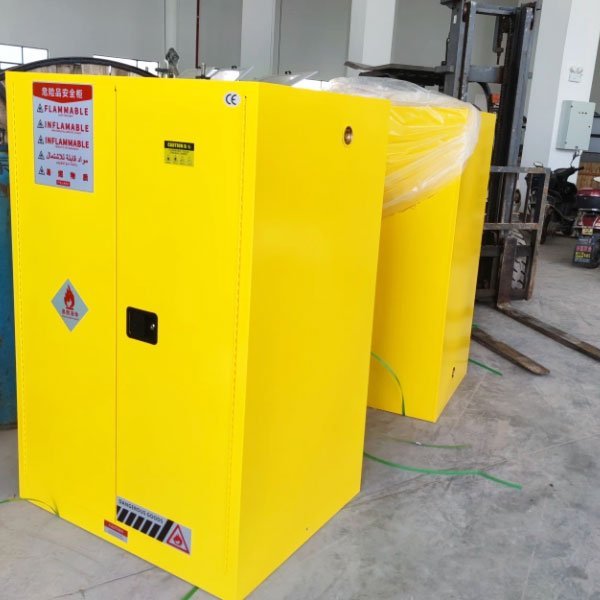
If you are specifying cabinets for a lab, workshop, or paint store and want a second opinion on the capacity math, send the chemical list and floor plan. Hengna will match sizes to what you actually store and confirm the configuration before anything is crated.