
Every research lab knows the problem. Slides pile up faster than you can catalog them. Wax blocks fill boxes until you lose track of what is where. And six months later, finding a specific sample means opening every drawer in the room.
This cabinet fixes that.
Designed for university research labs, it stores up to 8,250 standard glass slides or 14,840 paraffin blocks in a single four-section stack. Each sample has its own slot — slides in grooved tracks, blocks in partitioned grids. No stacking, no friction, no lost samples.
Why Research Labs Need Dedicated Storage
Generic office cabinets were never designed for pathology samples. The problems are predictable:
Slides stacked horizontally crack under their own weight. Wax blocks stored loosely tip over every time you open a drawer. Wood cabinets absorb moisture and swell. Thin steel cabinets rust at the base within two years.
The bigger problem is retrieval. When your sample collection reaches a few thousand items, there is no organized way to find anything — unless the cabinet was built for indexing from the start.
This cabinet solves the structural problems first: dedicated tracks for slides, individual grid slots for wax blocks, and a labeling system on every drawer front. Then it adds modularity — buy one section today, add three more next year, expand to eight as your collection grows.
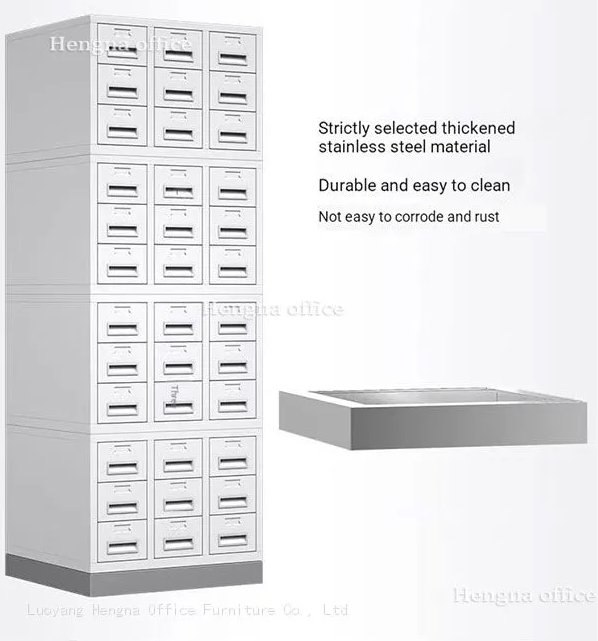
Cold Rolled Steel – Built for Daily Lab Use
The cabinet body is formed from cold rolled steel — not thin sheet metal, not particleboard. The surface receives an electrostatic powder coating, the same finish used on medical equipment.
What this means in practice:
- No rust. Tissue processors leak. Staining baths splash. Floors get mopped daily. The powder coating and stainless steel base handle all of it.
- No deformation. A four-section stack weighs several hundred pounds when fully loaded. Cold rolled steel holds its shape. Thinner materials would bow or warp.
- Easy cleaning. Steel does not absorb xylene, formalin, or other lab chemicals. Wipe it down, it is clean.
The stainless steel base is the part most cabinets get wrong. On painted steel, the base is the first point of failure — within 2–3 years in a wet lab environment, rust appears where the cabinet meets the floor. Stainless steel eliminates that completely.
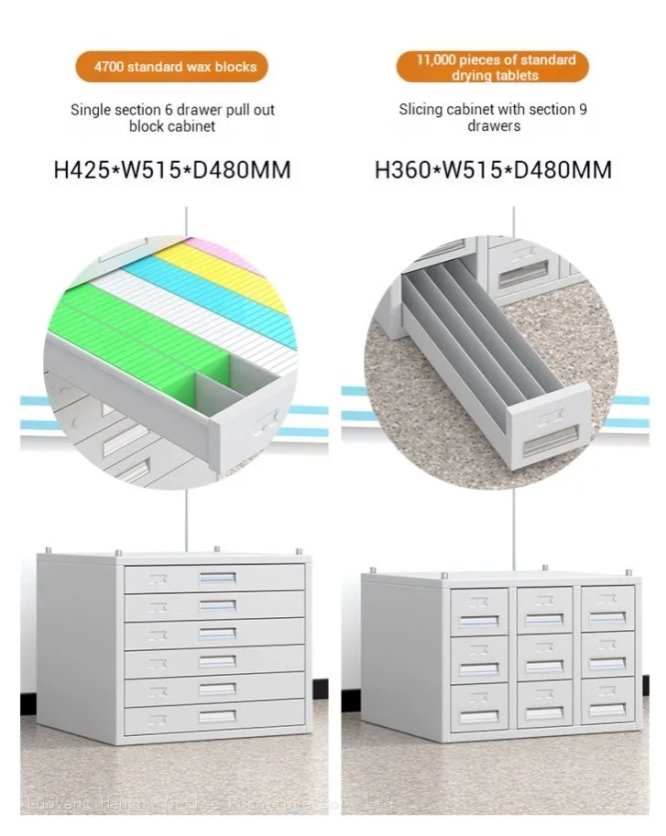
Capacity: 8,250 Slides or 14,840 Wax Blocks
Single section: 360 × 515 × 480 mm (H × W × D) Full stack (4 sections): 1,520 mm height — just below counter level, no line-of-sight obstruction.
| Configuration | Slides | Wax Blocks |
|---|---|---|
| 1 section | 1,650 | 3,710 |
| 4 sections | 8,250 | 14,840 |
A mid-size university lab processing 30–50 cases per day fills a four-section cabinet over 6–9 months. For labs that are still growing, start with one or two sections and add more later. The modular system requires no tools — just align the corners and stack.
Interior Design Is What Makes It Different
This is where the cabinet separates from a generic steel storage unit.
Slide cabinet: grooved tracks. Each slide sits horizontally in its own channel, separated from neighboring slides by an air gap. No glass-on-glass contact means no scratches. The gap also allows airflow, preventing moisture buildup and mold on sample mounts. Finding a slide is visual — scan the row, pull the one you need.
Wax block cabinet: partitioned grid slots. Each paraffin block stands vertically in its own compartment, supported on all four sides. No tipping, no sliding, no blocks fusing together in warm weather. The grid is sized for standard 7 mm cassettes — the block fits snugly without rattling.
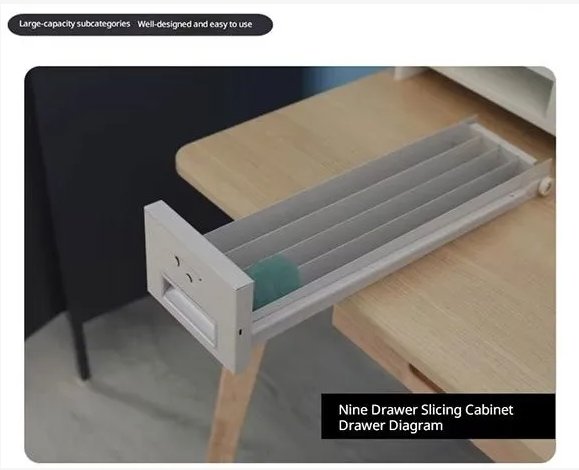
Modular by Design – One Section Today, Four Next Year
University research labs rarely get full funding in one budget cycle. This cabinet works with that reality.
Buy one section this year. Next year, add another — they match exactly, same color, same dimensions, same drawer rails. Two years later, buy two more for a full four-section stack.
The slide cabinet and wax block cabinet share identical external dimensions. That means you can place slide cabinets next to block cabinets, stack them in any order, or build a dedicated archive wall with multiple four-section units side by side.
Silent Drawers with Label Holders
Each drawer runs on ball-bearing slides — full extension, silent operation. You can pull a drawer all the way out to access the back row without straining.
Every drawer front has a label holder. Use it for:
- Case number ranges (e.g., 2025-BL-001 to 2025-BL-500)
- Date ranges
- Specimen types (GI biopsies, dermatology, neurology)
- Principal investigator initials
With labels in place, any lab member can find a sample without asking where it was stored.
About Our Factory
This product is manufactured by Luoyang Hengna Office Furniture, a Chinese manufacturer with 15 years of experience in cold rolled steel furniture production. Our products are exported to more than 30 countries across Southeast Asia, the Middle East, and Africa. The factory holds ISO 9001 quality management certification.
The pathology storage cabinet series uses the same powder coating line as medical-grade equipment. Every unit undergoes a 48-hour moisture resistance test before shipping. Each section ships fully assembled — unpack, place, stack. No assembly required.
Who Uses This Cabinet
| Setting | Application |
|---|---|
| University pathology department | Teaching slide collections, long-term archive |
| Life sciences research platform | Research sample archiving by project |
| CAS / medical institute labs | High-value specimen secure storage |
| National key laboratories | Standardized sample management |
| Third-party testing centers | High-throughput retrieval workflow |
Wax Block Cabinet Specifications
| Parameter | Single Section | 4-Section Set |
|---|---|---|
| Height | 360 mm (14.17″) | 1,520 mm (59.84″) |
| Width | 515 mm (20.28″) | 515 mm (20.28″) |
| Depth | 480 mm (18.90″) | 480 mm (18.90″) |
| Slide capacity | 1,650 slides | 8,250 slides |
| Wax block capacity | 3,710 blocks | 14,840 blocks |
| Material | Cold rolled steel, powder coated | Same |
| Base | Stainless steel | Stainless steel |
| Drawer slides | Ball-bearing, silent, full extension | Same |
| Assembly | No tools, stackable | No tools, stackable |
| Shipping | Fully assembled | Per section, ready to stack |
Packaging & Shipping
Each section ships fully assembled. Open the box, set it on the base, stack the next section on top. No screws, no brackets, no instruction manual.
International orders are packed individually by section:
- Foam corner protectors for impact resistance
- Moisture-barrier wrapping for sea freight
- Standard cardboard outer carton
A full four-section set fits on a standard shipping pallet.
FAQ
Q: How long does this cabinet last? A: 10+ years under normal lab conditions. The cold rolled steel body and stainless steel base are the key factors. Wood or thin steel cabinets typically need replacement every 3–5 years.
Q: How do you assemble the modular sections? A: No tools needed. Align the corners of each section and lower it onto the one below. Gravity locks it in place. One person can do it.
Q: Can I store slides and wax blocks in the same cabinet? A: Not in the same interior — the slide cabinet uses grooved tracks, the wax block cabinet uses partitioned grid slots. But both cabinets share the same external dimensions, so you can place them side by side or stacked in any combination.
Q: Do you offer custom labels or logos? A: Yes. Drawer labels can be pre-printed with your numbering system. Cabinet exteriors can be powder coated with your institution’s logo or a custom RAL color. Minimum quantities apply.
Q: Do you export internationally? A: Yes. We export to 30+ countries in Southeast Asia, the Middle East, and Africa. We support FOB and CIF terms. Sea freight packaging includes moisture barrier and edge protection.
Request a quote — tell us your average daily case volume and available floor space, and we will recommend the right configuration.