Last week I got an email from a lab buyer at a university. He asked a simple question: “What do I actually look for when buying an acid alkali cabinet?”
He’d read a dozen guides. Most said the same thing — “check the material, check the size, check the price.” Technically not wrong. But none of them told him what actually matters.
Acid cabinets are different. You’re not storing paper or tools. You’re storing things that eat through metal. Hydrochloric acid. Sulfuric acid. Nitric acid. Sodium hydroxide. One spill and you’ve got a real problem. So the buying logic changes. Not “which looks good” but “which survives the stuff I put in it.”
This guide skips the fluff. Four things you need to know.
How to Choose an Acid Alkali Cabinet for Your Lab — A No-BS Guide That Skips the Rust
Step 1: What You Store Determines What You Buy
The chemical you store decides the cabinet you need. That order matters — most people get it backwards.
Hydrochloric / Sulfuric / Nitric Acid — The cabinet killers. Their vapors are heavier than air. They sink to the bottom. Steel cabinets have a paint coating on top. One chip in that coating and acid starts eating the metal underneath. Two years in, the bottom panel’s gone.
We saw this at a chemical plant QC lab in Southeast Asia. A 90-gallon steel acid cabinet storing HCl and nitric acid. Year three, bottom rusted through. Acid hit the floor. Only the spill tray saved them.
Sodium Hydroxide / Potassium Hydroxide — Most people don’t know this, but strong bases corrode steel just as fast as acids. Steel shelves develop bubbles, peeling, warping. Six months is enough to see real damage.
Organic Solvents — Fair warning: PP cabinets can’t take strong oxidizing acids long-term (fuming sulfuric, for example). But the solvents a typical lab uses? PP handles them fine.
Bottom line:
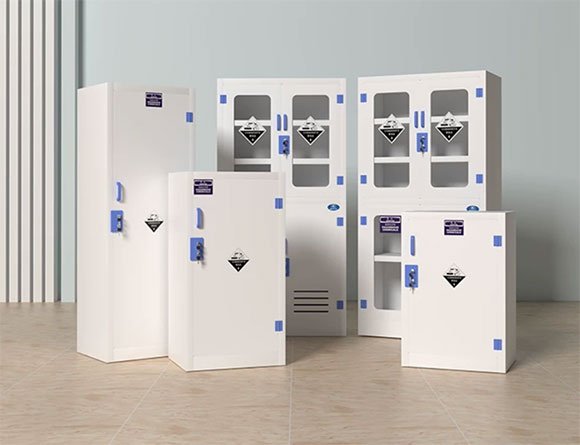
Strong corrosives (the stuff that smokes, stings your nose, or bubbles when it spills) → PP cabinet
Non-corrosive solids, neutral liquids → Steel cabinet saves you money
Step 2: 5 Specs That Actually Matter
Skip the handle shape and color options. Check these five.
1. All-PP Construction — Not just “PP” on the label
Some cabinets say “PP acid cabinet” but use steel hinges, steel handles, metal shelf brackets. The rust problem just moved from the body to the hinges. Body looks fine, hinges seize up. That’s not a PP cabinet — that’s a half-PP cabinet.
Ask three things before buying: What are the hinges made of? The handles? The shelf brackets? If any answer is “steel,” walk.
2. Spill-Containment Shelves — Flat shelves are a no-go
Shelves need raised edges, about 2cm deep, tray-style. A tipped bottle stays on that shelf — no liquid running down to the level below. Shelves should adjust in height and pull out for hosing down. Double-sided is a bonus — use one side, flip it when it gets stained. This is the baseline, not a premium feature.
3. Dual Lock — A single lock with two keys is not dual lock
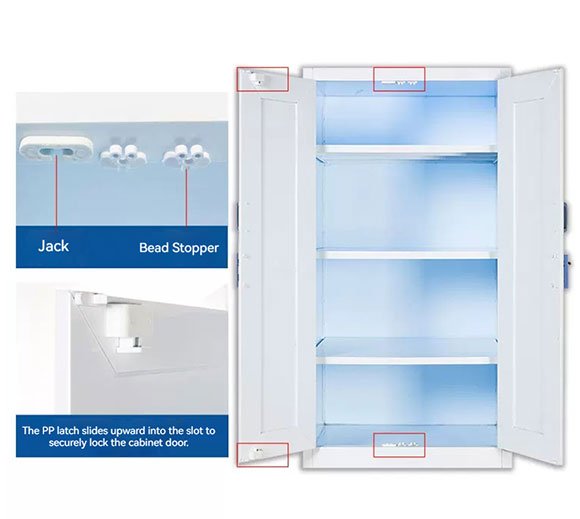
Real dual lock means two independent cylinders, two different keys, two people required to open. EHS auditors check this specifically. Some suppliers say “dual lock” but give you one lock with two copies. That won’t pass a serious audit.
4. Exhaust Port — Louvered vents alone aren’t enough
Store volatile acids (HCl, nitric, formic) and you close the door, trapping the vapor inside. Hinges go first. Then metal fittings. Then the cabinet becomes a corrosion box. The vents must connect to your lab’s exhaust system. Air intake louvers are not ventilation — you need exhaust.
5. Capacity — Match it to your space, not your ego
| Capacity | Placement | Best For |
|---|---|---|
| 2-4 gallon | Benchtop | Daily small bottles, grab-and-go |
| 22 gallon | Under-counter / wall-side | University labs, small clinics — most common size |
| 60-90 gallon | Stand-alone | Pharma QC, chemical plants, bulk storage |
| 200L glass door | Stand-alone | Pharmacy prep rooms, visual inventory without opening |
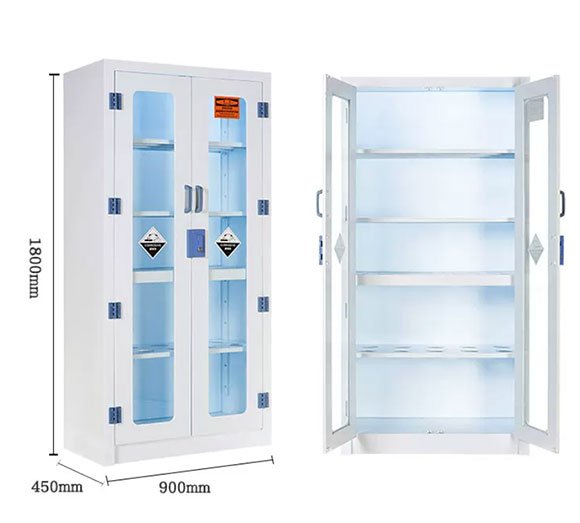
Twenty-two gallon hits the sweet spot for most labs — shoulder height, fits standard bottles. Ninety gallon is for drum storage.
Step 3: 3 Traps That Cost You Twice
These aren’t rare. We see them every month.
Trap 1: Price-first, spec-second
Cheap PP cabinets cut corners somewhere. Thinner PP sheet. Steel hinges swapped in. Flat shelves with no spill edge. Price looks 30% lower, but you’ll replace it twice as fast. True all-PP costs what it costs. If the price seems too good, something got swapped.
Trap 2: Steel cabinet where you need PP
Some labs buy steel acid cabinets for dilute HCl, thinking they’re saving money. Replace it every year. Add up the swap, the reagent transfer, the disposal, the downtime — by the time you’re done, you haven’t saved a thing. We sell both steel and PP, so this isn’t a sales pitch. Match the material to the chemical. Hard-saving isn’t real saving.
Trap 3: Sealed cabinet in a volatile-acid lab
Buy a sealed cabinet for HCl storage. Six months in, open the door — a cloud of vapor hits you. Everything metal inside is rusted. Not the cabinet’s fault. You needed exhaust. Check your lab ceiling before you buy: is there an exhaust hookup?
FAQ
| Question | Answer |
|---|---|
| What’s the MOQ? | 1 unit for standard models. Custom orders (logo, packaging) — larger volumes get better pricing |
| What’s the warranty? | 1 year, non-human damage — free replacement parts |
| Do you support OEM? | Yes — silk-screen logo, custom packaging, custom manuals, custom shelf/door configs |
| What’s the lead time? | Standard 7-15 days. Custom 20-30 days |
| How is it packaged? | Moisture film + corner protectors + partitioned packing. Foam padding between units |
| What certifications? | CE certified |
| How fast do you quote? | Within 24 hours |
The Short Version
Choosing an acid cabinet comes down to one thing: what you’re storing.
- Strong corrosives → PP cabinet
- Neutral chems → Steel cabinet
- Not sure? Ask a supplier who knows the difference — a real supplier asks what you store, not what model you want.
Luoyang Hengna Office Furniture Co., Ltd. has built PP acid cabinets for 9 years. CE certified. MOQ 1 unit. OEM available. Tell us what chemicals you store, your available space, and whether you need to pass an EHS audit. We’ll reply with a plan and a quote — no fluff, no sales pitch — within 24 hours.