
Wait until after an accident, and “I wish I’d known” doesn’t help anymore.
Here’s a real story.
A printing shop in our city used to store ink thinner in plain steel lockers at the corner of their workshop. Come summer, the temperature climbed, volatile vapors built up inside, and when a worker opened the door — static spark, ignition. Nobody got hurt, but half the workshop was blackened and production stopped for two months straight.
When the owner came to us afterward, he said something that stuck with me: “I spent ten times more fixing the workshop than a few hundred bucks on a proper safety cabinet.”
Choosing an explosion-proof cabinet is one of those things nobody thinks about until it’s too late. Walk into any factory, lab, or chemical plant and you’ll see cabinets that all look the same — yellow, blue, red — with prices ranging from fifty to five hundred dollars. What’s the actual difference?
Here’s the straight talk.
Step 1: Know what you’re storing — color matters more than you think
Cabinet colors follow an international classification system (NFPA 30 / OSHA 1910.106). This isn’t a design choice.
Yellow = Flammable Liquids Alcohol, thinner, acetone, gasoline, isopropyl alcohol, solvents — anything with a low flash point that evaporates fast. This is the most common type by a wide margin.
Blue = Mild Acids & Corrosives Hydrochloric acid, nitric acid, sulfuric acid, hydrofluoric acid. Important to know: a blue cabinet isn’t fully acid-proof. Its job is containment plus spill control via the built-in sump. If you’re storing strong acids long-term, confirm the coating and seal materials with your supplier first.
Red = Combustible Liquids (slightly different from flammable) Ink, paint, coatings, dyes, lubricating oils — these can burn too, but their flash point is higher (above 60°C / 140°F), which puts them in the “combustible” rather than “flammable” category.
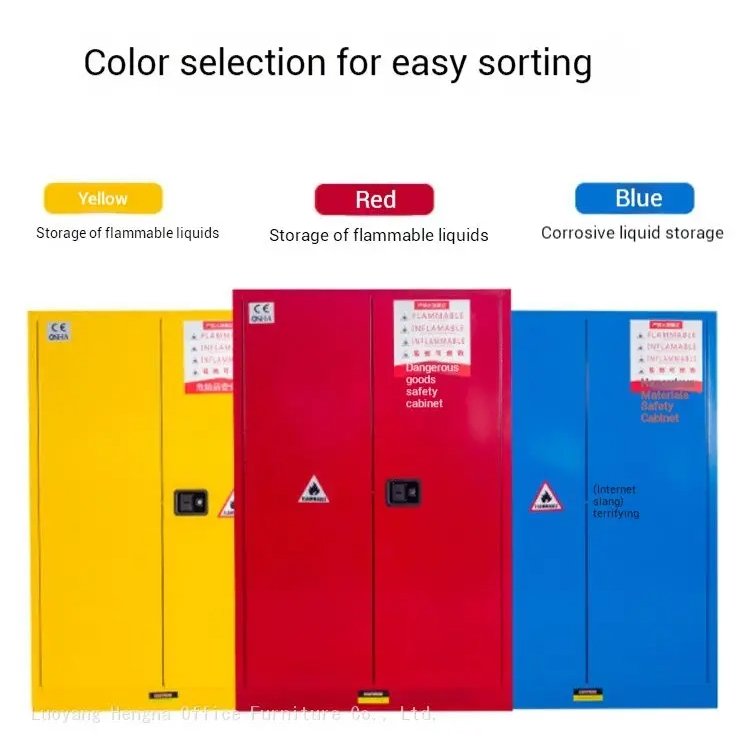
Short version: Yellow for the most urgent risk, red for moderate, blue for corrosives.
Step 2: Choose capacity by actual usage, not “bigger is better”
Safety cabinets range from 22 to 110 gallons. Here’s what each size fits best:
| Capacity | Best For | Why |
|---|---|---|
| 22 gal | Small labs, R&D centers, maintenance rooms | Fits under a workbench — space efficient |
| 45 gal | Mid-size workshops, production teams | Best balance between capacity and footprint |
| 60 gal | When uniform cabinet depth is needed | Square body fits wider aisles |
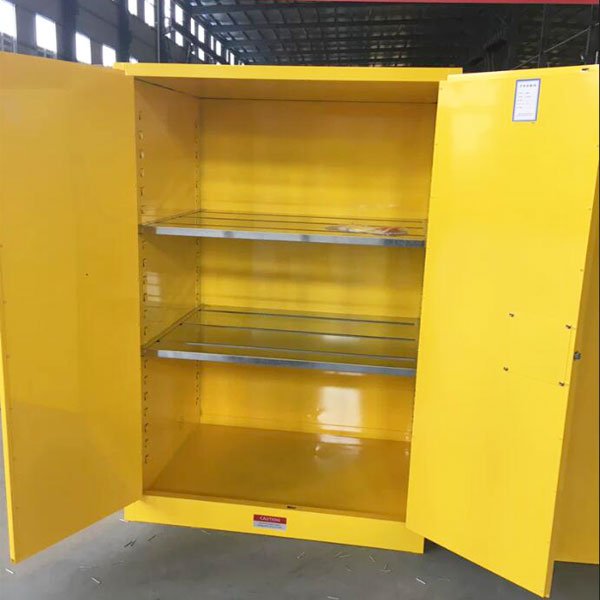
| 90 gal | High-volume solvent turnover | Two adjustable shelves for organized storage |
| 110 gal | Central storage rooms, warehouse | Large capacity, best paired with exhaust ducting |
Here’s the logic — buy enough, but don’t overbuy. A single 110-gallon cabinet packed full is heavy, hard to move, and puts all your eggs in one basket. Industry best practice is to distribute storage across multiple cabinets rather than consolidating everything.
A practical rule: calculate daily consumption × safety stock period. If you use 10 liters of alcohol per day and keep a week’s supply (70 liters), a 45-gallon cabinet (≈170 liters capacity) is plenty. No need to jump to 90 gallons.
Step 3: Look at the cabinet itself — the real quality is inside
A safety cabinet is a piece of safety equipment. Its value is in the details you can’t see from the outside.
Double-wall steel with 40mm air gap
This is the foundation. A quality cabinet uses two layers of cold-rolled steel with a 40mm air gap in between. If a fire breaks out nearby, that air gap slows heat transfer to the contents inside, buying critical time. A single-wall steel locker? Heat hits it, contents cook.
Vents are not optional
Every compliant cabinet has adjustable vent plugs — one low, one high on opposite sides. Why? Because even sealed containers breathe. Vapors build up inside the cabinet over time. Open vents (connected to exhaust if needed) keep vapor concentration below dangerous levels.
We once had a customer who sealed off the vents because they thought “any opening is a leak.” When we visited for a follow-up, we measured the vapor concentration inside — three times above the safe threshold. Vents are there to be used, not blocked.
Built-in spill containment sump
That recessed bottom isn’t wasted space. Chemical containers sometimes crack or leak. Without a sump, the liquid spreads across the floor. With one, you have time to contain and clean it up. Small detail, big difference.
Grounding wire
Static grounding is mandatory for flammable liquid storage. Every cabinet ships with a grounding lug and wire — connect it to your earth terminal during installation. It’s the cheapest and most effective safety measure in the whole setup.
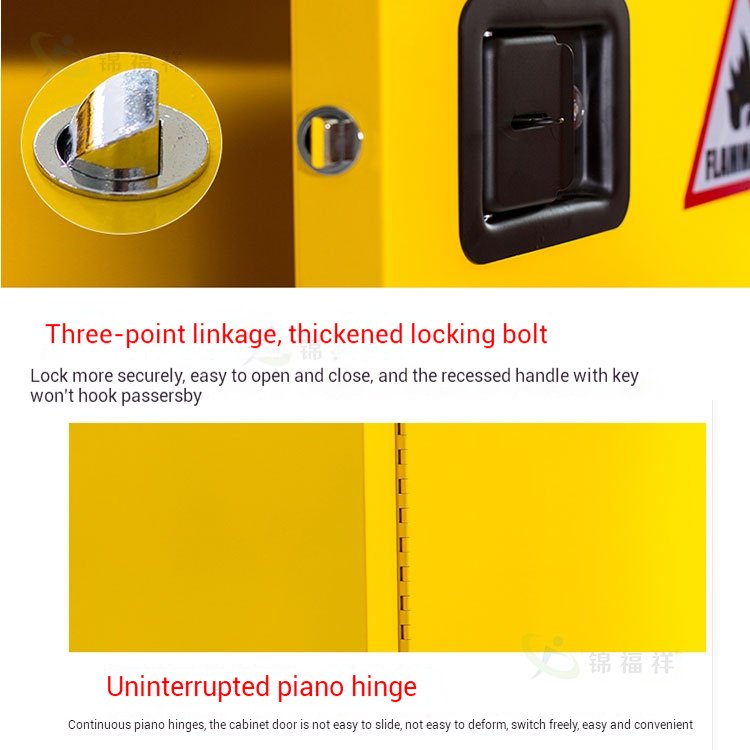
Zinc-plated shelves, continuous piano hinge, three-point lock
These are the tell-tale signs of build quality. Zinc-plated shelves resist rust and hold weight. A continuous piano hinge keeps the door aligned after years of use. A three-point lock secures the door at multiple points — not just a simple latch.
Step 4: Check certifications — never buy an uncertified cabinet
Certifications are the line between a real safety cabinet and a painted box.
- OSHA — US Occupational Safety and Health Administration standard. Required for North America.
- CE — European conformity. Required for EU markets.
Both mean the cabinet has passed fire resistance testing on its steel structure and meets regulatory requirements.
Always ask your supplier for certification documents. If they can’t produce them, walk away. It’s not being picky — factory safety inspections, insurance claims, and customs clearance all require these papers. Fines for uncertified cabinets can run many times the cost of the cabinet itself.
Step 5: Check how it ships — assembled or knocked down
The difference between assembled and KD (knocked down) delivery goes far beyond convenience.
Assembled delivery (整装发货) — the cabinet arrives ready to use. Steel forming, welding, sealant application, and hinge alignment are all done at the factory under controlled conditions. Every Luoyang Hengna cabinet ships fully assembled with an inspection report attached — seal integrity checked, door operation tested.
KD delivery — the buyer assembles it on-site. How tight are the screws? Is the seal strip seated properly? Are the hinges aligned? These are all variables. For safety equipment, it’s risky to leave assembly quality to chance.
When you find a supplier offering assembled delivery with a factory inspection report, that’s a keeper.
Bottom line: Five steps to the right Explosion-Proof Storage Cabinet for Flammable Liquids
- Identify your stored liquid → choose the color (yellow / blue / red)
- Calculate daily usage + safety stock → pick the capacity (22–110 gal)
- Check the build — double-wall steel, vents, spill sump, grounding wire
- Verify certifications — OSHA + CE, both required
- Confirm shipping method — assembled delivery preferred
A safety cabinet is the kind of thing you hope you never need — until the day you absolutely do. Spending a bit more on a proper cabinet is nothing compared to the cost of a single incident.
Luoyang Hengna Office Furniture Co., Ltd. manufactures compliant safety storage cabinets from 22 to 110 gallons in yellow, blue, and red, with CE and OSHA certification. All units ship fully assembled with factory inspection. If you’re sourcing for your facility, contact us for a spec sheet — every workplace has different needs, and we’ll help you find the right fit.