
 Email:sarahhnl@atoolcabinet.com
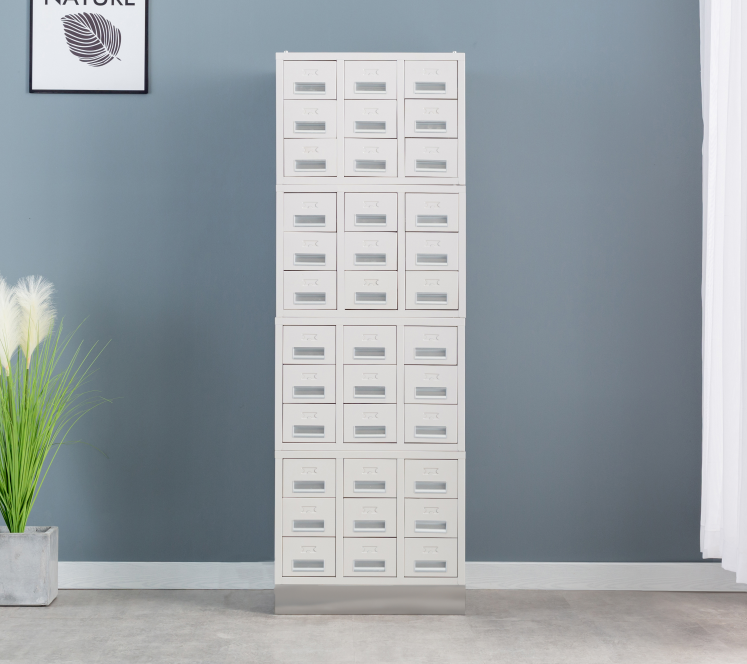
Quick answer: The QST-09 is a modular slide-drying cabinet built from four stacked sections. Each section holds 12,960 standard 7.8cm-length slides vertically; a full four-section set holds 51,840 slides in a footprint of 515 × 480 mm, standing 1520 mm high. It gives pathology and research labs a closed, organized drying stage between the staining station and the archive. The figures below are the factory specification for this cabinet.
Drying is the quiet bottleneck in a histology workflow. Stained slides cannot be stacked, cannot be touched, and cannot sit in open air where dust settles on the section — yet they need time and space before coverslipping or filing. The QST-09 solves it with vertical slide storage: every slide stands separated in its slot, labeled end up, drying without contact while the bench stays clear for the next run.
A Modular System: 12,960 Slides per Section
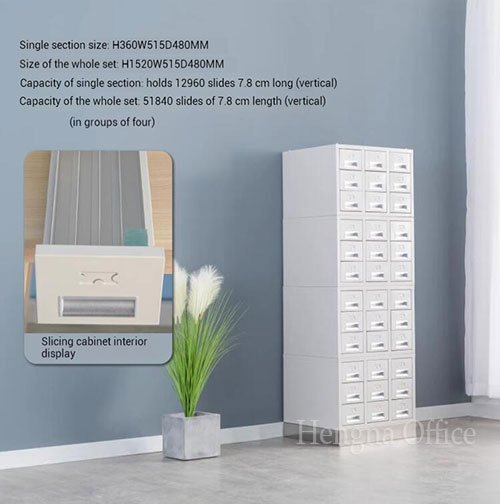
The QST-09 is built in sections. Each section measures 360 mm high by 515 mm wide by 480 mm deep and holds 12,960 slides of 7.8 cm length in the vertical position. Four sections form one complete set: 51,840 slides in a body standing 1520 mm high. The section system also means the cabinet can be configured to the space — confirm the set size and the slide count with the factory when ordering.
Vertical Loading: Why the Slides Stand Up
Vertical loading is the detail that makes a slide cabinet work. Slides standing on edge keep the tissue section untouched — nothing presses on the specimen face. Drainage and residue stay at the lower end instead of pooling on a flat surface. And the labeled end remains visible at the top of every slot, so identification happens without lifting slides out. For a drying batch, vertical separation also means air can move between the slides instead of trapping moisture flat against a shelf.
Real Dimensions for Real Lab Planning
The full set stands 1520 mm high, 515 mm wide and 480 mm deep — a footprint narrower than an A4 sheet is long, which lets it sit against a wall, beside the microtome, or between two staining stations. A single 360 mm-high section can be planned separately where the volume is lower. Confirm the placement and the section count with the factory when ordering; the dimensions in this page come from the product specification.
Where the QST-09 Fits in the Lab
Hospital pathology departments use it as the drying and holding stage between the staining bench and the slide archive. Independent laboratories use it to organize high-volume batches from multiple sources. University and research labs use it to keep teaching and research slides separated by project. Any workflow that stains slides daily and archives them for years needs this stage — the QST-09 is the cabinet for it.
Built in the Same Line as Our Storage Cabinets
The QST-09 comes from the same production line as our histology storage and pathology archiving cabinets: steel body, factory inspection before packing, and export-grade crating with foam cushioning. Because the factory builds the full specimen-storage range, matching archive cabinets can be ordered alongside — one supplier, one finish, one documentation pack.
FAQ
What slide length does the QST-09 hold?
The stated capacity is for 7.8 cm-length slides loaded vertically — the standard laboratory slide format. Confirm your slide format with the factory when ordering.
How many slides fit in one section?
12,960 slides per section, vertical loading. The standard set is four sections: 51,840 slides total.
Can the set size change?
The four-section set is the standard configuration. Confirm your volume and available height with the factory — configuration options are supported through OEM and ODM.
Drying and Holding: One System, Two Stages
The same vertical slot system that dries a batch during the day holds it for the long term after sign-out. Slides that stay in their slots are not touched, not re-sorted, and not exposed — which is exactly how an archive should behave. Labs that use one cabinet for both stages avoid a transfer step entirely: the slides that dry on Monday are still in order when the pathologist requests them in March. For higher volumes, the archive continues in the larger storage cabinet formats from the same line.
Who Buys High-Capacity Slide Cabinets
Hospital pathology departments are the core buyer — patient slides are kept for years and must be retrievable on request. Independent laboratories use them to manage high volumes from multiple client sites. University medical and research labs archive teaching and study slides by project. Forensic units need controlled, organized evidence storage. The common requirement across all four: high slide density, untouched specimens, and retrieval that does not depend on memory.
Ordering: What to Confirm Before You Buy
Four confirmations make the order right the first time. The slide format — the stated capacity is for 7.8 cm-length slides loaded vertically. The set size — the standard is four sections; confirm whether your volume and ceiling height suit the full 1520 mm set. The placement — measure the wall run and the door swing. And the stage — drying, archiving, or both, because the internal divider layout follows the use. The factory confirms all four in the specification sheet before production.
How does vertical drying compare to flat drying racks?
Flat racks expose the tissue face upward — dust, condensation and touching lids all land on the section. Vertical loading keeps the specimen face protected and lets air move along the slide. Racks also spread a batch across the bench; a cabinet contains it. For a daily staining workflow, the cabinet is the version that scales.
Related reading: 51,840-Slide High Capacity Histology Storage Cabinet · Professional Slide Drying Storage Cabinet for University & Research Labs · How to Choose the Right Pathology Slide Archiving System
Need the QST-09 specification sheet? Send your daily slide volume and the placement in the lab, and the factory confirms the configuration, dimensions and capacity in writing.