
 Email:sarahhnl@atoolcabinet.com
Quick answer: A laboratory workbench with a wood side table pairs a chemical-resistant main workbench with a wooden side table for paperwork, sample prep and storage. The main bench handles chemicals and instruments; the side table absorbs everything else. Splitting the two jobs keeps the wet workspace clear and the lab organized.
Labs fail at the edges. The workbench is specified carefully, and then notebooks, reference manuals, spare pipettes and shipping boxes drift onto the same surface where reagents are open. A workbench with a dedicated wood side table fixes that by giving the auxiliary work its own place — close enough to reach, separate enough to keep the wet area clean.
The Main Workbench: Built for the Wet Zone
The primary workbench is constructed from chemical-resistant laminate or stainless steel, depending on the model, over a frame that holds the surface stable under daily use. This is where experiments happen: microscopes, spectrometers, open reagents, and the spills, heat and wear that come with them. The worktop is specified to resist acids and bases so a splash does not become a permanent scar. Height and depth follow ergonomic standards so staff can work long sessions without the fatigue that comes from reaching and bending.
The Wood Side Table: The Dry Zone
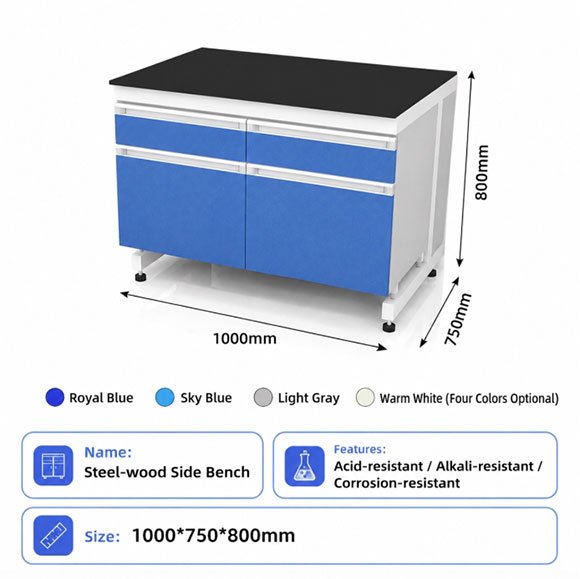
The wood side table is made from solid wood or quality wood composite, finished to resist minor spills and scratches. Its job is everything the wet zone should not touch: notebooks and reference materials, documentation during experiments, preliminary sample prep, and storage of less-frequently-used equipment in drawers or shelves. The natural wood finish also softens the look of a steel-heavy lab — a small detail that makes long days better.
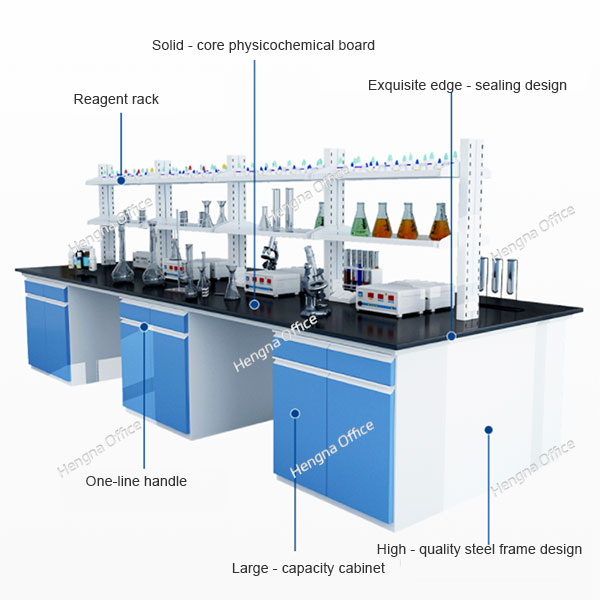
The side table height is coordinated with the main workbench, so the two surfaces work as one continuous workstation. Some configurations add drawers under the side table for gloves, wipes and small tools.
How the Two Surfaces Divide the Workflow
The division is simple: wet work on the chemical-resistant bench, dry work on the wood. During a biological assay, reagents and plates stay on the main bench while the data logger, manuals and spare supplies sit on the side table. In a testing lab, samples move from the bench to the side table only after they are sealed. This separation reduces contamination risk, keeps instruments away from splash zones, and makes cleaning the wet bench faster because nothing has to be moved off it first.
Customization for Different Labs
The pair is configurable to the lab’s work. A materials-science research lab adds power outlets and fixtures on the main bench and deeper drawers under the side table for bulk samples. A teaching lab keeps a simpler setup, with the side table holding student notebooks and shared equipment. Dimensions, worktop material, drawer layout and shelf configuration are all specified at order time — the factory builds the pair to the room, not the other way around.
Sizing and Layout Notes
Plan at least the main bench depth for standing work with instruments, and give the side table enough depth for an open notebook or a laptop. Leave a walkway between the two surfaces if staff work back-to-back tasks. Position the side table on the dry side of the room, away from the fume hood exhaust path. These three decisions prevent most layout regrets.
FAQ
Can the wood side table handle lab chemicals?
It handles minor spills and routine wipe-downs thanks to its finish, but it is designed as the dry zone. Strong acids and daily solvent contact belong on the chemical-resistant main worktop — that separation is the point of the pairing.
Can the worktop material be upgraded?
Yes. The main bench accepts chemical-resistant laminate, stainless steel, or phenolic resin and epoxy resin worktops depending on the chemicals in use. Send the chemical list and the factory will recommend the surface.
Is the pair suitable for a teaching lab?
Yes — it is one of the most common uses. Students run experiments on the main bench while the side table holds manuals and shared equipment, and the layout scales across multiple stations.
Worktop Material Options
The main bench worktop is specified by chemical exposure. Chemical-resistant laminate suits teaching labs and dry analytical work. Stainless steel suits hygiene-heavy and heat-exposed workflows. Phenolic resin and epoxy resin worktops handle strong acids, alkalis and solvents for wet chemistry benches. Send the chemical list; the factory matches the surface to it before production starts.
Power and Utility Planning
Plan outlets on the main bench for the instruments that stay put — microscopes, balances, hotplates — and keep those outlets on the wall side, away from wet tasks. The side table carries no utilities in the standard configuration, which is deliberate: it stays the flexible, cable-free zone. If the project needs service connections, gas valves or data ports, they are integrated into the main bench frame at production.
Cleaning the Two Zones
Cleaning follows the zone split. The chemical-resistant worktop takes disinfectant wipes and solvent dampening according to the worktop material. The wood side table takes a dry or lightly damp cloth — no solvent soaking, no abrasive pads. Two zones, two cleaning routines, and both surfaces last longer for it.
Do the two surfaces have to be the same height?
They do not have to be, and matching height is the common choice because it lets the pair work as one continuous surface. A slightly lower side table also works well for seated documentation work. Specify the heights when ordering — both the workbench and the side table are built to the dimensions the lab confirms.
When placing the pair, keep one worktop-height stretch between the main bench and the side table if staff work in pairs — two people can then use both surfaces without crossing paths. In single-worker labs, an L-shaped arrangement with the side table at right angles to the main bench keeps everything within a pivot.
Related reading: Full-Steel Laboratory Workbench for Quality Inspection Labs · STEM Lab Workbench — Modular Steel Frame for Schools · GMP Compliant Lab Bench — Phenolic Resin Top
Send your lab dimensions and the tasks the bench must support, and the factory will return a layout with the workbench and side table configured for the workflow.