
Quick answer: A pharmaceutical testing lab workbench needs three things: a worktop that survives solvents and daily disinfection, a frame that stays level under precision instruments, and storage that keeps standards and samples separated. Our pharma-configured benches pair an epoxy resin or phenolic worktop with 1.0-1.5mm powder-coated steel, built from 1000 to 4500mm.
Pharmaceutical testing labs run dissolution, assay preparation, stability sampling and cleaning validation — often in the same room, on the same shift. The bench is the platform all of that sits on, and generic lab furniture shows it fast: swollen edges near the sink, stained surfaces around the solvent station, drawers that no longer glide after a year of reagent bottles. This page shows how we configure benches for pharmaceutical testing work and what to specify.
Built for Pharmaceutical Testing Workflows
Three demands shape a pharma testing bench. First, solvent-heavy assays — the worktop must tolerate the solvents and reagents on your chemical list, not just water and detergent. Second, cleaning protocols — surfaces get wiped with disinfectant several times a shift, so the finish has to be chemical-resistant through the coating, not a laminate that peels. Third, precision instruments — balances and analyzers need a level, vibration-stable surface, which comes from the frame, not the worktop.
The Worktop: Epoxy Resin for Solvents and Heat
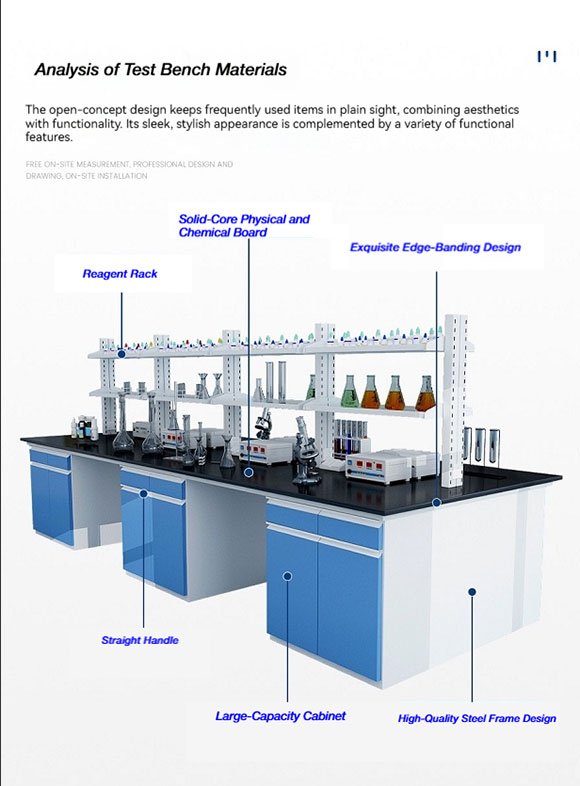
For pharma testing positions, we usually recommend an epoxy resin worktop. It is a cast, homogenous material with broader resistance to solvents and higher sustained temperatures than phenolic — the right surface where hot glassware, solvent splash and wash-down routines share the same bench. Where the chemical list is milder, a 16mm or 19mm phenolic resin top delivers the same workflow at a lower cost. Both are sealed with PVC edge banding and carry an E1 formaldehyde rating.
Frame, Storage and Utilities
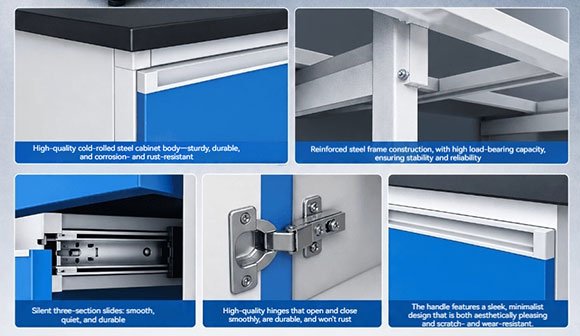
Cabinet bodies run 1.0mm to 1.5mm cold-rolled steel with electrostatic powder coating. Storage is configured to the workflow: drawer packs for glassware and tools, reagent racks above the bench for daily-use bottles, sink units with polypropylene basins where water work happens, and blind base modules for utilities. Hardware includes 16-inch silent slides, 115-degree hinges and 8mm nylon adjustable feet with a 15mm leveling range — the details that keep a loaded drawer moving straight after two years.
Sizes and Layouts for Pharma Suites
Bench lengths run from 1000mm to 4500mm in modular steps, 750mm deep, 800mm or 850mm high. Four layouts cover pharma suites: wall benches along the testing wall, island benches for shared instruments, peninsula benches for combined zones, and mobile benches on locking casters for flexible rooms. Modules step in 25mm increments, so a run absorbs real wall lengths without custom shells.
Chemical List Matching
The fastest way to the right bench is the chemical list. Send the reagents and concentrations your testing actually uses; we match the worktop material and the storage surfaces to them in writing — epoxy where solvents and heat dominate, phenolic where the profile is milder, welded PP where strong acids sit long-term. The recommendation comes with the quotation, so the decision is documented before production starts.
FAQ
Epoxy or phenolic for a pharmaceutical QC bench?
If the bench handles solvent-heavy assays or hot glassware daily, epoxy. For sample prep, documentation and dilute reagents, phenolic does the job at a lower cost. Many pharma labs run both: epoxy at the wet positions, phenolic across the dry runs.
Can you build to our layout drawings?
Yes. Send your CAD layout and we manufacture to it — bench lengths, utility positions and cabinet configurations follow your drawing, with shop drawings returned for confirmation before production.
What utilities can be integrated?
Sink units with polypropylene basins, reagent racks, power outlets positioned per your drawing, and service connections routed through the frame. Utilities are planned at the drawing stage so the countertop stays uncluttered.
Cleaning and Disinfection Compatibility
Pharma testing benches are wiped down with disinfectant several times a shift, and some of those agents are aggressive. Both epoxy and phenolic surfaces tolerate routine disinfectant wiping without dulling, and the powder-coated steel frame takes the same treatment. The rule we give buyers: match the surface to the strongest agent in the daily cleaning rotation, not just to the assay chemicals — cleaning chemistry is a workload too.
Delivery, Installation and After-Sales
Benches ship knock-down in wooden crates with foam cushioning and a numbered part map; assembly on site follows the map with basic tools. After delivery, spare slides, hinges, handles and locks are available as parts, and technical questions go to the factory team that built the units — not to a call center reading a script.
What is the lead time for a pharma-configured bench?
Standard configurations move on the normal production schedule. Custom lengths, epoxy upgrades and utility integrations add configuration time, which is confirmed at order placement along with the shipping mode.
Can drawers be locked per station?
Yes. Locking is configurable per drawer pack, so controlled substances and reference standards can be secured independently from the rest of the bench. For shared testing rooms, mixed locking — locked drawers for controlled items, open shelves for general glassware — keeps daily work moving while the sensitive inventory stays controlled.
One more note on chemical segregation: the same chemical list that decides the worktop also decides what must be stored apart. The layout drawing stages incompatible chemicals on separate bench runs, so storage conflicts are solved on the drawing, not discovered on site.
Is the frame welded or bolted?
Welded. Frames are spot-welded and argon arc welded at the load points, then ground and coated — a welded frame stays square under load, where bolted frames work loose over years of drawer cycling. Adjustable feet handle the final leveling on site.
Related reading: GMP Compliant Lab Bench — Phenolic Resin Top for Pharmaceutical QC Labs · All-Steel Lab Bench — 304 Stainless Steel Frame & 19mm Phenolic Resin Worktop · Lab Bench Rusting? 7 Proven Ways to Prevent Rust on Steel Lab Benches
Send your chemical list and room dimensions, and the factory returns a configured bench layout with a written material recommendation and quotation.